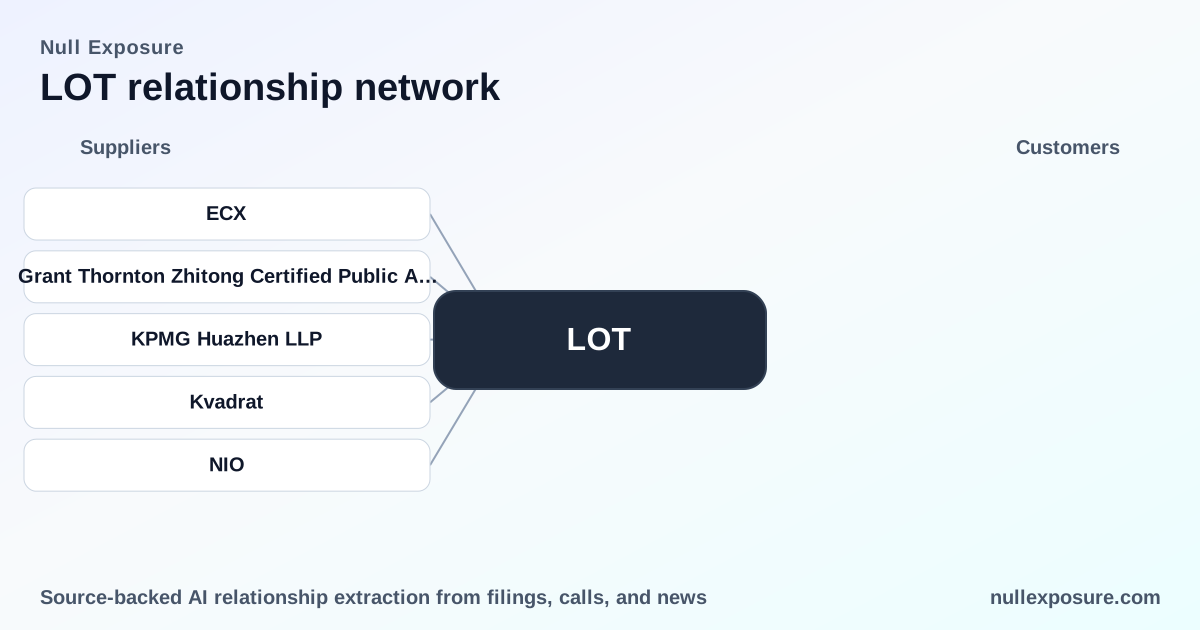
Lotus Technology (LOT): Customer relationships that double as financing signals
Lotus Technology operates as an electric-vehicle and connected-mobility platform company that monetizes through vehicle sales, recurring software/services and equity financings tied to strategic partners. The business converts product rollouts into revenue while relying on partner capital and convertible instruments to fund scale—making customer relationships an equal part commercial channel and liquidity source. For investors and operators, the recent partner transactions illuminate both capital sufficiency and dilution risk that will drive corporate outcomes over the next 12–24 months. For more on the company profile and updates, visit https://nullexposure.com/.
Quick take: financial posture and what it implies about partnerships
Lotus reported $519.1M in trailing revenue with negative net margins and EBITDA, underscoring a growth-at-costs profile. High insider ownership (87.25%) and minimal institutional ownership (0.8%) create a concentrated control structure, limiting passive market support and increasing the importance of bilateral financings and strategic partners. Valuation multiples—an EV/Revenue of 5.02 and elevated price-to-book—reflect investor pricing for future growth rather than current profitability. These structural features explain why the company leverages share placements and convertible notes through strategic partners to preserve runway while pursuing vehicle deliveries and software rollouts.
What the partner relationships reveal (every relationship in the record)
ECARX / ECX — December 23, 2025 share subscription (reported FY2026)
Lotus executed a share subscription agreement under which ECARX agreed to purchase 16,788,321 newly issued ordinary shares at US$1.37 per share for US$23 million, providing an immediate equity infusion tied to a strategic automotive-software partner. This transaction was confirmed in a GlobeNewswire release summarized by media on April 22, 2026, and mirrors a December 2025 agreement described in company disclosures. (Source: GlobeNewswire release reported April 22, 2026 — https://www.globenewswire.com/de/news-release/2026/04/22/3278973/0/en/lotus-tech-to-present-at-the-dbvic-deutsche-bank-adr-virtual-investor-conference-april-28th.html)
ECARX / ECX — December 23, 2025 placement referenced in earlier reporting (FY2025)
Media reporting from late 2025 captured the same ECARX placement: a US$23M private placement at US$1.37 per share for 16,788,321 ordinary shares, described as a strategic investment by ECARX Holdings. The earlier coverage provides corroborating public notice of the transaction and confirms ECARX’s role as a capital partner to Lotus. (Source: Manila Times coverage of a GlobeNewswire announcement, Dec. 29, 2025 — https://www.manilatimes.net/2025/12/29/tmt-newswire/globenewswire/lotus-technology-inc-announces-us23-million-strategic-investment-from-ecarx-holdings-inc/2250379)
ATW Partners — convertible notes facility announced Aug 19, 2025 (reported FY2025)
Lotus entered a securities purchase agreement with ATW Partners to issue convertible notes for up to $300 million, establishing a large-format debt-to-equity financing vehicle that can be drawn to support production, working capital and software deployment. The commitment creates a meaningful potential for future conversion-related dilution while supplying a sizeable committed funding source if drawn. (Source: QuiverQuant summary of the Lotus second-quarter 2025 results and financing commitments — https://www.quiverquant.com/news/Lotus+Technology+Inc.+Reports+Second+Quarter+2025+Results:+2,800+Vehicle+Deliveries,+$218+Million+Revenue,+and+Funding+Commitments)
How these relationships function operationally and financially
The transactions with ECARX and ATW Partners reveal a dual commercial-financial posture: Lotus treats strategic vendor/partner relationships as sources of capital and go-to-market alignment. The ECARX placement is equity capital from an automotive-software partner, strengthening product integration and providing non-debt financing. The ATW arrangement is a contingent convertible facility, delivering optional drawdown capacity that trades off dilution against balance-sheet flexibility. Together they demonstrate a deliberate capital strategy: pair limited equity placements with large convertible lines to preserve short-term liquidity while pacing dilution to investment needs.
Company-level operating signals and constraints
Although there are no formal constraints listed in the record, company-level indicators describe the operating model:
- Contracting posture: hybrid capital-and-commercial — Lotus negotiates both equity placements and convertible securities rather than relying exclusively on bank debt or public markets, indicating a tailored funding approach tied to partner relationships.
- Concentration and control: With 87% insider ownership and under 1% institutional ownership, decision-making is highly concentrated, which accelerates private financing decisions but also limits external stewardship.
- Criticality of partner capital: Given negative margins and negative EBITDA, partner financings are critical to sustaining operations and scaling production, not merely complementary.
- Maturity stage: Financial ratios and recurring losses position Lotus as growth-stage with product commercialization underway (vehicle deliveries reported), not a mature cash-generative automaker.
These signals are company-level and are not attributed to any single relationship unless the transaction explicitly names that partner.
Risks and upside for investors and operators
- Dilution risk is explicit. The $23M equity placement and the up-to-$300M convertible note facility create both immediate and potential share issuance pressures that will affect per-share metrics on conversion or further placements.
- Funding optionality versus cost. Convertibles provide flexible capital but transfer future dilution risk to equity holders; equity placements lower leverage but dilute current holders. Both instruments are consistent with a capital-intensive growth plan.
- Operational execution remains pivotal. Lotus reported 2,800 vehicle deliveries in the referenced quarter and $218M of revenue in that period; continued delivery cadence and software monetization will determine whether these financings translate into sustainable scale and margin improvement.
- Governance and liquidity constraints. Concentrated insider ownership delivers strategic decisiveness but limits institutional liquidity and oversight, which can amplify volatility and governance risk.
Bottom line for readers
The partner transactions documented with ECARX (equity subscription for US$23M) and ATW Partners (up-to-$300M convertible facility) are definitive signals that Lotus is financing its commercial rollout through strategic capital relationships rather than traditional public-market follow-on offerings. For investors, the trade-off is clear: these relationships supply runway and strategic alignment at the expense of dilution and concentrated governance. For operators, they provide the capital velocity needed to scale production and embed software partnerships into product roadmaps.
If you want a concise tracker of partner-financing events and what they indicate about LOT’s liquidity runway, governance, and dilution profile, explore additional company summaries at https://nullexposure.com/.