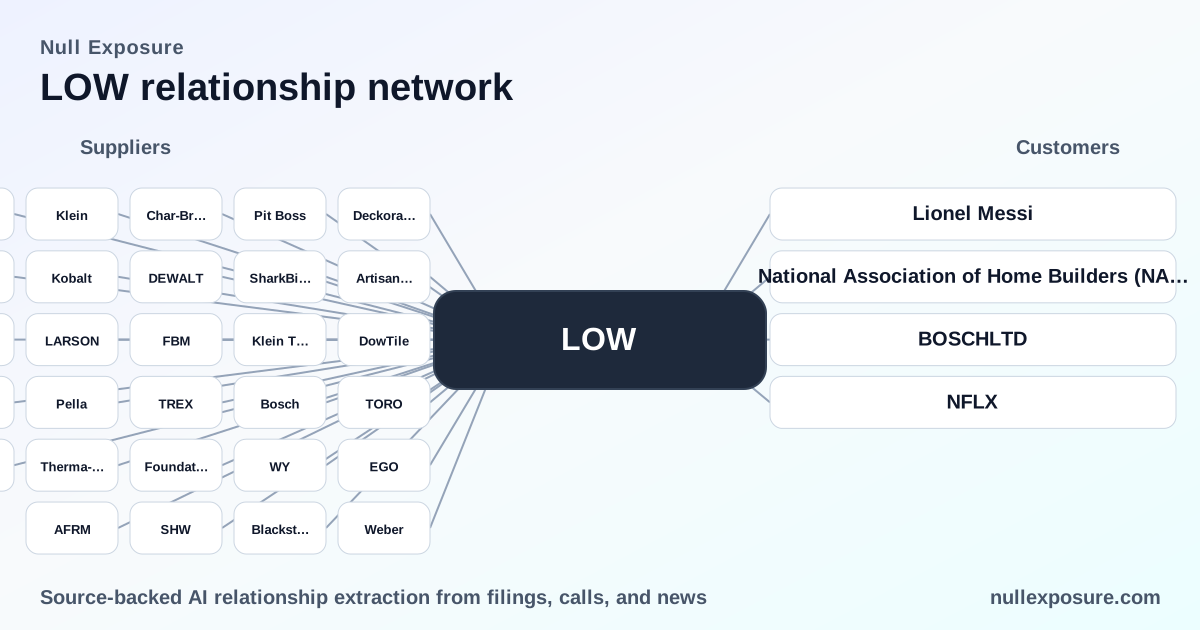
Lowe’s Customer and Partner Map: What Investors Need to Know
Lowe’s operates a dominant U.S. home‑improvement retail platform that monetizes through product sales, installation services, and multi‑year protection plans, with the bulk of revenue generated at point‑of‑sale and a steady annuity stream from deferred protection plan revenue. For investors and operators, the business is a highly concentrated, North‑American retail model where branding partnerships, exclusive product deals, and professional channels supplement the core merchandise economics.
If you want a concise, structured view of Lowe’s customer and partner exposure for diligence or portfolio monitoring, visit https://nullexposure.com/ for the full coverage and signals.
How Lowe’s actually contracts with its customers (and why it matters)
Lowe’s revenue model mixes three distinct contracting postures that shape cash flow and margin stability:
- Spot transactions dominate: The company recognizes product revenue at the point a customer takes control (in‑store purchase or delivery), which produces immediate cash conversion and sales volatility tied to retail cycles and traffic.
- Short‑term service contracts: Installation services are recognized as performed and largely complete within a week, creating small but meaningful margin variability and operational dependencies on subcontractors.
- Long‑term protection plans: Lowe’s sells separately‑priced protection plans that are deferred and recognized straight‑line over 1–5 years, supplying predictable recurring revenue and customer retention advantages.
Geography and segment signals are decisive: Lowe’s is primarily a U.S. operator (1,748 stores as of January 31, 2025) focused on core product categories (appliances, tools, hardware, building materials) while services (including installed sales) account for roughly 5% of total sales, indicating the company’s customer economics remain product‑centric with services as a complementary offering (company filings, FY2025).
Relationship roll call — what every named partner actually means for Lowe’s
Below I list each relationship from the coverage set; each entry is a plain‑English investor note with its source.
Lionel Messi (mentioned in 2025 Q2 earnings call)
Lowe’s is continuing a marketing relationship featuring Lionel Messi as part of its consumer advertising strategy, leveraging high‑profile athlete branding to boost national consumer awareness. This was disclosed on the company’s 2025 Q2 earnings call (2025Q2 earnings call, March 2026).
CNK / Cinemark (press release, FY2026)
Lowe’s teamed with Cinemark to expand the “Bring Your Own Bucket” promotional activation for National Popcorn Day, an example of consumer marketing collaborations aimed at broadening in‑store/brand engagement. The partnership was announced in a Cinemark press release tied to FY2026 promotions (Cinemark press release, March 2026).
National Association of Home Builders (NAHB) (FY2026 earnings transcript)
Lowe’s is the exclusive national home improvement partner of NAHB, giving Lowe’s access to the association’s network of more than 140,000 professionals and enabling member‑only offers targeted at Pro customers. Management highlighted this affiliation on the FY2026 earnings transcript as a deliberate channel strategy to deepen professional sales (InsiderMonkey transcript of FY2026 earnings call, March 2026).
Bosch (2025 Q3 earnings call)
Lowe’s reported an exclusive Bosch hybrid tub dishwasher line available only at Lowe’s, reflecting the company’s use of exclusive product assortments to differentiate traffic and capture category share. This product exclusivity was referenced on the 2025 Q3 earnings call (2025Q3 earnings call, March 2026).
BOSCHLTD (2025 Q3 earnings call — duplicate entry)
The same announcement appears under the BOSCHLTD identifier: Lowe’s secured exclusive rights to a Bosch hybrid dishwasher line as a merchandising lever to drive appliance sales and margin. The disclosure is in the 2025 Q3 earnings call record (2025Q3 earnings call, March 2026).
NFLX (2025 Q2 earnings call entry — inferred tag)
Lowe’s cited ongoing marketing with Lionel Messi alongside sponsorship of the NFL as part of its national marketing program; the NFLX tag here appears as an inferred match but is tied to the NFL sponsorship note in the company’s remarks. Reference: 2025 Q2 earnings call (2025Q2 earnings call, March 2026).
NFL (2025 Q2 earnings call)
Lowe’s is the official home improvement partner of the NFL, an arrangement used to amplify national advertising reach and seasonal promotions that align with football viewership. Management called out the NFL sponsorship on the 2025 Q2 earnings call (2025Q2 earnings call, March 2026).
What these relationships tell investors about strategic posture
- Branding and marketing are strategic levers: High‑visibility sponsorships (NFL, Lionel Messi) and consumer activations (Cinemark) indicate Lowe’s is investing in mass‑market brand affinity to protect traffic and pricing power in a mature retail category.
- Exclusive product assortments support margin capture: The Bosch exclusivity is a textbook play to win appliance share while preserving branded supplier economics and customer loyalty.
- Professional channel expansion is explicit and measurable: The NAHB partnership signals a direct effort to scale the Pro customer segment, which has higher ticket sizes and recurring demand for installed solutions.
Together, these relationships reinforce a retail operator that balances spot transactions with strategic long‑term commercial ties—a model that amplifies scale while creating modest recurring revenue via protection plans.
Risk profile and operational constraints investors should map
- Concentration on North America creates exposure to U.S. housing cycles and consumer spending patterns; the company has explicitly pivoted to simplify around its U.S. home improvement business (company filing, FY2025).
- Revenue mix skews to product sales; services are small (installed sales ≈ 5% of sales), so margin and cash generation remain sensitive to merchandise mix, commodity costs, and promotional cadence (company revenue table, FY2025).
- Protection plans introduce deferred revenue accounting and duration risk; these plans generate predictable recognition over 1–5 years but also create liabilities and potential claims volatility (company filings on protection plan terms).
- Marketing and sponsorship scale raises fixed operating leverage; sponsorships like the NFL and celebrity marketing increase fixed promotional spend that must be offset by incremental traffic and conversion.
Investment takeaway and practical next steps
For investors, Lowe’s is a scale‑led retailer that levers brand partnerships and exclusive product agreements to sustain category leadership while relying on a familiar mix of spot sales, short‑term service delivery, and long‑term protection plan revenue. The company’s mix is consistent with a defensive, cash‑generative retail play that benefits from housing activity and professional channel growth.
Explore a full relationship and signal map at https://nullexposure.com/ if you need to integrate these partner exposures into model assumptions or operational due diligence.