Lipocine (LPCN): Commercial partnerships are the product
Lipocine is a clinical-stage biopharma that monetizes its lead asset TLANDO primarily through territorial licensing and supply agreements, not through direct large-scale commercialization. The company grants exclusive, royalty-bearing licenses and supply deals to regional partners, collecting milestone payments, royalties and supply revenues as partners advance regulatory approvals and launches. For investors, the value proposition is licensing optionality combined with execution risk concentrated in a small set of commercial partners. For more detailed partner mapping, visit https://nullexposure.com/.
How Lipocine’s commercial model actually works
Lipocine’s revenue model is straightforward: intellectual property → territorial license → royalties and supply revenue. Public disclosures and press coverage show the company consistently chooses exclusive, non-transferable licenses for defined territories—agreements that are structured to generate royalties and supply income rather than immediate product sales by Lipocine itself.
This contracting posture signals several operating characteristics:
- Concentration of commercial exposure: revenue depends on a handful of regional licensees executing regulatory filings and launches.
- Critical dependence on partners: partners are responsible for development, regulatory strategy and distribution; Lipocine’s upside is therefore asymmetric—limited to contract economics—while downside is tied to partner underperformance or contract changes.
- Contract maturity varies: some agreements are post-approval commercial supply deals, others are pre-launch licenses contingent on regulatory progress.
- Contract structure is protective: where disclosed, deals are exclusive, royalty-bearing and non-transferable—preserving value but also creating single points of failure at the territory level (e.g., the U.S. or a major export market).
These characteristics are supported by Lipocine’s public statements and filings summarized in FY2025–FY2026 reporting and earlier press releases.
Customer relationships: who holds the commercial levers
Below are the commercial partners referenced across Lipocine’s recent filings and press cycle, each with a concise plain-English summary and the source cited.
-
Aché — In 2025 Lipocine executed a license and supply agreement in Brazil with Aché to commercialize TLANDO, establishing Brazil as a licensed market and creating a new regional revenue pathway. (Reported in Lipocine’s FY2026 results summarized on FinViz, May 2026.)
-
Pharmalink — Lipocine signed an exclusive supply and distribution agreement with Pharmalink to commercialize TLANDO across the Gulf Cooperation Council (GCC) countries (Saudi Arabia, UAE, Kuwait, Qatar, Bahrain and Oman), positioning Pharmalink as the GCC commercialization partner. (Described in company results and public reporting; see FinViz FY2026 summary and TradingView coverage, 2026.)
-
SPC Korea Limited (SPC) — Lipocine entered a distribution and license agreement with SPC that grants SPC an exclusive, royalty-bearing license to develop and commercialize TLANDO in South Korea, establishing an explicit APAC foothold. (Announced in Lipocine disclosures and summarized in FY2026 reporting via FinViz, September 2024 language cited in company filings as referenced in FY2026 material.)
-
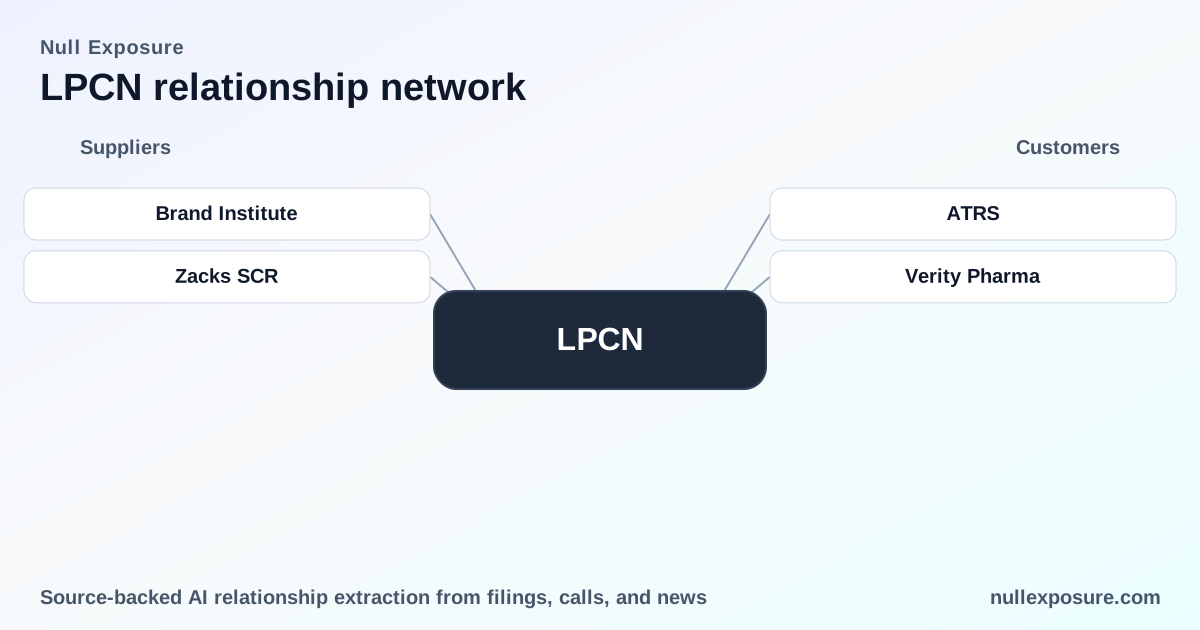
Verity Pharma — Lipocine and Verity executed an exclusive license for the United States and Canada, giving Verity the commercial rights to TLANDO in North America if regulatory conditions are met; this is Lipocine’s strategic route to re-establish U.S./Canada commercialization after changes to earlier arrangements. (Lipocine and Verity announced the license publicly; see PR Newswire release and company FY2025–FY2026 reporting, January 2024–2026.)
-
Antares Pharma, Inc. (ATRS) — Lipocine previously granted Antares an exclusive license to commercialize TLANDO in the U.S., but Antares notified Lipocine of termination on October 2, 2023, with the license ending January 31, 2024; the original license and subsequent termination materially changed Lipocine’s U.S. commercialization pathway. (BioSpace covered the original Antares license and FDA actions in FY2022; company filings and disclosures document the termination effective January 31, 2024.)
Each of these partners is documented in Lipocine’s reported disclosures and contemporaneous press coverage; the summaries above synthesize those primary public references.
What the partner map implies for investment risk and upside
Lipocine’s partner-first strategy creates a clear risk/reward profile:
- Upside: Exclusive territorial licenses mean successful partner approvals and launches convert into scalable royalty and supply revenue without Lipocine bearing full commercialization expense. Successful launches in major territories (Brazil, GCC, South Korea, North America) translate directly into recurring royalties and supply margins.
- Downside: The company’s commercial fate is tied to a small number of partners; a terminated U.S. license with Antares and the need to re-license North America to Verity illustrates execution fragility. Partners’ regulatory timelines govern revenue recognition and cash flow.
- Contractual protections and limits: Where disclosed (SPC, Pharmalink), agreements are exclusive, non-transferable and royalty-bearing, which both protects value and concentrates execution risk into the named licensee. (These contract features are described in the company’s September–October 2024 agreement disclosures summarized in FY2026 reporting.)
Constraints and company-level operational signals
Company filings and press releases provide constraint-level signals that shape how the business operates:
- Contract type: Licensing is the dominant contract class for TLANDO commercialization (high-confidence signal), with SPC and Pharmalink explicitly described as licensing/supply agreements in September–October 2024 filings.
- Geography: The partner map shows targeted regional rollouts—APAC via SPC Korea and EMEA/GCC via Pharmalink—supporting a territory-by-territory commercialization strategy rather than global direct sales. (Geographic excerpts are present in the September–October 2024 disclosures summarized in FY2026 reporting.)
- Relationship stage: The Antares license was terminated, effective January 31, 2024, returning U.S. rights to Lipocine and requiring the company to re-license North America (a material event recorded in filings).
- Related-party licensing: Lipocine also assigned IP for non-core fields to a related-party entity, Spriaso, with royalty mechanics capped at $10 million, indicating selective non-core asset monetization and related-party arrangements disclosed in filings.
Taken together, these constraints show a company that deliberately monetizes IP through exclusive territorial grants while retaining upside via royalties, but that also faces concentrated counterparty and regulatory risk.
Bottom line for investors
Lipocine is a licensing-centric play on TLANDO’s territorial commercialization. The company’s upside depends on partners executing regulatory approvals and launches in Brazil, GCC, South Korea and North America, while historical contract events—most notably the Antares termination—underscore execution risk. Investors should weigh the leverage of royalty economics against the company’s dependence on a handful of licensees and the timing uncertainty embedded in partner-led regulatory pathways.
If you evaluate partnership-driven biotechs, map the counterparties and their regulatory track records—Lipocine’s model makes that analysis decisive. For a partner-focused partner map and monitoring framework, see https://nullexposure.com/.
Key takeaways:
- Licensing-driven revenue with exclusive, royalty-bearing contracts is Lipocine’s commercial DNA.
- Concentration risk is material: a handful of partners control near-term commercialization outcomes.
- Contract events change valuation paths quickly, as the Antares termination demonstrates.