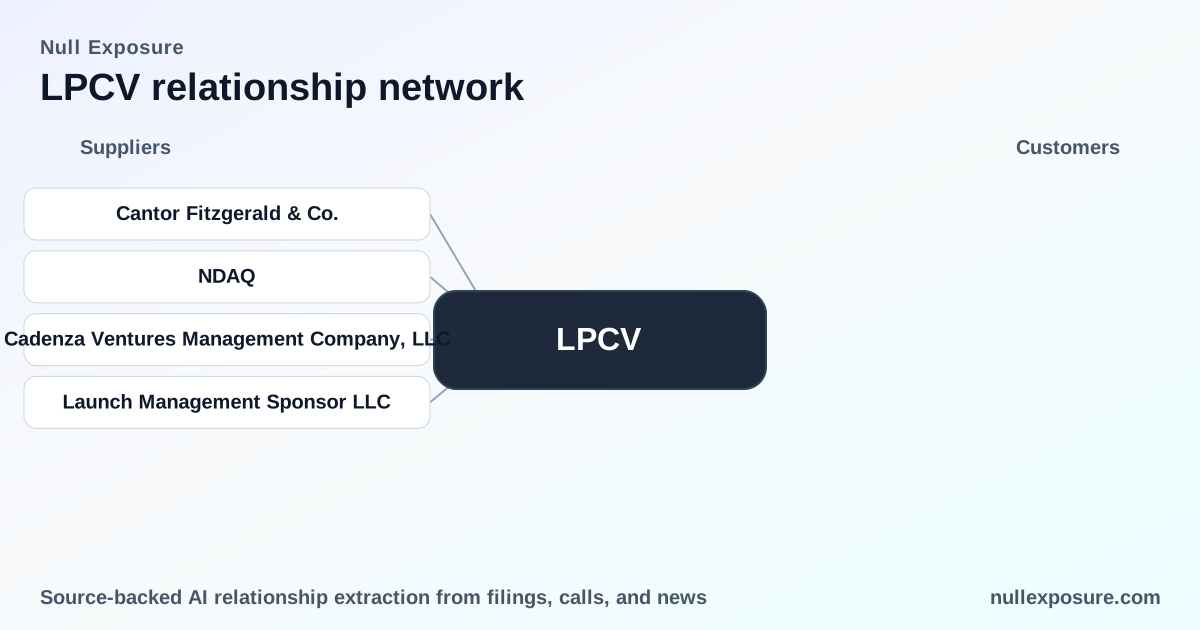
LPCV customer relationships: what investors should know
Launchpad Cadenza Acquisition Corp I (LPCV) is a special purpose acquisition company that raises capital in trust to execute a transformational merger with a target in the technology and digital sectors. The vehicle monetizes through an eventual business combination: sponsor economics, potential PIPE and investor upside on a successful de-SPAC, rather than operating revenues today. LPCV is listed on NASDAQ with a market capitalization of roughly $287.2 million and 23.0 million shares outstanding, signaling an investor base oriented toward an event-driven return profile. For ongoing monitoring and signal aggregation on LPCV, see https://nullexposure.com/.
Quick investor thesis: event-driven exposure, few recurring customer signals
LPCV is a classic SPAC with no operating revenues and no traditional customers; instead, investor outcomes depend on deal execution, target quality, and sponsor-led commercial introductions that can create optionality. Customer-relationship mentions tied to LPCV should be interpreted as strategic marketing or partnership signals—not recurring revenue streams. Institutional ownership is modest at ~6.6%, and book value is negative at -0.333 per the company snapshot, reinforcing the securities-driven nature of investor returns.
The customer relationships on record (one item, fully covered)
Below is every customer/partnership mention returned for LPCV in the customer-scope results.
Safety Shot (SHOT) — marketing partnership to raise brand awareness
Safety Shot (NASDAQ: SHOT) is reported to be partnering with Launchpad to raise brand awareness of its flagship product among college-age students, a marketing-focused collaboration rather than a supplier or revenue contract. This item was documented in a FinancialContent press release dated May 3, 2026 (FY2026). The mention frames Launchpad as a distribution or promotional ally for SHOT’s wellness product aimed at reducing blood alcohol content in a short time window. (FinancialContent press release, May 3, 2026.)
What these relationship signals say about LPCV’s operating model
The sparse customer mentions are consistent with LPCV’s SPAC profile. Treat these as company-level operational signals rather than indicators of durable commercial traction.
- Contracting posture: Event-driven and bilateral. Partnerships reported are tactical and marketing-focused, not long-term supply contracts. That contracting posture implies short lead times and limited counterparty lock-in.
- Concentration: Single or very few third-party mentions; concentration is effectively total in the customer-signal set because LPCV has no operating customers. This increases sensitivity to each disclosed relationship’s strategic value.
- Criticality: Low-to-moderate. Marketing partnerships can influence a target’s post-combination go-to-market, but they are not critical supplier relationships that would disrupt operations if they ended.
- Maturity: Early-stage and opportunistic. The relationships are nascent promotional initiatives rather than mature, revenue-generating contracts.
These characteristics translate into an investment model where execution risk on the de-SPAC transaction and target selection dominates, and partnership mentions are signals of deal-orientation rather than evidence of recurring cash flows.
Valuation and risk takeaways tied to customer mentions
- Customer/partnership mentions do not change LPCV’s cash flow profile. LPCV reports zero revenue and zero operating margins; all upside is tied to a successful merger or liquidation event.
- Marketing collaborations can still be material to target selection. A sponsor that leverages its network to secure brand partnerships could improve a combined company’s growth trajectory post-close, creating asymmetric upside for LPs and public shareholders.
- Single-mention signal risk is high. One marketing partnership in press coverage is informative for PR intent but insufficient to infer commercial scale or durable demand.
Key balance-sheet and market context: LPCV’s market cap is approximately $287.2M, shares outstanding and float are both 23.0M, institutional ownership is about 6.6%, and 52-week trading range is narrow (9.88–10.03). These metrics underscore a tightly priced SPAC vehicle with limited trading dispersion and investor interest concentrated around the pending deal thesis.
How to use the Safety Shot relationship in due diligence
- Treat the Safety Shot mention as a directional signal—it confirms sponsor activity in the consumer/wellness vertical and a willingness to engage in co-marketing. Use this to refine target vertical expectations.
- Request deal-level diligence to understand whether such partnerships translate to contractual or pipeline commitments for a target post-merger, or whether they are promotional PR arrangements only.
- Monitor subsequent filings, press releases, and PIPE announcements for evidence that the sponsor is converting promotional ties into commercial agreements or revenue commitments.
For an ongoing tracker of LPCV’s external relationships and filings, consult https://nullexposure.com/.
Practical next steps for investors and operators
- Investors should prioritize deal disclosure, sponsor track record, and the quality of the announced target over single press-mention relationships when assessing LPCV upside.
- Operators evaluating an engagement with LPCV (or its future target) should seek clarity on the commercial terms: guaranteed placements, co-marketing budgets, measurement of outcomes, and exclusivity.
- Maintain a watchlist for follow-up coverage—marketing partnerships often precede tighter commercial arrangements if the sponsor intends to scale a target quickly.
Bottom line
LPCV is an event-driven investment vehicle with no operating customers and limited public disclosures about partner relationships; the reported Safety Shot collaboration is a marketing partnership that signals sponsor activity in consumer wellness but does not constitute a revenue relationship. Investors should treat these customer-scope mentions as informational signals that refine sector focus and sponsor behavior, while continuing to evaluate core deal execution and target fundamentals as the primary drivers of value.