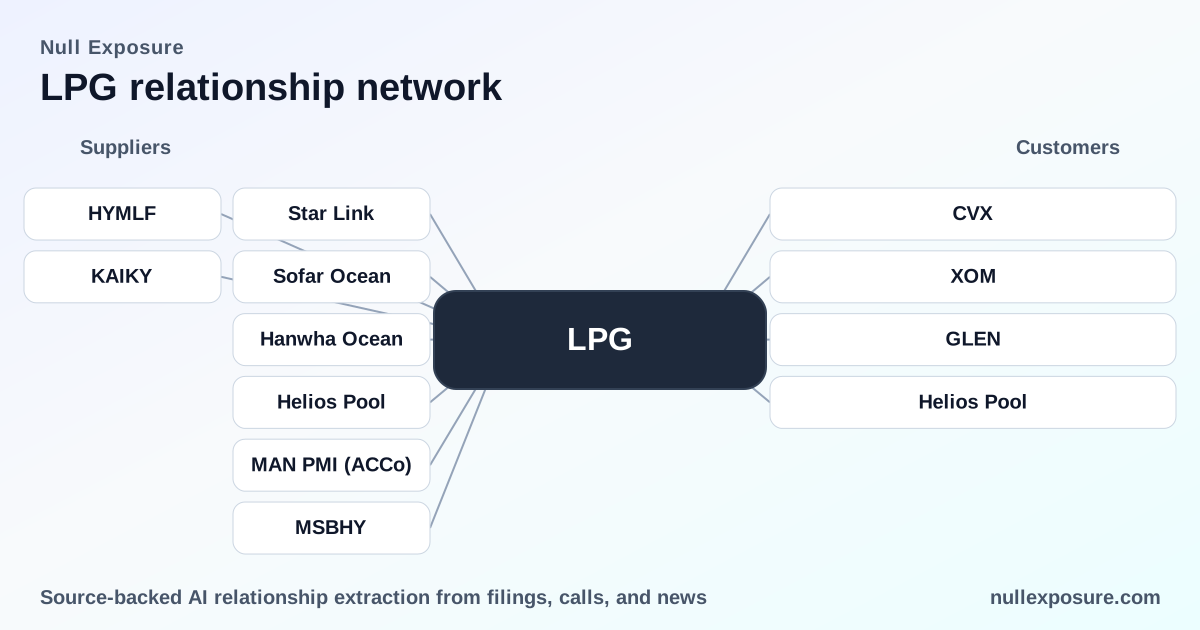
Dorian LPG (LPG) — customer relationships and commercial posture investors need to price in
Dorian LPG operates and monetizes a fleet of very large gas carriers (VLGCs) by providing seaborne transportation services to commodity traders, major energy companies and importers, and by participating in a commercial pooling arrangement called the Helios Pool; revenues flow from a mix of voyage charters, short-term/time charters and pool profit allocations. The business is effectively a shipping services operator that sells transport capacity and commercial management, with revenue concentration driven by a single pooled commercial vehicle. For a concise company overview and related signals, see Null Exposure’s research hub: https://nullexposure.com/.
How Dorian makes money and how the commercial model constrains value
Dorian’s income derives from chartering its VLGCs and capturing upside through pool economics when vessels are committed to the Helios Pool. The firm provides in‑house commercial services for its vessels and either charters them directly to counterparties or deploys them into the Helios Pool — an arrangement that allocates voyage profits according to pro rata performance. The Helios Pool is central to operating leverage: for the year ended March 31, 2025 the pool accounted for 97% of total revenues, a concentration that converts pool performance into company-level earnings volatility (company filing commentary reported in FY2026 press materials).
Contracting posture and counterparty mix are material to valuation. The company’s disclosures describe customer engagements that are predominantly short-term and spot-oriented for vessels operating inside the Helios Pool, and its customer list reads like the global energy and trading incumbents (Exxon, Chevron, Glencore, shell names, Vitol, etc.), which creates high counterparty credit quality but also revenue concentration. Geographic reach is global and the firm reports customer relationships with very large enterprises, reflecting both scale and sensitivity to commodity cycle swings. On segmenting, Dorian reports a single operating segment: international LPG transportation services.
Key operating signals:
- Concentration: Helios Pool drives the bulk of revenue (97% in FY2025), making pool performance a primary earnings driver.
- Contracting: Vessels in the Helios Pool operate on a mix of spot, COAs, and short time charters (two years or less), enforcing short-duration revenue realization and exposure to freight-rate swings.
- Counterparty quality: Customers are large and very large energy traders and importers, delivering high credit quality but limited diversification.
- Commercial role: Dorian acts as a service provider and in-house commercial manager for its fleet.
If you want a clean summary of how these relationship signals map to investment risk, Null Exposure provides structured intelligence at https://nullexposure.com/.
Customer relationships and citations (each reported result)
Helios LPG Pool LLC — charter counterparty and joint commercial vehicle (FY2026)
Dorian reports deploying newbuild VLGCs on charter under the Helios LPG Pool LLC, a commercial pool jointly controlled by Dorian and MOL Energia Pte Ltd; vessels placed in the pool operate under pooled voyage charters with profit allocation by performance. Source: Rigzone press report on the company’s new delivery, March 24, 2026 (Helios deployment noted).
Chevron Corp. (CVX) — listed customer in company filings (FY2025)
Chevron is cited among Dorian’s customers, representing a typical major energy company contracting for LPG transportation services either directly or via pool arrangements. Source: SEC 10‑Q reporting referenced by TradingView summarizing FY2025 customer base.
Exxon Mobil Corp. (XOM) — listed customer in company filings (FY2025)
Exxon is named in the company’s customer roster; engagements with integrated oil majors reflect large single‑counterparty cargo volumes and standard commercial charter relationships. Source: SEC 10‑Q reporting referenced by TradingView summarizing FY2025 customer base.
Glencore plc (GLEN) — listed customer in company filings (FY2025)
Glencore shows up among the commodity traders using Dorian’s transport capacity, a classic trader counterparty that sources and places cargoes via spot and contract markets. Source: SEC 10‑Q reporting referenced by TradingView summarizing FY2025 customer base.
XOM (duplicate mention) — alternate reference to Exxon Mobil (FY2025)
A separate TradingView item reproduces the same SEC disclosure naming XOM among customers; this repeats the earlier identification of Exxon as a customer and underscores repeated disclosure to investors. Source: TradingView SEC 10‑Q summary, March 2026.
Helios LPG Pool — vessel employment and pool mechanics described (FY2026)
Media reports reiterate that new dual‑fuel vessels will commence employment under the Helios LPG Pool, which is jointly controlled by Dorian LPG and MOL Energia with offices in Copenhagen and Singapore; reports include language on pooled voyage charter employment and pro‑rata profit calculations. Source: MarineLink and Offshore‑Energy coverage of newbuild employment, May 2026.
Helios Pool — accounting and revenue allocation language (FY2026)
In its quarter commentary, Dorian explicitly defines the “Pool” and explains that the company receives a portion of pool profits based on vessel pro‑rata performance; that reporting also quantifies the pool’s contribution to total revenue in FY2025. Source: Morningstar/BW press release covering Dorian’s third-quarter FY2026 results (pool description and revenue attribution).
Helios LPG Pool (additional media coverage) — pool joint control with MOL Energia (FY2026)
Another trade press article reiterates that the vessel will be chartered under the Helios LPG Pool and notes the joint control with MOL Energia, echoing earlier coverage about the governance and locations of pool offices. Source: Offshore‑Energy piece on Dorian’s new dual‑fuel VLGC taking delivery, May 2026.
MOL Energia — Helios Pool partner and commercial co‑controller (FY2026)
MOL Energia is identified as Dorian’s partner in operating the Helios Pool, which confirms that commercial management is shared and that pool economics are the product of a joint operating construct. Source: TradingView report summarizing Helios Pool operations in May 2026.
Investment implications: upside, concentration risks, and the cash flow profile
- Upside: Dorian’s exposure to spot and short-term charters inside the Helios Pool delivers high operating leverage to freight rate recoveries; ownership of modern VLGCs and in‑house commercial management support margin capture when rates rise.
- Concentration risk: The Helios Pool accounted for 97% of revenue in the year to March 2025, an outcome that converts pool operational stress directly into company cash‑flow pressure. Counterparty quality is high but concentrated among a limited set of very large trading houses and oil majors, reinforcing the revenue concentration signal from the pool.
- Cash flow profile: Short‑term/spot contracting increases revenue cyclicality; investors should price a higher beta to freight cycles despite Dorian’s defensive balance sheet metrics (EBITDA and margins reported in FY2025).
- Operational control: Dorian’s role as an in‑house commercial service provider aligns incentives for utilization and voyage optimization but makes company earnings sensitive to pool governance and partner alignment (MOL Energia).
Bottom line
Dorian is a service‑oriented shipping operator whose earnings are driven overwhelmingly by its Helios Pool participation and by short‑term market exposures to freight rates. For investors, that combination implies higher cyclicality and concentration risk offset by the potential for outsized earnings in freight upcycles and the credit quality of blue‑chip customers. For more coverage of Dorian’s counterparties, pool economics, and structured commercial signals, visit Null Exposure: https://nullexposure.com/.