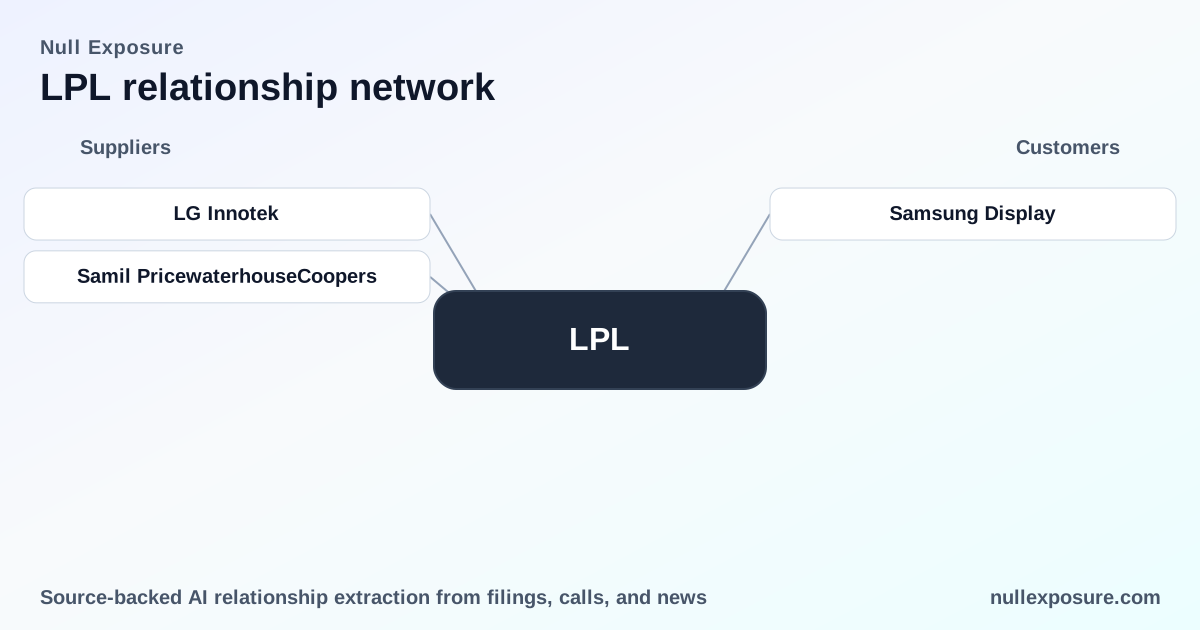
LG Display (LPL): Customer Map and What It Means for Revenue and Risk
LG Display designs and manufactures premium display panels (TFT‑LCD and OLED families) and monetizes through direct sales to global original equipment manufacturers (OEMs), affiliate channel supply, and intellectual property transactions. The firm’s revenue profile is driven by large, contract‑style supply relationships with electronics OEMs and strategic IP arrangements; recent wins in premium laptop panels and continued affiliate demand position the company on the higher end of the supply chain. For further relationship intelligence and monitoring, visit https://nullexposure.com/.
The short investment thesis
LG Display operates as a capital‑intensive component supplier to a concentrated set of large electronics brands; value accrues when the company secures design‑win positions in premium product lines and when IP assets are monetized or rationalized through transfers. Revenue volatility tracks product cycle timing and panel ASPs, while margin expansion requires successful migration to higher‑margin OLED and oxide technologies.
How LG Display contracts and where concentration shows up
LG Display’s operating model is that of a supplier to large OEMs and affiliates, executed via multi‑year supply contracts, design wins, and licensing/IP transactions. Key operating model signals:
- Contracting posture: Supplier → OEM bilateral contracts and design‑win commitments with premium device manufacturers.
- Customer concentration: Sales are concentrated among a handful of global electronics brands and internal affiliates that purchase at scale.
- Criticality: Panels are mission‑critical components for OEMs’ premium product differentiation (e.g., laptop displays, TVs, CTVs).
- Maturity and transition: The business is in a technology transition from mainstream LCD to OLED/oxide premium panels, shifting margin profiles and capital allocation.
These are company‑level signals derived from observed customer relationships and IP activity rather than isolated contract excerpts.
What the public record shows about LPL’s customers and partners
Dell — premium XPS laptop panels
LG Display will supply its Oxide 1Hz laptop panel to Dell for the flagship XPS lineup, reflecting a design win into a high‑visibility premium notebook family. According to a PR Newswire release on May 3, 2026, this supply arrangement targets Dell’s premium segment and leverages LG Display’s oxide low‑power panel capabilities; the same development was picked up by market news outlets on the same date. (PR Newswire; Finviz, May 3, 2026)
Samsung Display — patent transfers and IP reallocation
LG Display transferred dozens of LCD‑related patents to Samsung Display, an action that reorganizes legacy LCD IP ownership in the Korean display ecosystem. A Korea JoongAng Daily report in August 2025 documents the patent transfers, indicating an active reallocation of LCD intellectual property that reduces LG Display’s legacy LCD IP holdings while clarifying rights across major suppliers. (Korea JoongAng Daily, Aug 8, 2025 / reported Mar 2026)
LG Electronics — affiliate supply relationship
LG Display supplies panels to its affiliate LG Electronics as part of its core sales base, where internal channel sales support stable baseline revenue and captive demand for LG Electronics’ consumer products. InsiderMonkey noted LG Display’s revenue stream includes panel supply to LG Electronics, reinforcing the role of affiliate demand in the company’s top line. (InsiderMonkey write‑up, May 3, 2026)
DSP — participation in Direct Access program for CTV
A DSP earnings call (Q2 2025) states the company “welcomed LG, a major CTV OEM, to our Direct Access premium publisher program,” which reflects LG’s role as a content‑device ecosystem participant in connected TV supply chains. This relationship indicates LG Display’s participation in the CTV OEM ecosystem beyond traditional panel sales, embedding the company into digital advertising and platform distribution channels via OEM partnerships. (DSP earnings call, 2025 Q2)
What these relationships mean for revenue, margins, and risk
- Premium design wins drive ASP leverage. The Dell Oxide 1Hz panel design win puts LG Display into a higher‑margin product band where power and display performance are selling points, supporting revenue per unit expansion when volume ramps.
- Affiliate demand provides a revenue floor. Sales to LG Electronics contribute predictable internal volume and shorten sales cycles relative to third‑party OEMs, cushioning against open‑market cyclicality.
- IP reallocation is strategic, not purely defensive. The patent transfers to Samsung Display remove legacy LCD obligations and signal a strategic shift toward next‑gen OLED and oxide innovation; that reallocation affects potential licensing upside but clarifies competitive IP boundaries.
- Ecosystem play in CTV diversifies commercial exposure. The DSP disclosure that LG is a CTV OEM partner expands LG Display’s exposure to non‑hardware monetization vectors and underlines cross‑industry engagement with programmatic and platform channels.
Key risks and watchpoints for investors
- Concentration risk: Large OEM customers can account for a disproportionate share of revenue, so loss of a design‑win or volume swing has outsized P&L impact.
- Technology transition execution: Profitability hinges on successfully scaling OLED/oxide manufacturing and moving away from low‑margin LCD production.
- IP repositioning consequences: Patent transfers reduce legacy IP complexity but could also constrain future licensing revenue from LCD technology.
- Revenue timing and capital intensity: Panel ASP cycles, capital expenditure for next‑gen fabs, and inventory timing create pronounced quarter‑to‑quarter volatility.
Constraints and corporate signals
No explicit contractual constraints or limiting clauses were captured in the reviewed relationship records; this absence itself is a company‑level signal that public disclosures emphasize transactional supply wins, affiliate supply, and IP transfers rather than restrictive covenants. Investors should treat sourcing and patent transfers as structural signals of strategic repositioning rather than evidence of binding downstream constraints.
Bottom line for investors
LG Display’s customer relationships show a clear strategic stance: win premium design slots (Dell), maintain captive affiliate demand (LG Electronics), rationalize legacy IP (Samsung Display transfers), and extend into ecosystem plays (CTV OEM participation via DSP). This mix supports a thesis that revenue growth and margin expansion depend on successful technology migration and the firm’s ability to convert design wins into volume at favorable ASPs.
For a continuous feed of relationship intelligence and to track how these links evolve into revenue outcomes, visit https://nullexposure.com/.
Bold takeaways
- Design wins into premium product lines are the primary route to margin improvement.
- Affiliate sales provide baseline stability while IP moves reallocate future licensing dynamics.
- Monitor OEM concentration and capex cadence as leading indicators of earnings volatility.