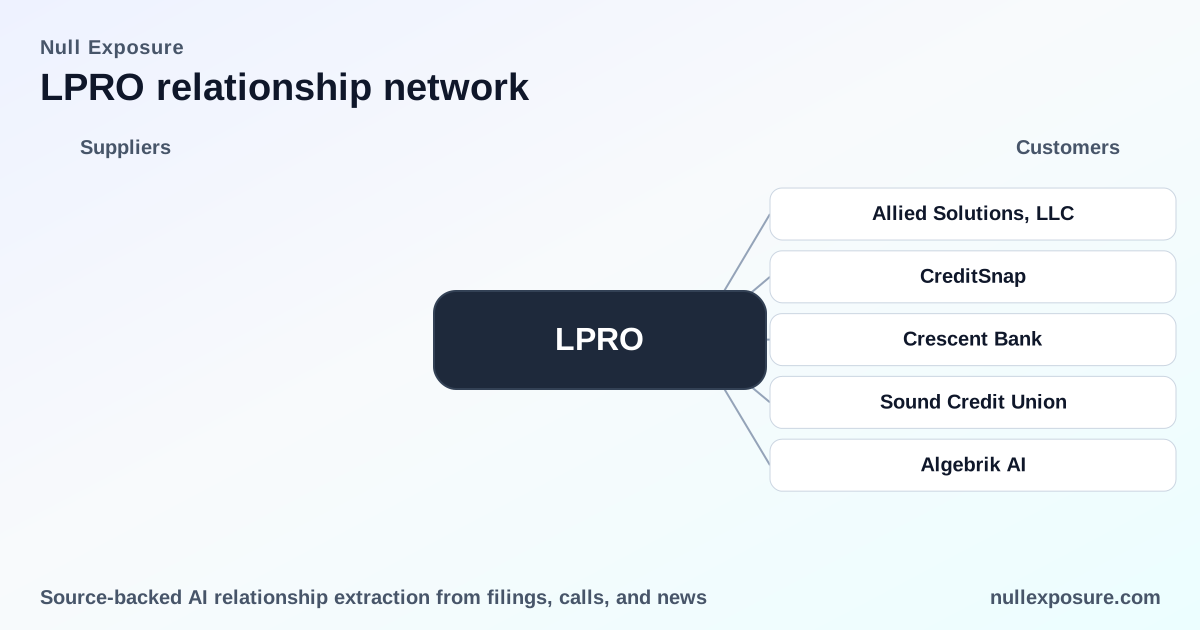
Open Lending generates revenue by selling access to its cloud-based Lenders Protection (LPP) platform and related services to automotive lenders — primarily credit unions, regional banks and OEM finance partners — through usage-based program fees, profit-sharing with insurance partners, and claims-administration fees. Investors should value LPRO as a software-enabled financial services intermediary: its economics hinge on volume of originated loans in the U.S., the stickiness of lender integrations, and the durability of resale and OEM partnerships that convert underwriting and insurance flows into recurring program fees.
Open Lending (LPRO): Customer relationships and what they mean for investors
How the company actually gets paid and where the leverage comes from
Open Lending’s commercial model is usage-based: program fees are recognized when loans are certified and are generally a percentage of loan amounts or a per-loan average (the company reported an average program fee around the mid-hundreds per loan in public filings). Revenue is also derived from profit share and claims administration fees tied to default insurance arrangements. This structure creates a direct link between loan origination volumes and top-line results, and it gives Open Lending both scaling upside and cyclicality tied to auto-loan origination trends. According to company disclosures, LPP is a cloud-based platform sold to U.S. automotive lenders, and Open Lending reports serving over 400 active lenders — illustrating both concentration in a vertical market and operational scale in the U.S. For more structured coverage of partners and implications visit https://nullexposure.com/.
What operational constraints tell investors about the business model
The company-level signals in public materials indicate several defining characteristics of Open Lending’s operating posture:
- Contracting posture — usage-based: fees are tied to loan certification and the life of originated loans, aligning revenue with lender activity rather than fixed license fees.
- Geographic concentration — U.S. only: commercial reach and regulatory exposure remain domestic, concentrating market, credit-cycle and regulatory risk in the U.S. automotive lending market.
- Relationship role — buyer-facing platform vendor: customers are lenders who buy underwriting, pricing and insurance-enabled decisioning; Open Lending functions as the underwriting and insurance-enablement supplier.
- Relationship status — active and recurring: the company reports hundreds of active lenders, indicating broad but industry-focused penetration and reliance on recurring throughput.
- Segment — cloud software for financial services: LPP is marketed and operated as a cloud-based lending enablement platform that couples decisioning with insurance flows.
These constraints drive both revenue leverage (volume-dependent, scalable software economics) and concentration risk (single-vertical exposure and U.S.-centric operations).
Customer-level relationships: partners that define the revenue funnel
Below I cover every named relationship reported in public materials and summarize the commercial reality for each partner.
Allied Solutions, LLC
Open Lending amended its reseller agreement with Allied Solutions on August 13, 2025, agreeing to a one-time $11.0 million payment that extinguished Allied’s right to certain ongoing compensation and reset referral fees. This transaction reflects a deliberate move to convert an ongoing reseller payout into an upfront settlement and restructured economics. (Source: Open Lending Q3 2025 press release via GlobeNewswire, FY2025.)
Crescent Bank
Crescent Bank entered into a partnership with Open Lending to accelerate auto-loan approvals and expand lending reach across multiple states, positioning Open Lending’s decisioning and pricing capabilities at the front end of Crescent’s origination process. That agreement demonstrates how regional banks use LPP to scale underwriting capacity across a broad geographic footprint. (Source: Open Lending press release via Business Wire, March 7, 2023; additional coverage in AutoRemarketing, FY2023.)
Sound Credit Union
Sound Credit Union reported an 8% increase in auto-loan yield after implementing Open Lending’s Lenders Protection platform, underscoring the revenue and pricing lift lenders capture by adopting risk-based pricing and insurance-enabled overlays. This is an illustrative case study of the quantifiable pricing benefits LPP delivers to credit unions. (Source: Open Lending case study via Business Wire / FinancialContent, May 5, 2023.)
Algebrik AI
Algebrik AI integrated Open Lending’s Lenders Protection platform into its loan origination workflows to expand intelligent auto-loan decisioning for credit unions, aiming to increase approvals and streamline risk controls. This partnership indicates Open Lending’s strategy to embed LPP into third-party LOS vendors and extend reach through distribution partners. (Source: Algebrik–Open Lending press release via PR Newswire and coverage by PYMNTS, FY2025.)
CreditSnap
Open Lending launched a partner integration with CreditSnap, a fintech that delivers pre-qualification and account automation, enabling lenders using CreditSnap to access LPP decisioning and pricing inside their consumer touchpoints. This reflects Open Lending’s channel strategy of integrating with fintechs to capture originations earlier in the borrower journey. (Source: Open Lending partnership announcement via Business Wire, reported on aijourn.com, FY2024.)
OEM 3 (non-branded dealer channel)
During an earnings commentary, management outlined a strategy to become the “first-look decisioning engine” for non-branded OEM 3 dealers, signaling intentional expansion into OEM-adjacent origination flows and a growth vector outside branded captive finance. This speaks to a longer-term commercial objective to broaden distribution and capture a greater share of dealer-originated volume. (Source: Q4 2025 earnings call transcript published on InsiderMonkey, FY2026.)
Why these relationships matter for valuation and risk
- Revenue sensitivity to originations: Partnerships with banks, credit unions, LOS vendors and dealer channels all translate to variable fees; valuation should assign sensitivity to U.S. auto-loan origination trends.
- Distribution via channel partners reduces sales friction but increases dependency: Integrations with LOS and fintech partners (Algebrik, CreditSnap) accelerate scale but tie future volume to the partner ecosystem’s health and renewal economics.
- Contract re-pricing and one-time settlements are material: The Allied Solutions settlement shows management will restructure legacy commercial economics to accelerate margin profile — a positive for near-term cash but a reminder that reseller economics can be renegotiated.
- Concentration and domestic focus are both strength and risk: Deep penetration in U.S. near-prime auto lending produces strong domain expertise but concentrates macro, regulatory and credit-cycle exposure.
Bottom line for investors
Open Lending is a software-first, usage-based commercial platform that monetizes loan throughput and insurance flows. Its partner roster — banks, credit unions, LOS vendors and dealer channels — reflects a deliberate go-to-market that trades fixed-contract visibility for scalable, volume-linked economics. Evaluate LPRO on three axes: loan origination volume trends, partner pipeline health (particularly LOS/OEM integrations), and margin improvement from contract re-pricing actions such as the Allied Solutions amendment. For a consolidated view of partner dynamics and implications for positioning, visit https://nullexposure.com/.
Bold takeaway: LPRO’s upside is tied to U.S. loan volumes and partner distribution; its downside is concentrated exposure to the same.