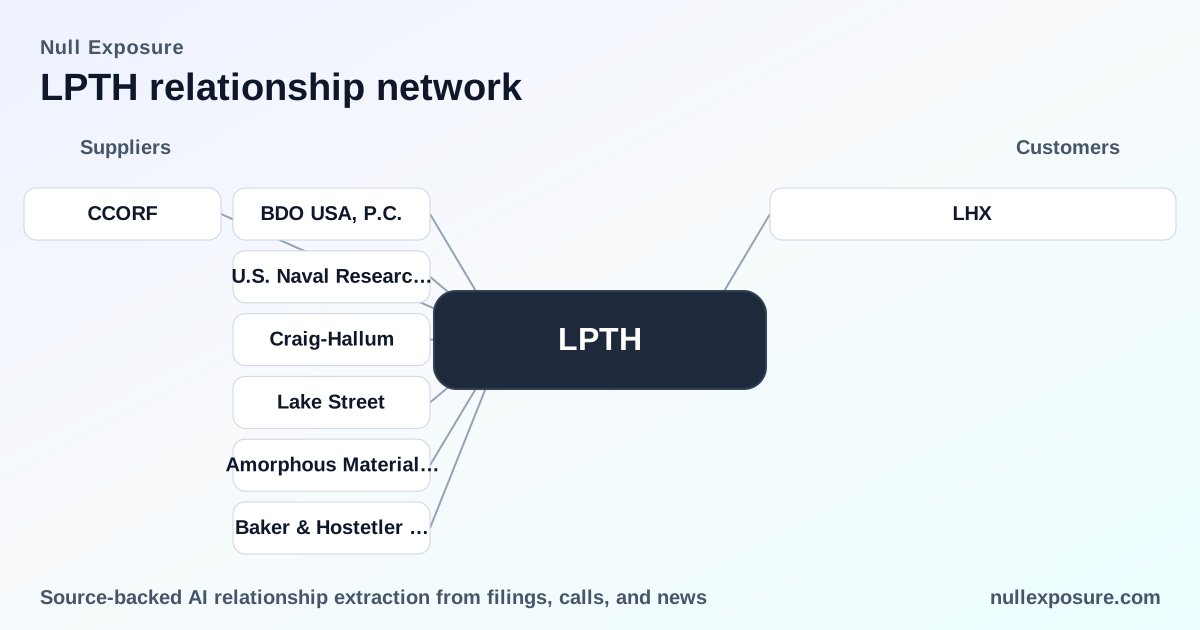
LightPath Technologies (LPTH): Customer Relationships and What They Mean for Revenue Quality
LightPath Technologies designs, manufactures and sells precision optical components and assemblies—monetizing through a mix of point-in-time component sales, short-term product development agreements, and multi-year defense program contracts that deliver recurring revenue. For investors, the company's business model blends manufacturing scale in optics with engineering services tied to defense primes, creating a revenue profile that is partly predictable through program awards and partly transactional through component orders.
Explore deeper relationship intelligence at https://nullexposure.com/ to see how customer wins and contract types drive near-term and long-term cash flow.
How LightPath makes money: manufacturing plus bespoke engineering
LightPath operates primarily as an optics manufacturer with notable engineering services capability. The company sells:
- Infrared and visible optical components and assemblies at a point in time;
- Custom engineering and development agreements where revenue is recognized on completion of defined deliverables;
- Longer-term defense and government program work that can produce multi-year, program-of-record revenue streams.
The public financial profile shows Revenue (TTM) of $52.8 million with negative net margins in the most recent reporting, reflecting ongoing investment in product development and program capture. The business is geographically diversified across the U.S., Asia and Europe, but concentration and contract mix are the key levers that determine revenue stability.
Notable customer interactions on record
LightPath’s customer references in the source material show a specific program-level award and two separate mentions of the same news release; both must be accounted for:
L3Harris Technologies — FY2025 IR camera EDM order (record 1)
LightPath was awarded an initial $2.2 million engineering development model (EDM) order for infrared cameras by L3Harris Technologies as part of a shipboard optics program, representing a program-level award from a major defense prime. According to a PR Newswire release dated March 10, 2026, the award is positioned as an initial engineering development model order tied to U.S. Navy shipboard optics work (PR Newswire, March 10, 2026: https://www.prnewswire.com/news-releases/lightpath-technologies-awarded-initial-2-2-million-ir-camera-order-for-us-navy-shipboard-optics-speir-program-302424218.html).
L3Harris Technologies — FY2025 IR camera EDM order (record 2)
The same PR Newswire release is recorded a second time in the relationship results, reinforcing that this $2.2 million EDM award is the principal documented program-level customer interaction in the dataset. This duplicate mention corroborates program relevance to fiscal-year activity and the company’s positioning with defense primes (PR Newswire, March 10, 2026).
What these relationships imply for revenue and program exposure
- Defense prime program exposure is real and material. The L3Harris EDM order is typical of awards that can convert into larger production contracts if development milestones are met; such awards support near-term engineering revenue and the prospect of follow-on production work.
- Typical award size aligns with the company’s spend band signals. The $2.2 million order fits within a spend-band profile where the company records customers in the $1M–$10M range, consistent with LightPath’s disclosure that three customers collectively represented roughly 23% of FY2025 revenue.
- Customer concentration and government counterparty mix drive both opportunity and risk. LightPath’s client mix includes defense primes and government agencies, which provide program visibility but also concentrate revenue risk if any single prime reduces purchases.
Operational constraints and business-model signals investors should weigh
The corporate disclosures and relationship constraints reveal several integrated characteristics that shape LightPath’s operating model:
- Contracting posture is mixed: LightPath runs multi-year defense program relationships alongside shorter-term product development agreements and point‑in‑time component sales. This creates a layered revenue stream: some recurring program-backed revenue and some transactional variability.
- Customer concentration is meaningful and persistent: In FY2025 the company reported three customers that together comprised approximately 23% of annual revenue, with one customer around 9% and others at 7% and 6%, indicating material counterparty concentration that can amplify revenue volatility if one prime reduces scope.
- Counterparty criticality is elevated in defense channels: Government and defense-prime customers dominate program wins; these are high-criticality relationships because program loss would meaningfully affect revenues and backlog.
- Geographic reach is genuinely global but regionally skewed: LightPath operates facilities in the U.S., China and Latvia and reported that roughly 38–39% of revenue came from outside the U.S., with the majority of foreign sales tied to Europe and Asia—a profile that introduces both market diversification and geopolitical exposure.
- Segment mix blends manufacturing scale with services: The company’s single optics reporting segment covers both volume manufacturing of precision lenses and engineering services that support custom modules and infrared assemblies; margin profiles will differ across these activities.
- Maturity and spend-band signaling: Typical customer engagements sit in the $1M–$10M range, consistent with multi-year program awards and initial development orders rather than only high-volume commodity sales.
Risk / reward narrative for investors
- Upside: Program awards from defense primes—illustrated by the L3Harris EDM order—provide a tangible pathway to larger, higher-margin production contracts and create an expanding backlog if development milestones succeed. The engineering-services capability differentiates LightPath from pure-play component vendors and supports cross-sell into assemblies and modules.
- Downside: Concentration risk is a near-term constraint: a small number of customers account for a meaningful share of revenue. The mixed contract posture means revenue will show step-changes tied to program wins and completions rather than smooth organic growth. Foreign sales concentration in EMEA/APAC exposes the company to regional demand swings and supply-chain complexity.
Investment takeaway and next analytical steps
LightPath is a specialist optics manufacturer that generates revenue through a mix of spot sales, product development agreements, and multi-year defense programs. The March 2026 L3Harris EDM award is evidence that LightPath is winning defense-prime work that can scale if development converts to production, but material customer concentration and a blended contracting posture require active monitoring.
For a deeper, deal-level view and to track future customer awards and program conversion, see Null Exposure’s platform at https://nullexposure.com/—dive into relationship timelines, contract types and concentration analytics to quantify program conversion probability and revenue runway.
Bold, observable signals—program awards, customer concentration, global footprint—define the investment case here. Monitor follow-on orders from L3Harris and the company’s reported customer mix in each fiscal filing to assess whether development wins translate into sustained production revenue.