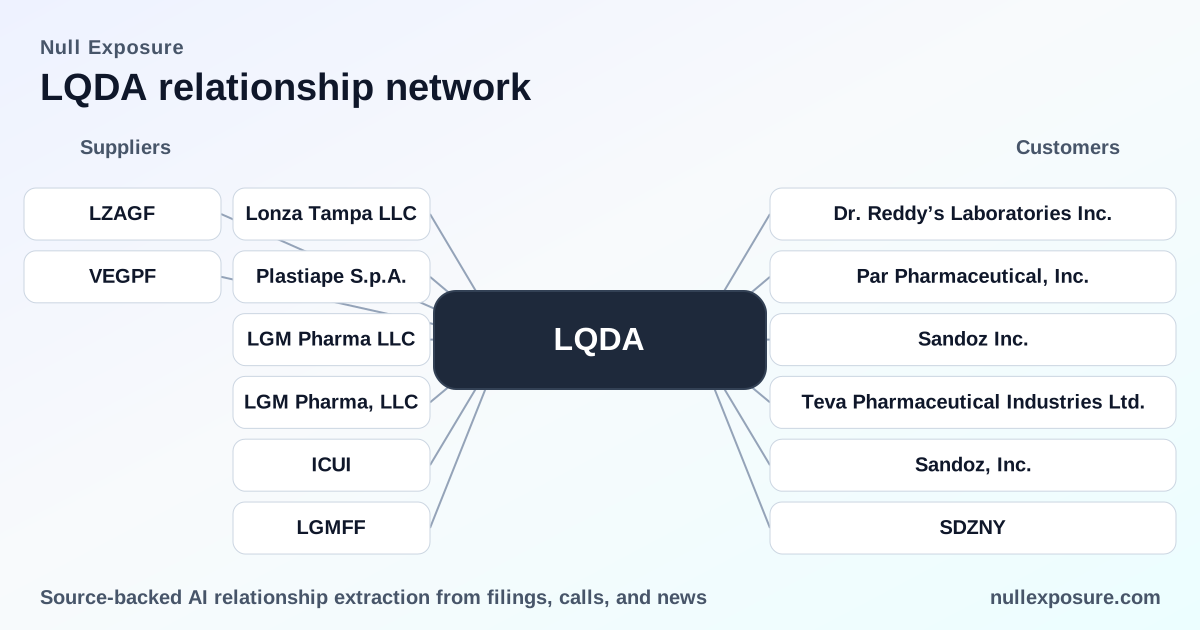
Liquidia Technologies (LQDA) — the customer map that defines the business
Liquidia monetizes a single commercial asset: a profit‑share Promotion Agreement that delegates U.S. commercial activities for Treprostinil Injection to a partner and converts Liquidia’s role into a services‑and‑promotion revenue model rather than a traditional product seller. The company’s cash flow and receivables are highly concentrated around that agreement, and investors should treat Liquidia as a promotion services platform with a single critical commercial counterparty rather than a diversified pharmaceuticals distributor. For a concise company‑level dossier and relationship monitoring, visit https://nullexposure.com/.
How Liquidia makes money and why customers matter
Liquidia’s operating model is dominated by a Promotion Agreement that gives it exclusive rights to conduct commercial activities to encourage appropriate use of Treprostinil Injection in the U.S. Revenue is generated primarily as profit‑share and service revenue tied to that agreement rather than volume sales recorded on Liquidia’s balance sheet. That structure creates a business that is contract‑dependent, top‑heavy in counterparty credit exposure, and operationally focused on commercial execution rather than manufacturing scale.
- Concentration is fundamental: the Promotion Agreement produces essentially all reported revenue in recent years, making counterparty performance a primary driver of Liquidia’s topline.
- Contracting posture is service‑oriented: Liquidia’s role is buyer/promoter and commercial operator under the agreement, not a broad distribution or manufacturing function.
- Operational criticality is high: receivables and refund liabilities are tied directly to the agreement, creating single‑counterparty balance sheet sensitivity.
For additional company intelligence and ongoing tracking of these relationships, see resources at https://nullexposure.com/.
What the filings and press coverage list as Liquidia’s customer relationships
Below are the relationships cited in Liquidia’s customer reporting and related press coverage. Each item is a direct read from the provided filings or news items; the one‑ to two‑sentence notes summarize the practical implication for investors.
Dr. Reddy’s Laboratories Inc. — FY2024 (10‑K)
Liquidia’s 2024 Form 10‑K references Dr. Reddy’s launch of a generic treprostinil for parenteral administration in April 2023, which is relevant competitive context for Treprostinil Injection’s market dynamics. According to Liquidia’s FY2024 10‑K, that competitive entry is part of the external environment that affects demand and pricing for products in this therapeutic class.
Par Pharmaceutical, Inc. — FY2024 (10‑K)
The 2024 10‑K notes Par Pharmaceutical’s earlier (September 2019) approval and launch of a generic treprostinil for parenteral administration sold primarily to hospitals; this legacy generic presence influences channel mix and purchasing behavior for the injection product. Liquidia cites Par’s product as a parallel competitive factor in the hospital/specialty channel (Liquidia 2024 Form 10‑K).
Sandoz Inc. — FY2024 (10‑K)
Liquidia discloses that one customer accounted for 95% and 99% of accounts receivable, net as of December 31, 2024 and 2023, respectively; that exposure is reported in its FY2024 Form 10‑K and is tied to the Promotion Agreement. The filing establishes Sandoz as the commercial partner whose cash flows and receivables dominate Liquidia’s balance sheet (Liquidia 2024 Form 10‑K).
Teva Pharmaceutical Industries Ltd. — FY2024 (10‑K)
The 2024 10‑K also references Teva’s October 2019 launch of a generic treprostinil for parenteral administration that is sold primarily through specialty pharmacies and to hospitals, adding another competitor shaping channel dynamics for the injection product. Liquidia lists Teva’s product as part of the competitive landscape in its FY2024 disclosure.
Sandoz, Inc. — FY2026 business update (GlobeNewswire, Mar 5, 2026)
A March 5, 2026 GlobeNewswire press release on Liquidia’s fourth quarter and full‑year 2025 results states that service revenue, net was related primarily to the promotion agreement with Sandoz, under which Liquidia shares profits from the sale of Treprostinil Injection in the United States. This press release confirms that Sandoz continues to be the operational and economic counterparty for promotion and profit sharing (Liquidia press release, March 5, 2026).
Sandoz / SDZNY reporting — FY2026 trading commentary (TradingView, Mar 10, 2026)
A TradingView summary on March 10, 2026 reiterated that Liquidia continues a profit‑share promotion with Sandoz for Treprostinil Injection and noted that the launch of competitive oral prostacyclin therapy (YUTREPIA) prompted a reallocation of field force resources away from the injection product, which affects promotional economics and near‑term revenue mix. The TradingView piece captures market commentary on how competing launches reallocate commercial focus and can pressure injection product performance.
SDZNY (duplicate TradingView feed) — FY2026
A duplicate TradingView feed (reported under the SDZNY ticker in the news crawl) repeats the point that the Sandoz profit‑share promotion remains active and that resource reallocation after YUTREPIA’s launch has altered promotional intensity for the injection product. This duplicate confirms that multiple market outlets are viewing Sandoz as the primary promoter and that competitive product introductions are shifting field priorities.
Operational constraints and business‑model signals investors should price in
Liquidia’s public disclosures and related constraints form a tight risk profile with a handful of decisive characteristics:
- Geography: U.S.‑centric commercial rights. Liquidia’s Promotion Agreement grants exclusive U.S. commercial rights for Treprostinil Injection; the company’s revenue is therefore concentrated in North America (Liquidia 2018 Promotion Agreement excerpt cited in the 2024 Form 10‑K).
- Critical revenue concentration. Company filings show that nearly all revenue in recent years flows from the Promotion Agreement, a company‑level signal of extreme concentration and single‑counterparty dependence (company filing language in FY2024).
- Active, contract‑dependent relationship posture with Sandoz. Where the filings explicitly name Sandoz, Liquidia describes an ongoing, active profit‑share and promotion arrangement with refund mechanics and accounts receivable offsets tied to net profits and future cash flows (FY2024 10‑K; GlobeNewswire Mar 5, 2026).
- Commercial role: buyer/promoter rather than manufacturer‑led scale. Excerpts characterize Liquidia’s operations as promotional and services activities under the Promotion Agreement, indicating a buyer/promoter relationship role in its core commercial model (FY2024 Form 10‑K).
- Distribution and inventory dependency (company‑level). Filings also note broader exposure to specialty pharmacy inventory dynamics and manufacturer support for medical equipment as a potential sales constraint; this is a company‑level operational risk rather than a relationship‑specific contract term.
Investment implications — what to watch next
- Primary risk is counterparty concentration. With accounts receivable and profit streams tied to one commercial partner, Sandoz’s commercial decisions, field allocation, and inventory management directly determine Liquidia’s revenue volatility. Credit and execution at Sandoz equals financial sensitivity at Liquidia.
- Competitive launches reprice promotional ROI. New oral treatments like YUTREPIA have already shifted field effort away from injection sales, reducing promotional leverage and creating a structural headwind to growth in the injection channel.
- Operational leverage is to promotion economics, not manufacturing scale. Investors should value Liquidia as a services and profit‑share business whose upside is linked to promotional effectiveness and contract terms rather than traditional drug sales multiples.
Bold, actionable monitoring items: track Sandoz receivables and refund liabilities disclosed in quarterly reports; monitor prescribing trends and specialty pharmacy inventory levels for treprostinil injection; watch promotion field‑force allocation following new competitor launches.
For continuing coverage of Liquidia’s customer and counterparty exposures, visit https://nullexposure.com/ to access structured relationship intelligence and filings‑based summaries.
Conclusion Liquidia is a small, highly concentrated commercial operator whose entire near‑term economics pivot on a single, active Promotion Agreement with Sandoz and an environment of competing generics and new therapeutics. Valuation and risk analysis must treat the Sandoz relationship as the central unit of analysis—credit quality, contractual mechanics, and field allocation will determine whether Liquidia’s profit‑share model scales or contracts.