Liquidity Services (LQDT): Customer relationships that underpin a growing public auction platform
Liquidity Services operates an e-commerce marketplace network that monetizes by charging transaction fees, selling purchased inventory, and delivering value-added services and software to sellers and government agencies. The company combines marketplace GMV-based economics with a developing SaaS/private-label auction business, and recent commentary from earnings calls highlights both municipal and state-level government client wins that feed its GovDeals segment and broader buyer base. For a deeper look at how these relationships translate into strategic growth, visit https://nullexposure.com/.
How customer composition converts into cash flow
Liquidity Services’ operating model is a hybrid of marketplace and services revenue. The company collects fees from sellers and buyers, markets and liquidates surplus assets, and increasingly sells auction platform technology as a subscription-style product since the January 31, 2025 acquisition of Auction Software. This dual revenue stream creates both transactional volatility (GMV-driven fees) and recurring, higher-margin SaaS-like revenue.
Key operating signals to interpret customer relationships:
- Contract posture: The firm has explicit SaaS/private-label capability following the Auction Software acquisition, signaling a move toward subscription and platform contracts in addition to transaction-level agreements.
- Counterparty mix and criticality: A notable government focus exists through GovDeals and related marketplaces, complemented by individual and small-business buyers and a commercial RSCG segment; government contracts provide stable account flow but do not concentrate overwhelmingly on a single buyer at the consolidated level.
- Concentration: The company reports that generally no single customer exceeds 10% of consolidated revenue, yet one RSCG customer represented approximately 13% of revenues in recent fiscal years — a meaningful concentration inside a single operational segment.
- Geography and maturity: Liquidity Services positions itself as a global provider while retaining strong North American government and corporate penetration; software and services segments are maturing post-acquisition and increasingly contribute to recurring revenue.
These signals combined indicate a company transitioning toward a mixed cash-flow profile: GMV-driven top-line growth paired with a growing, contract-based software offering.
Client wins called out on recent calls — what was named
The following entries are drawn from two recent earnings call transcripts that explicitly listed new agency clients acquired by the GovDeals business. Each bullet reproduces the reported client mention and the source context.
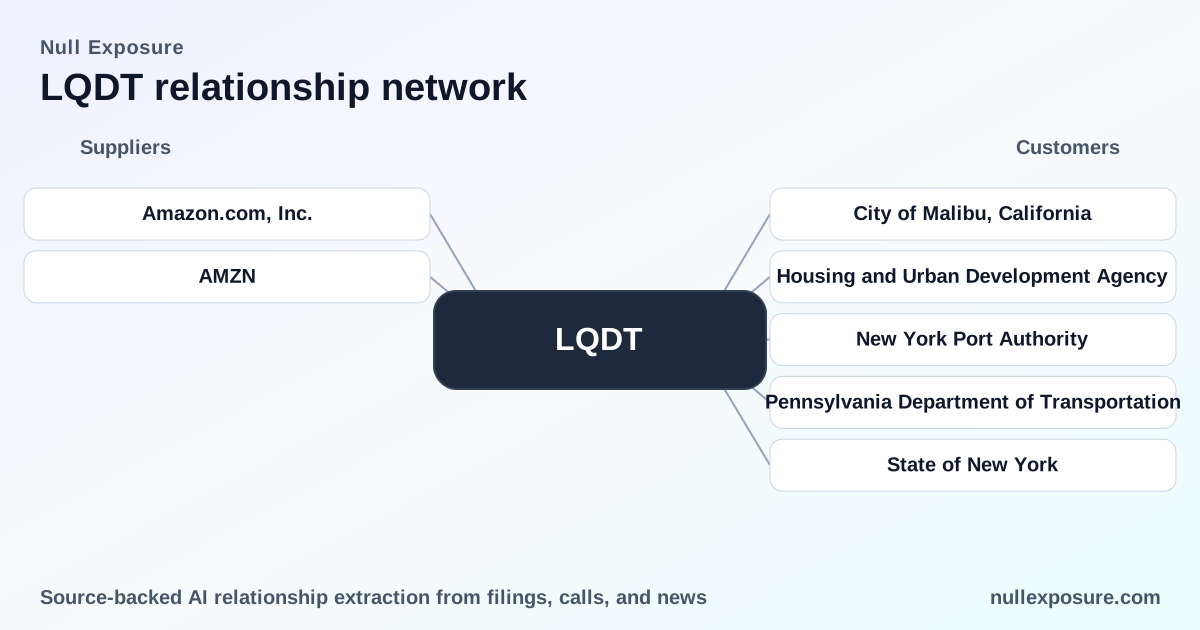
State of New York
Liquidity Services listed the State of New York among over 500 new agency clients acquired through GovDeals in FY2026. According to an earnings call transcript published on InsiderMonkey on March 10, 2026, this was called out as part of an all-time record of new agency wins.
City of Malibu, California
The City of Malibu, California was named on the same FY2026 call as one of the municipal agency clients added to GovDeals’ roster, reflecting local government adoption of the platform (InsiderMonkey, March 10, 2026).
Housing and Urban Development Agency
Liquidity Services specifically cited the Housing and Urban Development Agency among recent agency client additions, highlighting expansion into federal or federally-affiliated housing agency asset flows (InsiderMonkey, March 10, 2026).
New York Port Authority
The New York Port Authority was listed on the March 2026 earnings transcript as a new agency client acquired by GovDeals, indicating adoption by major transportation authorities (InsiderMonkey, March 10, 2026).
Pennsylvania Department of Transportation
The Pennsylvania Department of Transportation was included among the more than 500 new agency clients disclosed on the March 10, 2026 call, showing state transportation agencies are part of GovDeals’ growth vector (InsiderMonkey, March 10, 2026).
New York Port Authority Agency (Investing.com transcript)
The Q1 FY2026 transcript republished by Investing.com on May 3, 2026 also referenced the New York Port Authority Agency as part of GovDeals’ record agency additions that helped drive 7% GMV growth for the GovDeals segment.
Pennsylvania Department of Transportation (Investing.com transcript)
Investing.com’s May 3, 2026 transcript repeated the mention of the Pennsylvania Department of Transportation, confirming the state DOT win across multiple call transcriptions and media outlets.
State of New York Housing and Urban Development Agency (Investing.com transcript)
Investing.com’s May 3, 2026 coverage echoed the company’s call that included the State of New York Housing and Urban Development Agency among large agency additions fueling GovDeals’ momentum.
City of Malibu, California (Investing.com transcript)
The City of Malibu, California was again listed in the Investing.com transcript as one of the municipal clients contributing to GovDeals’ seller acquisition and market-share expansion in Q1 FY2026.
(Note: each of the above entries derives from Liquidity Services’ public remarks on Q1 FY2026; the March 10, 2026 transcript is hosted by InsiderMonkey and the May 3, 2026 transcript was republished on Investing.com.)
What these wins imply about product-market fit and risk
The named client list underscores several strategic conclusions:
- Product-market fit with public agencies: High-volume, varied government clients — from municipal (Malibu) to state DOTs and major port authorities — validate GovDeals as the standard channel for public-sector surplus disposal.
- Scale benefits for buyer liquidity: Adding over 500 agencies increases asset supply to buyers across the platform, supporting higher GMV and fee capture without proportionate incremental customer acquisition costs.
- Concentration nuance: While consolidated revenue exposure to any single customer is typically immaterial, the presence of a single RSCG customer that accounted for ~13% of revenue (fiscal years ended 2025 and 2024) is a company-level concentration risk to monitor; it is not tied to any specific agency named above in public excerpts.
- Diversifying revenue with software: The January 31, 2025 acquisition of Auction Software and the creation of a Software Solutions segment shift contracting posture toward subscription and private-label SaaS, improving revenue durability over time.
How investors should read the customer disclosures
Liquidity Services’ public client list provides clear evidence of GovDeals’ growth in government verticals, reinforcing the company’s thesis of monetizing scale in a fragmented surplus market while layering recurring software revenue. For portfolio managers and operators, focus on:
- Monitoring RSCG customer concentration in quarterly filings.
- Tracking SaaS revenue growth stemming from the Software Solutions segment (post-Auction Software acquisition).
- Watching GMV growth in GovDeals and buyer engagement metrics, which directly correlate to fee income.
For analysts seeking ongoing coverage and up-to-date signals on customer relationships, visit https://nullexposure.com/ for structured research and relationship monitoring.
Bottom line
Liquidity Services is executing a dual-path revenue strategy: marketplace GMV growth driven by government and commercial sellers, plus an emerging subscription-based software arm. The recent disclosure of more than 500 agency client additions — including the State of New York, Pennsylvania DOT, New York Port Authority, HUD, and the City of Malibu — demonstrates tangible traction in public-sector channels that feed transaction volume and platform liquidity. Investors should weigh the favorable scale dynamics against the segment-level concentration noted in RSCG disclosures and track the software segment’s progression toward recurring revenue.