Lead Real Estate (LRE): Customer relationships that move the balance sheet
Lead Real Estate Co., Ltd. operates as an integrated developer and manager of residential and commercial real estate, monetizing through property development sales, recurring rental income from operated assets, and selective asset dispositions that crystallize value. The company’s revenue mix blends steady operating cash flow with periodic portfolio rotations, and recent customer activity—chiefly institutional asset purchases—illustrates a monetization model that leverages development expertise to generate near-term cash and long-term operating yields. For investor due diligence on customer counterparty risk and commercial traction, LRE’s closed transactions and buyer mix are the most direct signals of demand and liquidity.
Explore more on portfolio-level customer intelligence at https://nullexposure.com/.
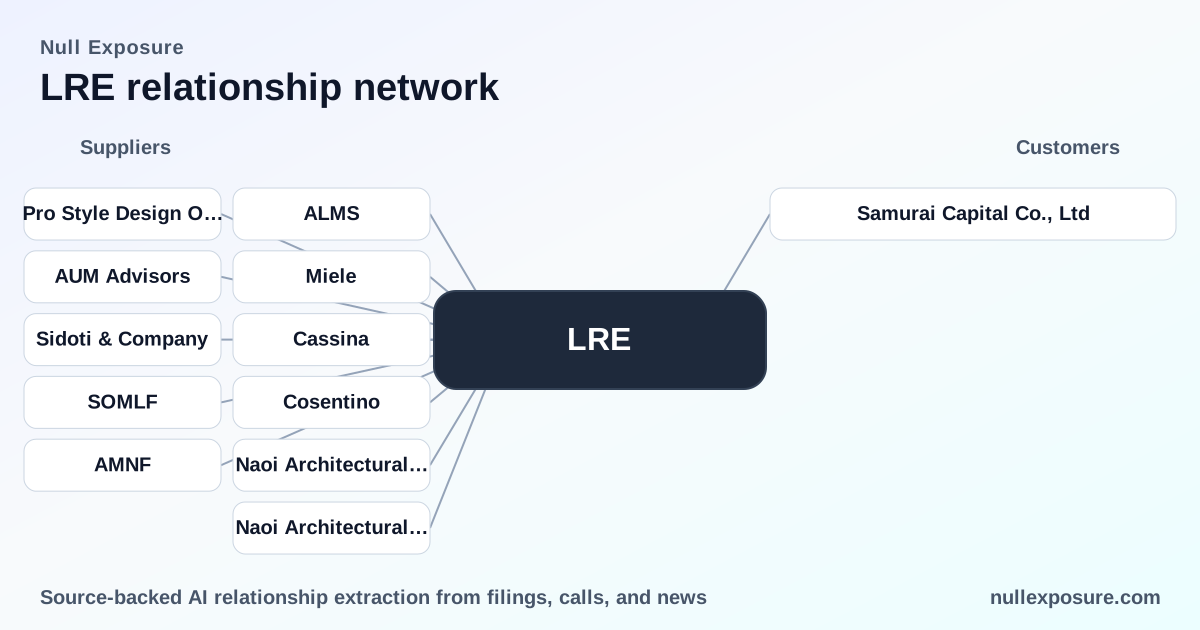
A discrete customer relationship: Samurai Capital bought retail assets from LRE
Lead Real Estate sold two long-stay hotels and concluded trust beneficiary right purchase agreements for two condominiums to Samurai Capital Co., Ltd. in June 2025, signaling the company is actively converting developed assets into cash and transferring rental/ownership rights to institutional buyers. This transaction was announced in a company press release distributed via GlobeNewswire on August 4, 2025. (GlobeNewswire, Aug 4, 2025)
Why this single relationship matters to investors
The Samurai Capital transaction is not merely a one-off sale; it is a live example of how LRE executes its monetization playbook. Selling long-stay hotel assets and trust beneficiary rights converts inventory into liquidity, reduces development cycle risk, and reallocates capital toward new projects or balance-sheet stabilization. Institutional buyers like Samurai validate LRE’s underwriting and provide immediate cashflow relief, supporting working capital and potentially boosting reinvestment ability.
Operating-model signals investors should weigh
Evaluate LRE through four practical operating lenses rather than isolated metrics:
- Contracting posture: LRE executes a mix of direct sales and trust-beneficiary transfers, indicating a flexible contracting posture that accommodates both outright disposals and structured transfers of economic interest. This flexibility reduces execution friction when institutional counterparties prefer different legal wrappers.
- Concentration: Institutional buyers are present but not yet widespread; the observed Samurai deal illustrates selective concentration—when LRE sells to a named institutional buyer, the counterparty is likely to be material for the particular asset pool sold but not yet a systemic single-buyer dependency for the company overall.
- Criticality: Asset sales to investors are operationally critical for cash generation and working capital management, especially in periods where development cycle timing and capital recycling determine growth. These transactions are central levers in the company’s liquidity toolkit.
- Maturity: The company’s approach—mixing development, operating assets, and portfolio rotations—signals a mature operating model with multiple monetization vectors rather than a pure speculative developer stance.
These are company-level signals drawn from LRE’s operating pattern; they are not specific attributions to any one buyer unless explicitly noted in filings.
Financial context that frames customer actions
Lead Real Estate’s scale and profitability provide context for its customer dealings. Revenue TTM is ¥18.84 billion with gross profit of ¥3.73 billion and operating margin around 15%, while return on equity registers at 18.3%, indicating that asset sales are additive to an already profitable core business. The market capitalization (¥17.67 million in the provided view) and high insider ownership (about 90% insider stake) imply concentrated shareholder control and potential governance implications for deal-making and cash allocation. LRE trades at a low trailing P/E (3.3x) and EV/EBITDA of ~8.5x, suggesting the market prices the combination of asset risk and steady earnings conservatively.
Relationship-by-relationship detail (complete coverage)
Samurai Capital Co., Ltd.: Lead Real Estate sold the long-term stay hotels “Ent Terrace Akihabara” and “Ent Terrace Asakusa”, and entered trust beneficiary right purchase agreements for two condominiums—“Excelsior Shakujii-Koen” and “Excelsior Yokohama Enokicho”—in June 2025; the sale and agreements were publicly announced in August 2025 via GlobeNewswire. (GlobeNewswire, Aug 4, 2025)
Key risks and upside drivers for investors
- Risk — Concentrated insider ownership: With insiders controlling roughly 90% of shares, minority liquidity and governance dynamics are relevant; strategic customer deals could be influenced by insider priorities.
- Risk — Buyer concentration per-transaction: While institutional buyers provide liquidity, dependence on a narrow set of counterparties for large disposals could compress negotiating leverage.
- Upside — Proven exit channels: Regular asset sales to institutional buyers demonstrate repeatable exit routes that lower execution risk for developments and support quicker capital recycling.
- Upside — Operational profitability: Solid margins and ROE indicate that asset dispositions are additive rather than compensatory for weak operations.
How to monitor for changes that matter
Investors should watch for three concrete signals that will change the investment thesis:
- Frequency and size of institutional disposals (more frequent large sales imply improved liquidity and faster growth conversion).
- Shifts in buyer diversity (greater buyer breadth reduces counterparty concentration risk).
- Any changes in insider ownership or governance actions that alter capital allocation priorities.
For ongoing tracking of LRE’s commercial counterparties and customer signals, visit https://nullexposure.com/.
Bottom line: Customer flows validate a conservative monetization play
Lead Real Estate’s engagement with Samurai Capital illustrates a pragmatic balance: active asset disposal to institutional buyers for liquidity, plus operating income from remaining assets, which together define the company’s monetization engine. Investors should treat these customer relationships as leading indicators of cash generation and execution risk—when LRE sells assets to reputable institutional buyers, it both crystallizes development value and demonstrates market demand for its product. Watch transaction cadence, buyer diversity, and governance signals to refine exposure over the next reporting cycles.