Stride Inc (LRN) — Customer Relationships and Contract Dynamics Investors Should Know
Stride, Inc. operates a mixed model of school-as-a-service, licensed curriculum and consumer-facing online education products, monetizing through long-duration contracts with school operators and per-student funding, recurring subscription/licensing fees, and services revenue for managed schools and virtual programs. The company captures predictable cash flow from multi-year government and charter relationships while supplementing revenue with direct-to-consumer and employer programs that carry higher margin variability.
If you want a concise commercial view of Stride’s partner ecosystem, see the company briefing on our homepage: NullExposure.
How Stride’s contracting posture shapes revenue quality and risk
Stride’s commercial model combines several contract archetypes that produce distinct cash-flow characteristics and risk exposures. Long-term, renewable school-management agreements provide the backbone of recurring revenue, while licensing and subscription deals broaden reach into direct consumers and employers.
Key operating constraints and what they signal about the business:
- Long-term orientation: The company reports average agreements for its school-as-a-service offering exceed five years with automatic renewals, which drives revenue visibility and lowers churn-linked volatility.
- Usage-based funding: Many public virtual and charter schools fund operations on a per-student basis, so Stride’s topline is directly linked to enrollment and state funding policies.
- Subscription and licensing: Stride sells both subscription services to schools and licenses of software and curriculum to individuals and institutions, diversifying monetization across services and software segments.
- Service-provider guarantees: Stride sometimes guarantees no operating deficits for schools it manages, creating contractual downside if enrollment or state funding declines.
- Client mix: The customer base includes government entities, not-for-profit charter organizations, and individual consumers, concentrating exposure on public funding cycles but reducing dependency on any single corporate buyer.
- Geography: Primary operations are U.S.-centric, but products are designed to operate globally, giving the company optionality for international expansion.
- Concentration signal: No single contract represented greater than 10% of revenue in recent years, indicating low customer concentration at the company level.
These constraints collectively explain why Stride presents as a capital-efficient, recurring-revenue education operator with exposure to enrollment cycles and policy risk rather than the idiosyncratic customer concentration seen in some SaaS plays.
Customer relationships in the news — the entities and what happened
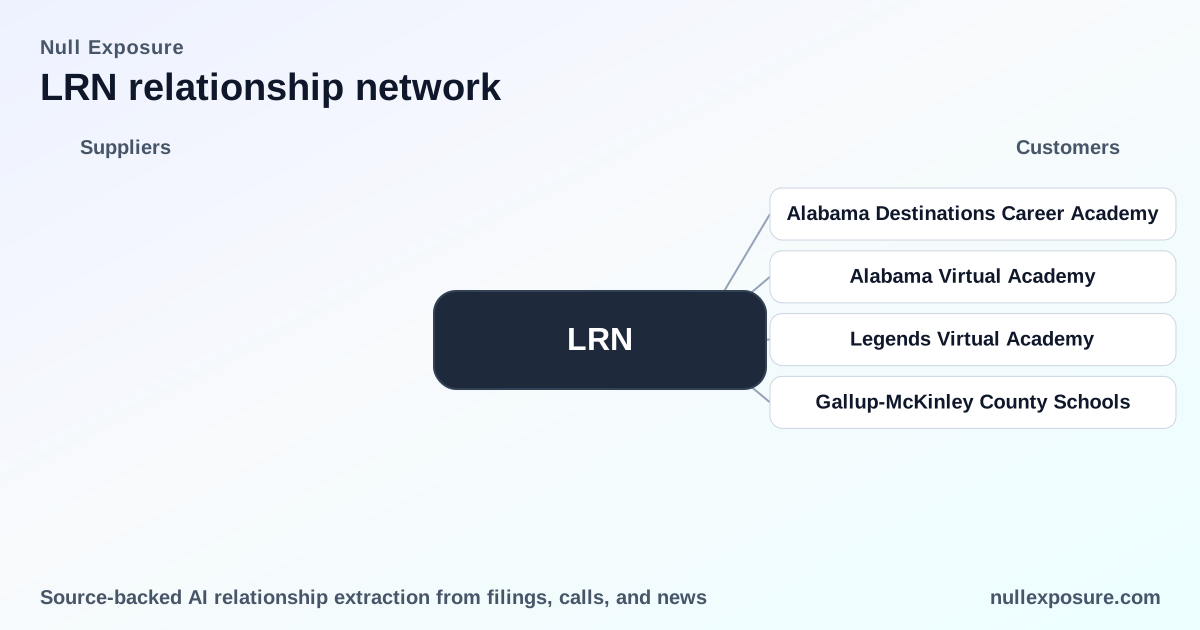
Gallup-McKinley County Schools
Stride resolved a longstanding contract dispute and renewed a modified partnership running through June 2026, which includes a framework for the company to provide defined tutoring services to the district. This resolution restores clarity to a previously contentious relationship and reduces litigation and customer-retention uncertainty. According to Simply Wall St coverage in May 2026 and a SahmCapital note in March 2026, the renewal addresses prior contract frictions and confirms service scope through FY2026. (Simply Wall St, May 2026; SahmCapital, March 2026)
Alabama Destinations Career Academy (ALDCA)
ALDCA is described as powered by K12, a Stride portfolio brand, and leverages Stride’s online curriculum and certified teachers to deliver flexible career-focused virtual public education. The announcement positions ALDCA as a growth channel for Stride’s Career Learning segment in Alabama for FY2026. (GlobeNewswire via Manila Times, March 2026)
Alabama Virtual Academy (ALVA)
ALVA is identified as a K12-powered school benefiting from 25 years of online learning expertise, indicating Stride’s continuing role as content and platform provider for state-level virtual public schools. The reference in March 2026 highlights the value of brand and curriculum experience the company leverages in public-school partnerships. (GlobeNewswire via Manila Times, March 2026)
Legends Virtual Academy (LVA)
Legends Virtual Academy likewise operates as a K12-powered virtual school relying on Stride’s curriculum and systems to serve students in Alabama, underscoring the company’s strategy of powering multiple state-backed virtual schools concurrently. This expands Stride’s footprint in state partnerships and reinforces recurring revenue streams tied to per-student funding. (GlobeNewswire via Manila Times, March 2026)
What these relationships reveal about Stride’s commercial execution
The portfolio of relationships shown in the recent coverage exposes several tangible business dynamics:
- Active and renewing engagements dominate: Public reporting lists dozens of active managed schools across multiple states, and the Gallup-McKinley resolution demonstrates Stride’s ability to retain and renegotiate institutional partners rather than exit.
- Revenue tied to enrollment and public funding: The Alabama virtual schools and career academy are funded by state mechanisms and operate under K12/Stride curriculum, reinforcing the usage-based and policy-sensitive nature of revenue.
- Low single-customer dependency: Company-level disclosures state no contract exceeded 10% of revenue in recent fiscal years, a structural strength that reduces idiosyncratic counterparty risk despite the political and regulatory exposure inherent to public education contracts.
- Service guarantees create downside exposure: Contractual commitments to avoid school operating deficits mean Stride can be financially responsible for underperformance at managed schools, creating contingent liabilities that investors must monitor.
Financial context and investor implications
Stride reported trailing revenues of approximately $2.54 billion with an EBITDA of about $519 million and operating margin north of 20% (TTM), signaling profitability tied to scale and recurring contracts. Its low beta and strong returns on equity reflect a steady cash-generating business insulated from cyclical consumer swings but exposed to enrollment and policy shifts.
For investors, translate the contract signals into monitoring priorities:
- Track enrollment trends and state funding changes that drive usage-based revenue.
- Watch renewals and dispute resolutions (like Gallup-McKinley) as indicators of client retention and contract renegotiation terms.
- Monitor any increase in guarantees or deficit-cover arrangements, which can compress margins if multiple schools underperform simultaneously.
- Consider the balance between high-visibility, long-duration school-as-a-service revenue and more elastic consumer/licensing revenue that affects near-term EPS volatility.
If you want a single-stop briefing on Stride’s customer exposure and contract posture, visit NullExposure for the full investor-facing dossier.
Bottom line: durable recurring revenue with policy sensitivity
Stride’s model delivers durable, contractually anchored revenue through multi-year managed school arrangements and licensed curriculum, while its usage-based exposure ties growth directly to student enrollment and public funding. Recent resolutions and the launch of K12-powered Alabama programs illustrate both the company’s ability to retain institutional partners and its continued expansion in virtual public education — outcomes that preserve revenue visibility but require active monitoring of state-level policy and enrollment dynamics.