LSF Customer Landscape: distribution footprint, DTC strength, and what it means for investors
Laird Superfood (LSF) is a branded consumer foods business that monetizes through three complementary channels: retail placement in mass and natural grocers, third‑party distribution to foodservice and specialty retailers, and direct‑to‑consumer (DTC) e‑commerce—where subscriptions and repeat buyers are a core profit driver. The company’s model relies on a hybrid go‑to‑market posture: national retail shelf coverage via partners, channel amplification through distributors, and higher‑margin recurring revenue through its own web storefront and Amazon presence. For a concise commercial view and dataset cross‑checks visit https://nullexposure.com/.
Retail, distributors and e‑commerce — the practical map of buyers
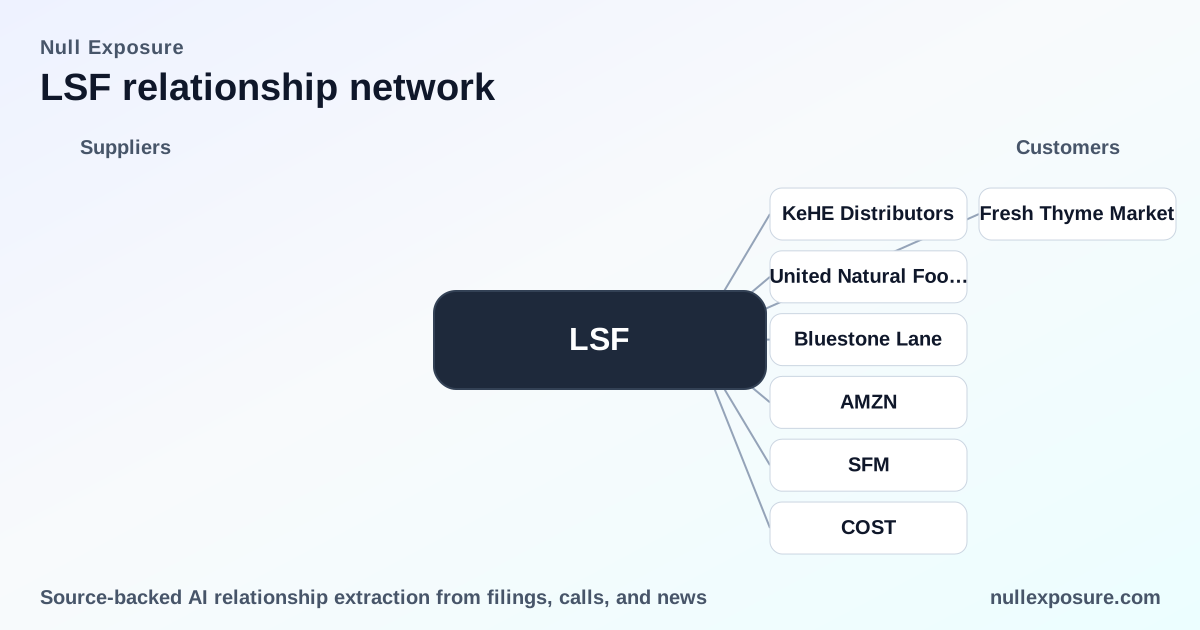
Below I list every counterparty referenced in public filings and recent press for Laird Superfood, with a short, plain‑English description and the supporting source for each relationship.
-
KeHE Distributors — LSF sells a meaningful portion of its products through KeHE as a national natural foods distributor, which helps place the brand in specialty and independent stores. According to Laird Superfood’s FY2024 10‑K, KeHE is named among the distributors used to reach retail partners. (FY2024 10‑K filing)
-
United Natural Foods, Inc. (UNFI) — UNFI is identified as a key distributor used by LSF to reach natural and specialty grocery accounts, a channel that supports broad shelf placement beyond direct supplier relationships. The FY2024 10‑K explicitly lists United Natural Foods among its distributor partners. (FY2024 10‑K filing)
-
Amazon (Amazon.com / AMZN) — Amazon functions as both a marketplace reseller (including Fulfilled‑by‑Amazon logistics) and a growth channel that partially offsets softness in DTC; LSF repeatedly confirms product launches and ongoing availability on Amazon across 2023–2026 press releases. PR Newswire and company announcements detail Amazon availability for new SKUs (Maca Instant Latte, Hydrate mixes, protein coffee), and FY2025 commentary notes Amazon growth partially offsetting direct‑to‑consumer softness. (PR Newswire releases, Dec 2025 press statements; trading commentary Q4/FY2025)
-
Costco (COST) — Costco is called out as a major retail partner where LSF places core SKUs, and the company announced expanded Costco availability in a March 2026 press release describing broader U.S. regional distribution. (PR Newswire, March 2026; FY2024 10‑K reference)
-
Bluestone Lane — LSF executed a branded partnership to supply functional mushroom latte drinks to Bluestone Lane café locations, enabling on‑premise product exposure at more than 50 U.S. cafés. The arrangement is described in a March 2026 PR Newswire release announcing the partnership. (PR Newswire, March 2026)
-
Sprouts Farmers Market (SFM) — LSF has introduced new Protein Coffee SKUs into Sprouts and flags Sprouts as an early retail roll‑out for that product line, reflecting crossover into natural‑format mainstream grocers. Coverage appears in FoodEngineering and Prepared Foods stories in early 2026. (FoodEngineering and Prepared Foods, March–May 2026)
-
Sprouts (alternate mentions / SFM) — Media summaries and investor notes repeat Sprouts as a target retailer for distribution gains following the Navitas acquisition, cited in LSF financial commentaries. (Investor/press notes summarizing Q4 and FY2025 results, May 2026)
-
Fresh Thyme Market — LSF plans to roll new functional mushroom powders into Fresh Thyme Market as part of a phased retail rollout after initial Amazon and direct launches. (FoodBev coverage, March 2026)
-
Whole Foods — Whole Foods is referenced in investor communications as a complementary retail target tied to distribution gains from the Navitas acquisition, suggesting expanded penetration in premium natural channels. (Intellectia investor note and May 2026 financial commentary)
Each of these relationships is documented either in LSF’s FY2024 10‑K or in company press and sector reporting across late 2025 and early 2026, which together trace a deliberate distribution strategy spanning wholesale, retail, café partnerships, and online marketplaces.
How these relationships map to LSF’s operating constraints
LSF’s go‑to‑market structure generates distinct operating characteristics that investors and operators should track:
-
Contracting posture and channel mix: LSF operates with a mix of distributor agreements and reseller flows—distributors (UNFI, KeHE) supply retail partners, while Amazon acts as a reseller using FBA logistics. These are commercial, broadly non‑exclusive relationships that emphasize distribution breadth rather than tight bilateral contracts. (Company 10‑K excerpts)
-
Revenue concentration and criticality: The company reports substantial revenue through a small set of retail and online channels—Costco, Amazon, and major natural retailers—so partner performance materially affects top‑line volatility. The FY2024 10‑K explicitly lists Costco and the two named distributors as core conduits to consumers. (FY2024 10‑K filing)
-
DTC maturity and subscription economics: Subscriptions are a material retention engine for LSF’s DTC business—company disclosures show subscriptions accounted for a majority of DTC net sales in 2023–2024 (52% and 55% respectively), and over 80% of DTC net sales came from subscribers or repeat buyers. This produces higher lifetime value per acquisition versus one‑off retail sales and reduces churn‑driven revenue swings. (Company financial disclosures, FY2024 10‑K)
-
Geographic concentration: LSF’s sales are predominantly U.S. domestic, with the company focused on the U.S. natural and functional foods market; this limits currency and international market risk but concentrates exposure to U.S. retail trends and foodservice demand. (Company disclosures)
-
Relationship stage and product focus: Most relationships are active and tactical—press launches and retailer rollouts in 2025–2026 show continuous SKU introductions (mushroom powders, protein coffee) and retail expansion, implying an active commercialization phase rather than legacy, mature shelf placements. (Press releases and media coverage, 2025–2026)
For a consolidated analytical feed and to compare these counterparty exposures across peer brands, see https://nullexposure.com/.
Strategic implications and investor takeaways
-
Upside from channel expansion: National rollouts at Costco, Sprouts, Fresh Thyme and café partnerships with Bluestone Lane increase penetration into both value and premium channels, which should lift baseline distribution and incremental SKU velocity as Navitas integration yields overlapping retail access. (Company press and investor commentary, 2025–2026)
-
Operational risk concentrated in retail and e‑commerce: Given the high share of revenue through a handful of channels and DTC subscription reliance, any disruption with Amazon logistics, a major retailer delisting, or deterioration in subscription economics would compress free cash flow quickly. (Company 10‑K and FY2025 trading commentary)
-
Distributor dependence shapes margin levers: Use of UNFI and KeHE supports shelf gain but embeds distributor margins and promotional cadence into LSF’s P&L; managing trade spend and working capital with these partners is a primary operational lever.
-
Domestic focus simplifies near‑term forecasting: The U.S. concentration reduces FX and international supply complexity, enabling investors to model growth from domestic assortment expansion and subscription retention improvements more directly.
Bottom line
Laird Superfood has stitched together a multi‑channel commercial engine—distributors and big‑box retail for scale, Amazon for discovery and logistics, and a subscription‑heavy DTC channel for margin and retention. The company’s future EBITDA trajectory depends on converting press rollouts into repeat in‑store velocity while sustaining DTC subscription economics. Monitor distributor inventory flows, Amazon placement dynamics, and the cadence of new SKU placements at Costco, Sprouts, Fresh Thyme, and Whole Foods for the clearest near‑term signal of durable growth.
For a structured view of LSF’s partner exposures and comparative counters across the consumer foods sector, visit https://nullexposure.com/.