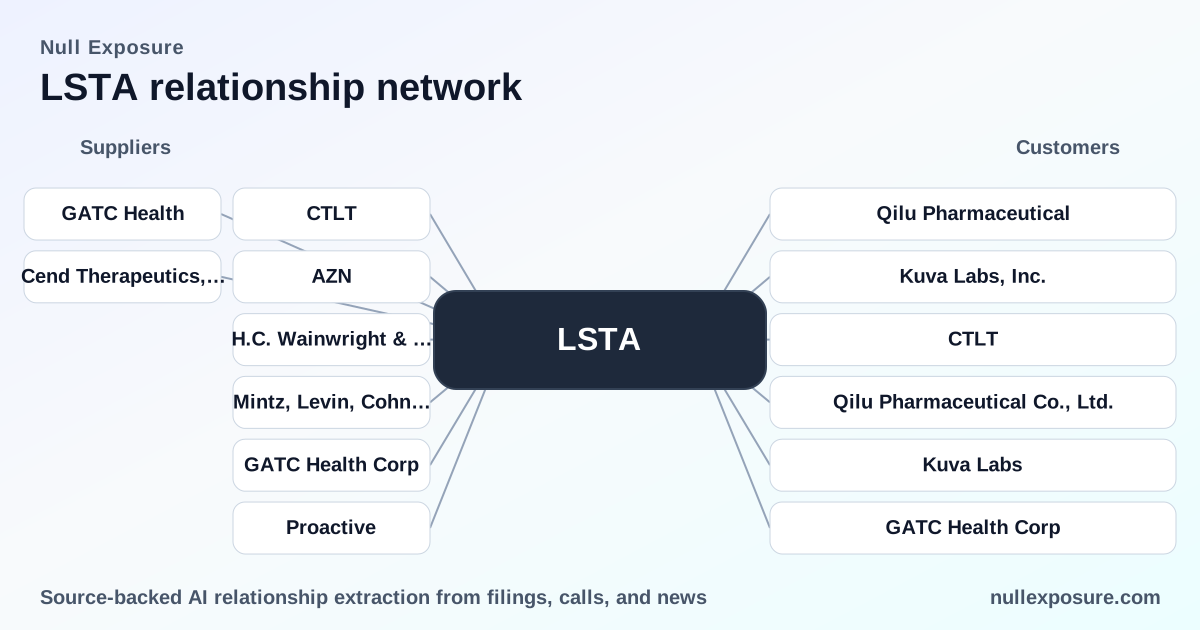
Lisata Therapeutics (LSTA): Licensing-first commercial relationships reshape value capture
Lisata Therapeutics operates as a clinical-stage biotech that monetizes primarily through out‑licenses of its lead targeting peptide, certepetide, and strategic collaborations rather than product sales today. The company captures value via upfront and milestone payments, targeted supply obligations, and contingent value rights tied to development and regulatory events; these commercial linkages—across North America and Greater China—are the core drivers of near‑term cash flow and the key determinants of enterprise value. For a concise overview of Lisata’s external relationship map and commercial posture, see https://nullexposure.com/.
How Lisata contracts and where value sits
Lisata’s operating model is licensing and partnering-first: the company develops a proprietary iRGD cyclic peptide (certepetide) and then monetizes it by granting both exclusive and non‑exclusive rights to third parties for therapeutic and imaging applications. This contracting posture produces several structural characteristics investors should treat as primary inputs:
- Revenue concentration by contract: material uplifts (for example a reported $10.0 million upfront under a prior agreement and a $1.0 million license fee recognized in 2024) come from discrete license agreements rather than recurring product streams, creating lumpiness and event-driven valuation inflection points.
- Geographic segmentation: Lisata’s rights have been carved geographically—Greater China was subject to an exclusive license, while North American licensing and supply arrangements support NA revenue recognition—so APAC and NA are complementary revenue channels embedded in the company’s commercialization design.
- Counterparty risk and role: partners act as licensees and development operators; Lisata’s position is typically supplier and licensor, not the primary developer or commercial lead for many indication/license pairs.
- Maturity and criticality: relationships range from early preclinical evaluation (Catalent ADC work) to clinical development collaborations (Qilu’s pancreatic cancer program), so counterparty importance varies by stage and by whether Lisata retains supply obligations or receives milestone/CVR economics.
These features make Lisata a small-cap, partner‑dependent biotech where near‑term returns and downside are both concentrated in a handful of licensing relationships.
Customer and partner relationships you need to know
Below I cover every partner relationship surfaced in Lisata’s customer results, with succinct plain-English summaries and source references.
Qilu Pharmaceutical Co., Ltd. — Greater China licensee turned reverted rights
Lisata historically granted Qilu an exclusive license for development and commercialization of certepetide in Greater China; Qilu ran a parallel development program combining certepetide with gemcitabine and nab‑paclitaxel for metastatic pancreatic cancer, and Lisata and Qilu mutually terminated that license in January 2026, returning regional rights to Lisata. According to Lisata’s press release via GlobeNewswire (Jan 27, 2026) and Lisata’s Q3 2025 disclosures, Qilu was the named licensee for the territory and had active clinical work prior to termination.
Source: GlobeNewswire press release (Jan 27, 2026) and Lisata Q3 2025 investor communications.
Kuva Labs, Inc. — Licensee for imaging platform and proposed acquirer
Kuva licensed certepetide for use with its NanoMark™ MR‑imaging platform (Lisata is responsible for supplying certepetide while Kuva assumes R&D and commercialization costs), and Lisata recorded $1.0 million of license revenue upon delivery in November 2024; later, Lisata entered a term sheet for an all‑cash acquisition by Kuva at $4.00 per share plus two contingent value rights tied to Greater China reversion and regulatory filings. Multiple company filings and press notices document the license, the $1.0 million recognition, and the acquisition term sheet. More recently, Kuva has sought alternative financing and a previously announced tender offer had not commenced as of the latest investor update.
Source: Lisata press releases (Dec 3, 2024 and Jan 21, 2026), company disclosures recognizing the $1.0 million 2024 license revenue, and investor news summaries (March–May 2026).
Catalent, Inc. (CTLT) — Global non‑exclusive ADC license and validation pathway
Lisata executed a non‑exclusive global license with Catalent that grants Catalent rights to evaluate certepetide and its analogs as SMARTag® payloads for antibody‑drug conjugates (ADCs). Catalent has reported positive preclinical data using Lisata’s peptide in ADC combinations, positioning certepetide as a non‑cytotoxic ADC payload candidate and validating an ADC commercialization pathway for Lisata’s core product. Lisata described the Catalent arrangement in its Q3 2025 earnings commentary and in a formal press release announcing the global ADC license.
Source: GlobeNewswire release (Oct–Nov 2025) and Lisata Q3 2025 earnings call.
GATC Health Corp — Strategic AI collaboration and operational partnership
Lisata entered a strategic collaboration with GATC Health to apply AI toward derisking and accelerating drug development, and the arrangement contemplates Lisata serving as an operational development partner for GATC’s own candidates. Lisata’s announcement (March 2025) frames this as a partnership that leverages Lisata’s development capabilities alongside AI tools.
Source: Lisata press release (Mar 5, 2025).
What the relationships imply about risk and upside
- Upside is event‑driven. The Catalent ADC program and Kuva imaging work create multiple optionality paths: validation by Catalent addresses a large ADC market, while Kuva’s NanoMark could unlock imaging revenue and acquisition premium dynamics. Catalent provides technical validation; Kuva is the nearest cash conversion event.
- Concentration and counterparty execution risk are material. A small set of licenses generate outsized revenue potential; termination or financing shortfalls at a single partner (for example Kuva financing delays) can materially change Lisata’s cash profile.
- Geographic and regulatory reversion mechanics matter. The Qilu termination returned Greater China rights to Lisata and triggered contingent value mechanics tied to CVRs in the Kuva term sheet—these contractual clauses drive future cash events and influence deal value realization.
- Capital structure and shareholder outcomes are tied to partner transactions. The proposed Kuva acquisition and CVR structure have prompted investor scrutiny and a law‑firm review of fairness questions, making the timing and structure of partner transactions a direct determinant of shareholder return.
Investment lens and next steps
For investors evaluating Lisata as a partner‑dependent biotech, focus on three near‑term monitors: (1) Catalent preclinical-to‑IND progress for ADC programs; (2) Kuva’s financing and completion of any tender offer or acquisition; (3) any re‑monetization events tied to Greater China rights and CVR triggers. These items will determine whether Lisata’s licensing model converts optionality into realized value.
If you want a deeper mapping of Lisata’s counterparty exposures and contract clauses, explore our coverage at https://nullexposure.com/ where we track partner milestones, revenue triggers, and geographic rights that drive small‑cap biotech valuations.
Bold, partner‑driven licensing remains Lisata’s operating center: investors should underwrite both the upside from validation deals and the execution risk stemming from a concentrated, contract‑based revenue model.