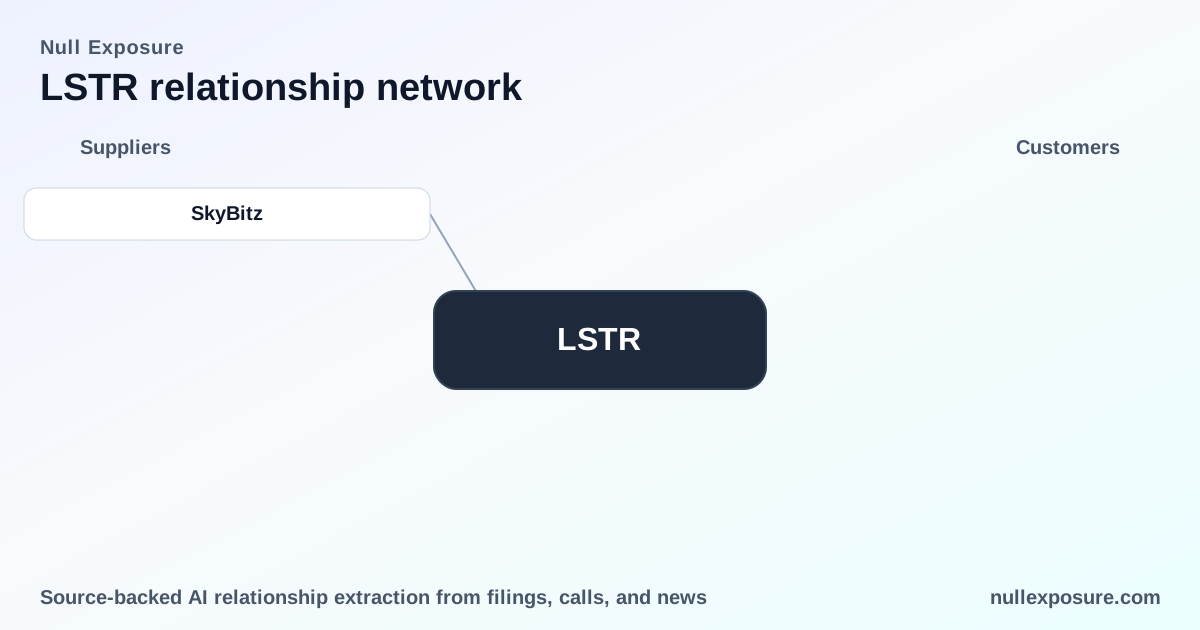
Landstar System (LSTR): Customer Relationships and the FAA Link that Matters
Landstar operates an asset-light, commission-driven transportation management network that monetizes by billing customers on a per‑shipment basis for freight transportation and related services, leveraging independent sales agents and third‑party capacity providers. The company's business converts network scale into recurring transportation revenue—roughly $4.8 billion in the most recent fiscal year—and extracts margin through brokerage-like pricing, equipment programs and agent commissions. For investors, the core thesis is simple: Landstar’s economics hinge on breadth of spot and contract freight, low capital ownership, and stable revenue recognition tied to transit performance. Learn more at https://nullexposure.com/.
Why the FAA relationship matters for portfolio risk and upside
Two separate news entries tie Landstar to the Federal Aviation Administration for emergency and contracted transportation services in FY2026. While the amounts cited are modest relative to consolidated revenue, the relationship is a strategic indicator: Landstar can secure government contracts for time‑sensitive logistics, demonstrating capability to serve specialized customers beyond the standard commercial freight mix. A government contract that is regularly executed can also provide episodic revenue spikes and reputational validation that supports pricing and agent retention.
What Landstar’s operating model signals about customer risk
Landstar’s disclosed constraints paint a clear profile of how the company sells and delivers services and the implications for customer relationships:
- Contracting posture: A substantial portion of truckload services is priced on the spot market and invoiced shipment-by-shipment, with typical payment terms of 30–60 days. That structure yields revenue flexibility but exposes margins to short-term rate volatility.
- Geographic concentration: Substantially all revenue is generated in North America, primarily the U.S., which concentrates demand and regulatory exposure geographically and aligns the business with North American economic cycles.
- Materiality and concentration: No single customer represented more than 10% of consolidated revenue in fiscal years 2022–2024 (an immaterial single‑customer concentration), yet the top 100 customers accounted for approximately 46% of revenue—meaning revenue is moderately concentrated among a broad set of repeat commercial customers.
- Criticality: Truck transportation services are critical to Landstar’s revenue (contributing roughly 90% of consolidated revenue), so operational disruptions in the brokerage or capacity network would have first‑order effects on top‑line performance.
- Role and segment: Landstar operates principally as a service provider in the integrated transportation solutions segment, utilizing third‑party capacity rather than owning fleet at scale; this reduces capital intensity but increases dependency on contractor capacity and partner adherence.
- Maturity and stage: The company presents as an established, active operator with mature revenue streams and agent networks—its revenue base and long-standing agent model imply predictable operational mechanics even in a spot-pricing environment.
Taken together, these signals form a balanced investment profile: low asset intensity and diversified client base mitigate large counterparty risk, while heavy reliance on spot pricing elevates margin cyclicality.
Relationship inventory: every customer mention in the results
Below are plain-English summaries of each relationship found in the review period; each entry is sourced to the original reporting.
-
Federal Aviation Administration — Landstar recorded $21 million of transportation revenue in the second quarter of FY2026 tied to services performed under a contract between Landstar Express America and the Federal Aviation Administration. This line item reflects a measurable, contractually driven revenue stream for emergency or government logistics in the quarter. Source: TruckingInfo report on Landstar’s record Q2 earnings (May 2026).
-
United States Federal Aviation Administration — A separate notice referenced emergency transportation services provided primarily under a contract between Landstar Express America Inc. and the United States Federal Aviation Administration during FY2026, underscoring the government services component of that quarter’s revenue. Source: TruckingInfo coverage of Landstar’s FY2026 quarter results (May 2026).
(These two entries report overlapping activity under FY2026 filings and press coverage; one highlights the specific $21 million revenue figure, the other emphasizes the service categorization as emergency transportation under the FAA contract.)
Investor implications: capital allocation, margin dynamics, and counterparty risk
- Revenue resilience and episodic government work. The FAA contracts illustrate Landstar’s ability to win short‑term, potentially higher‑priority assignments that deliver discrete revenue uplifts. For investors, this validates a diversified book that mixes commercial spot freight with occasional contract work.
- Rate sensitivity. Because a significant portion of revenue is spot priced, earnings and margins will fluctuate with freight market cycles, making forward EPS more sensitive to capacity tightness than pure asset‑heavy carriers.
- Customer concentration nuance. While no single customer is material (>10%), the fact that the top 100 customers generate roughly 46% of revenue indicates meaningful dependence on recurring shippers—monitor retention and churn among that cohort for indicators of revenue durability.
- Capital efficiency and operational leverage. The third‑party capacity model keeps capital expenditure low and supports strong returns on equity, but it transfers execution risk to contractors and agents; investors should watch contractor availability and cost pass‑through in high demand periods.
Key risks and what to watch next
- Watch freight rate trends and capacity tightness across North America; spot pricing drives quarter-to-quarter margin movement.
- Monitor retention among the top 100 customers and any changes in payment or contractual terms that would move revenue away from shipment-by-shipment invoicing.
- Track additional government contracts or emergency logistics assignments; accumulation of such work could shift Landstar’s revenue mix and support a higher premium if margins on that work are sustainable.
Bottom line and next steps
Landstar’s customer footprint in FY2026 includes measurable government contract work with the FAA, augmenting an otherwise diversified North American commercial customer base that is primarily spot-priced. The company’s asset-light, agent-driven model produces capital efficiency and scalable revenue, but investors must price in spot-rate cyclicality and moderate customer concentration within the top 100 accounts. For a deeper read on counterparty-level customer relationships and comparable logistics profiles, visit https://nullexposure.com/.
For tailored intelligence on how specific customer contracts influence credit and valuation dynamics, contact the research team at Null Exposure via the site above.