LTC Properties: operator concentration, contract depth, and what customers tell investors
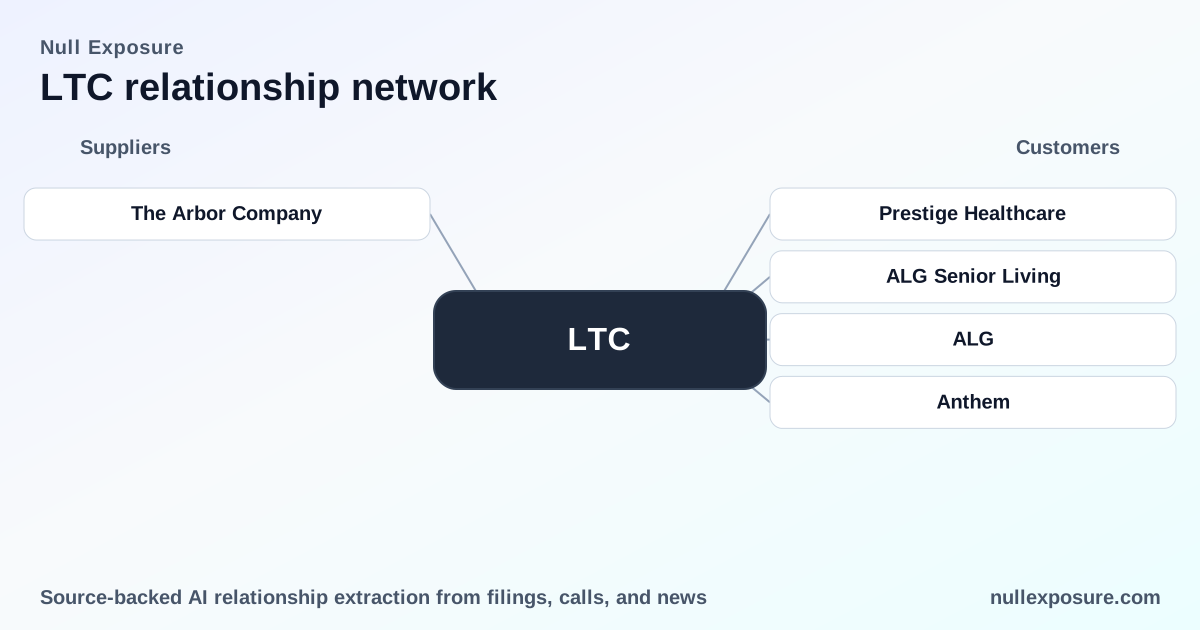
LTC Properties is a healthcare REIT that owns senior housing and skilled nursing real estate and monetizes through long-term operating leases, mortgage and mezzanine financings, joint ventures and structured equity. Revenue is driven primarily by lease rentals and interest income; LTC’s operator relationships therefore function as both revenue engines and counterparty credit lines. For investors, the critical questions are operator concentration, contract tenor and enforceability, and cash‑flow sensitivity to prepayments and lease amendments. Explore more at https://nullexposure.com/ for deeper relationship maps and filing-level context.
What the contract and relationship signals reveal about LTC’s operating model
LTC’s customer relationships reflect a classic landlord‑centric REIT posture: long-term, lease-dominated cash flows with embedded renewal options that provide durability, but with pockets of concentration and near-term re-pricing risk. Company disclosures show investments across 25 states and roughly 30 operators, indicating geographic diversification that tempers single-operator shocks. At the same time, LTC reports two operators supplying ≥10% of revenues and three operators producing ~31.3% of lease and interest income in 2024, creating meaningful revenue concentration.
Contract characteristics are predominantly long-term: master leases commonly run multiple years with two five‑year renewal options. That structure produces predictable rental receipts but also creates limited but material counterparty credit risk — evidenced by rent deferrals, lease amendments and occasional non‑renewals that require disposition or re-leasing. Collectively these signals position LTC as a long-term creditor/lessor whose earnings profile is stable but sensitive to operator operating performance and the timing of loan prepayments or purchase options.
The customer relationships — what each entry in the record says
ALG Senior Living (LTC 2024 Form 10‑K)
LTC identifies ALG Senior Living as one of two operators from whom it derives approximately 10% or more of total revenues, flagging it as a major operator in the portfolio. Source: LTC 2024 Form 10‑K (FY2024).
Prestige Healthcare (LTC 2024 Form 10‑K)
Prestige Healthcare is also listed as one of the two operators contributing ≈10%+ of revenues, underscoring operator concentration in LTC’s revenue base. Source: LTC 2024 Form 10‑K (FY2024).
ALG (InsiderMonkey earnings-call transcript, March 2026)
LTC management reported three to four separate investments with ALG and noted ALG has purchase options and is exploring alternative financing that is interest‑rate sensitive, suggesting potential timing of buyouts or refinancings around 2027. Source: InsiderMonkey transcript of LTC Q4 2025 earnings call (Mar 2026).
ALG (The Globe and Mail / Motley transcript, March 2026)
Management reiterated the three‑to‑four investments with ALG during the Q4 2025 earnings discussion, reinforcing ALG’s multi-asset exposure within LTC’s portfolio. Source: The Globe and Mail / Motley FOQ4 2025 earnings transcript (Mar 2026).
Prestige Healthcare (InsiderMonkey earnings-call transcript, March 2026)
LTC disclosed that Prestige delivered notice to prepay a $180 million loan that was yielding about 11%, an event that changes near-term interest income and redeployment timing for LTC. Source: InsiderMonkey transcript of LTC Q4 2025 earnings call (Mar 2026).
Prestige Healthcare (The Globe and Mail / Motley transcript, March 2026)
The public transcript confirms Prestige’s intent to prepay the $180 million facility around July 1, which crystallizes cash‑flow timing and interest income loss but also returns capital for redeployment. Source: The Globe and Mail / Motley Q4 2025 earnings transcript (Mar 2026).
Prestige Healthcare (Quartr event notes, May 2026)
Management commentary indicates projections that contractual interest due from Prestige will be received in 2025, supported by retroactive Medicaid payments and security deposits, signaling operational receipts that back scheduled cash flows. Source: Quartr Q4 2024 event notes (May 2026).
ALG Senior (Quartr event notes, May 2026)
LTC reported rent deferrals and lease amendments with ALG Senior through year‑end 2024, and that agreements included cross‑default and cross‑collateralization protections, which reduce downside but indicate operator stress that required restructuring. Source: Quartr Q2 2024 event notes (May 2026).
Anthem (The Globe and Mail / Motley transcript, March 2026)
Management noted that the cover on an Anthem portfolio was close to the rents being collected, implying limited upside but successful capture of expected cash flows on that set of assets. Source: The Globe and Mail / Motley Q4 2025 earnings transcript (Mar 2026).
How the constraints shape the investment thesis
- Contracting posture — defensive landlord profile. Long initial terms (2–10 years), master leases with multiple renewal options and repeated use of cross‑default/cross‑collateral language indicate LTC structures durable, enforceable cash flows rather than short-term operating leases.
- Concentration — credit and revenue risk clustered. Two operators account for ≥10% of revenues and three operators generate ~31.3% of lease and interest income for 2024, a concentration that creates idiosyncratic credit exposure that can move portfolio yields materially if one underperforms.
- Criticality — operator operations drive cash yield. Approximately 63% of revenue derives from operating lease rentals, so operator solvency and payer mix (e.g., Medicaid retro payments cited for Prestige) directly govern LTC’s earnings and distributable cash.
- Maturity mix — durable with localized churn. The existence of renewal exercises (one operator renewed through 2030) and one operator electing not to renew a master lease (portfolio maturing in Jan 2026) create a mixed maturity profile: steady long-term cash flows overall, with pockets of near-term re-leasing or disposition risk.
- Geographic diversification as mitigant. Investments across 25 states reduce single-state regulatory or payer shocks but do not eliminate counterparty concentration.
Investment implications and risk checklist
- Watch cash reflow timing: Prestige’s prepayment of a high‑yield loan and Medicaid retro payments materially change near-term interest receipts and redeployment needs.
- Monitor operator refinancing optionality: ALG’s purchase options and interest‑rate sensitivity create optionality that can accelerate asset sales or change yield realization timing.
- Assess concentration exposure: A three‑operator base representing ~31% of revenues requires focused credit surveillance and scenario analysis for concentrated defaults or non‑renewals.
- Contract enforcement matters: Lease amendments, rent deferrals and cross‑collateral clauses influence recovery assumptions and valuation under stress.
For investors and research teams building conviction, the combination of long-term lease structures and concentrated operator exposure makes LTC a classic yield play with asymmetric credit risk concentrated in a handful of counterparties. Further detail and filing-level linkage are available at https://nullexposure.com/.
Bottom line: what to track next
Prioritize monitoring operator cash collections, formal notices (prepayments or non‑renewals), and any changes in cross‑collateral or amendment activity. These events move valuation drivers faster than market multiples alone. For actionable tracking and filing‑level ties between operators, contracts and cash-flow outcomes, visit https://nullexposure.com/ for relationship maps and primary‑source references.