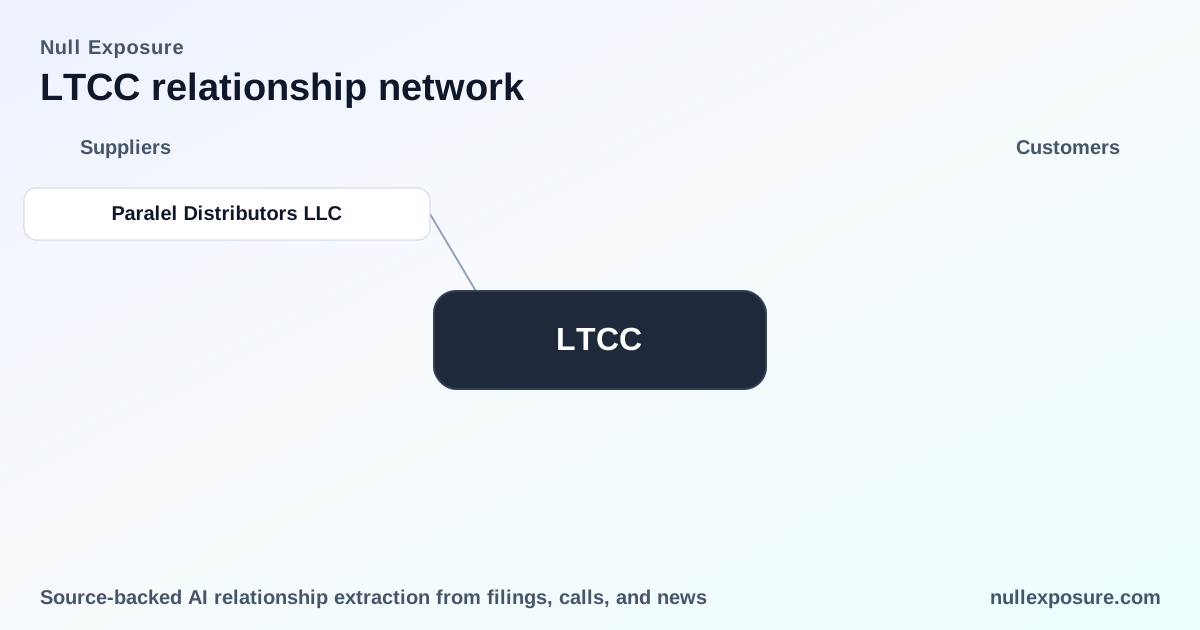
LTCC: Canary Capital’s ETF footprint and the customers that drive product distribution
LTCC operates as an ETF wrapper for Litecoin exposure under issuer Canary Capital Group LLC and monetizes through management and distribution fees tied to exchange-listed crypto products; revenue scale is a function of asset inflows into LTCC and Canary’s adjacent product slate plus strategic advisory and partnership mandates. Investors should treat LTCC not as a standalone cash flow engine but as a product node within a rapidly expanding boutique crypto-ETF franchise whose economics depend on product launches, distribution tie‑ups, and staking/yield integrations. For an overview of platform-level coverage and market signals, visit the Null Exposure research hub at https://nullexposure.com/.
Market-context snapshot
- Canary Capital has pushed beyond Bitcoin and Ethereum into a broader set of spot and staked crypto ETFs; those product launches are the primary customer-facing activity that drives LTCC’s monetization through fee capture and partner arrangements.
- Key value drivers: product adoption (AUM growth), cross‑sell into yield and staking products, and strategic advisory mandates that convert advisory fees into distribution or treasury deployment opportunities.
- Contracting posture and maturity: Canary’s model is transaction- and partnership-oriented — launches and strategic advisories reflect a growth-stage, product-first operator rather than a long-established diversified asset manager. That creates higher revenue volatility tied to issuance cycles and market liquidity.
Canary’s customer relationships — what matters for LTCC investors
Below I cover every customer/partner relationship surfaced in public reporting and explain their relevance to LTCC’s operating model and economics.
HBR — companion spot ETF for HBAR
Canary issued a companion spot HBAR ETF under the ticker HBR alongside LTCC as part of a broader product expansion that deliberately moves the issuer beyond Bitcoin and Ethereum-focused products. According to Yahoo Finance reporting in March 2026, LTCC and HBR were launched together as the first of their kind in the U.S. for these underlyings, signaling Canary’s strategy of simultaneous multi-asset listing to capture investor interest across niche tokens. (Yahoo Finance, Mar 10, 2026)
SOLC — Solana exposure and yield partnerships
Canary launched a Solana-focused ETF under the ticker SOLC oriented toward investors seeking both token exposure and yield-generation strategies, and the product stems from a partnership with Marinade Finance to integrate staking infrastructure. Benzinga and CoinCentral coverage describe the new Solana product as designed to capture growing investor interest in Solana and yield-enhanced crypto strategies, which indicates Canary is packaging on‑chain yield into ETF wrappers as a commercial differentiator. (Benzinga, reporting on Canary’s SOLC; CoinCentral, Mar 2026)
SUIS — staked SUI ETF and staking integration
Canary listed a staked SUI product on Nasdaq under the ticker SUIS that integrates on‑chain staking into an ETF vehicle, directly competing with other managers offering staking-enabled funds. Multiple industry outlets, including The Defiant and The Block in February–March 2026, reported Canary’s Canary Staked SUI ETF (SUIS) went live on Nasdaq, and coverage emphasized that the fund embeds staking rewards into its structure rather than simply holding spot SUI. This product type underscores Canary’s commercial bet that yield-bearing ETF features will attract incremental AUM. (The Defiant; The Block; Feb–Mar 2026)
Pineapple Financial (PAPL) — strategic advisory and treasury partnerships
Canary was appointed a strategic advisor to Pineapple Financial’s Digital Asset Treasury (DAT) program and is cited as a partner in Pineapple’s institutional infrastructure expansion and capital deployments into digital assets. Pineapple’s press releases and cross-posts in May 2026 confirm Canary’s advisory role and note that Pineapple deployed capital into digital assets and staking programs while expanding partnerships, which positions Canary as an advisor-to-client revenue channel in addition to ETF fees. (Newsfile/TradingView press release, May 3, 2026)
Business-model constraints and platform-level signals
There are no explicit contract-level constraints disclosed in the public relationship summaries provided, so the following are company-level signals derived from Canary’s product activity and partner set:
- Concentration and product dependence: Canary’s revenue profile for LTCC is concentrated around a small number of newly launched ETF products and a handful of advisory/treasury engagements. That concentration creates meaningful AUM and launch‑cycle sensitivity in the short term.
- Contracting posture: The operating model is partnership and distribution-centric — Canary forms alliances (e.g., Marinade, Pineapple) and lists multiple tickers simultaneously to broaden addressable market rather than locking long-term exclusive distribution deals.
- Criticality to customers: For partners like Pineapple and decentralized staking providers, Canary serves a combo role — product issuer + advisor + distribution conduit — which makes the relationship strategically important for both parties but still transactional in nature.
- Maturity: Product launches across FY2025–FY2026 categorize Canary as an early-stage but active entrant in the regulated ETF landscape; operating playbook focuses on first-mover product variety and staking integration rather than scale-driven fee compression.
Investment implications and risk vectors
- AUM/flow sensitivity: LTCC’s fee revenue will move with investor flows into Litecoin exposure and with overall appetite for altcoin ETFs; staked products (SUIS) add a second-order revenue driver through yield packaging but also introduce execution and custody complexity.
- Regulatory and custody risk: Launching spot and staking ETFs on regulated exchanges increases exposure to SEC interpretive changes and to custody/staking service provider performance; these factors are material to revenue continuity.
- Competition and margin pressure: Canary is entering direct competition with larger incumbents (e.g., Grayscale in staking ETFs) and must defend fee economics and distribution channels; product proliferation risks diluting AUM per ticker.
- Strategic advisory upside: Advisory roles (e.g., Pineapple) diversify revenue and create cross-sell pathways into treasury mandates, which supports higher-margin services and reduces pure AUM dependence if executed at scale.
Bottom line and tactical view
LTCC functions as part of Canary Capital’s boutique ETF portfolio; its economic outlook is driven less by standalone Litecoin fundamentals and more by Canary’s ability to win flows across a basket of niche spot and staked crypto products. Investors should monitor AUM trends for LTCC, flow patterns into companion tickers (HBR, SOLC, SUIS), and the evolution of advisory relationships like Pineapple for signs the business model is expanding beyond launch-driven revenue.
To track Canary’s product cadence and relationship developments, use Null Exposure’s coverage hub for periodic updates: https://nullexposure.com/.
Key takeaway: LTCC is a product in a product-led franchise — upside requires sustained inflows or successful conversion of advisory mandates into recurring fee streams; downside is concentrated flow volatility and regulatory/custody execution risk.