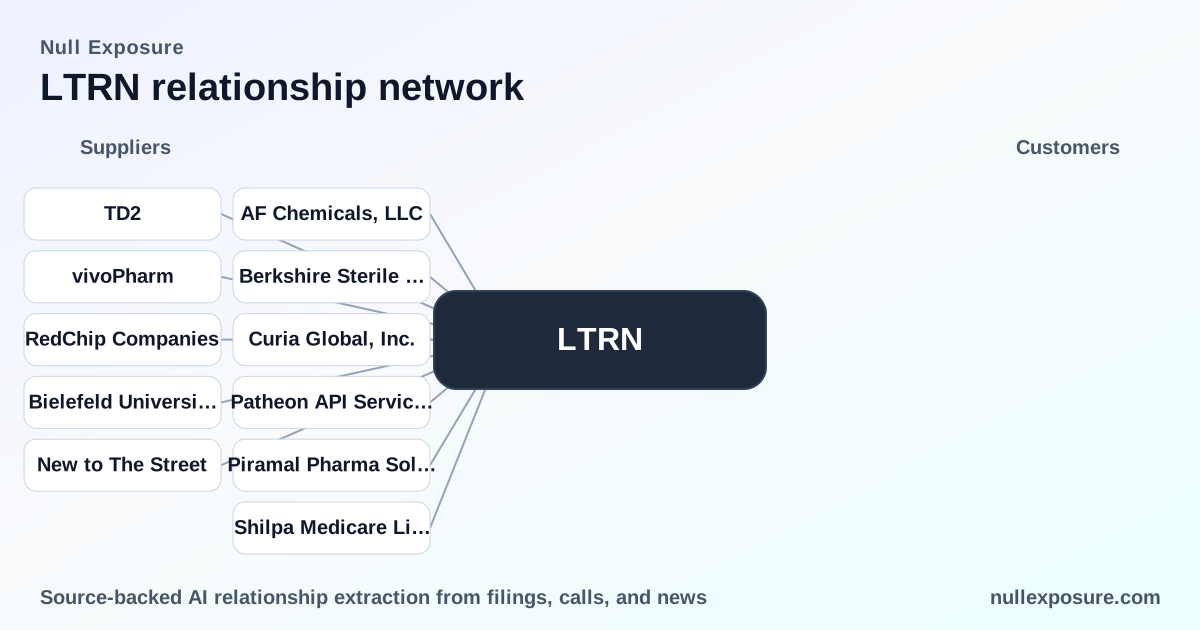
Lantern Pharma (LTRN) — Customer Relationships and Commercial Signals
Lantern Pharma is a clinical‑stage biotechnology company that combines AI, genomics and machine learning to accelerate oncology drug discovery and to license predictive models to third parties. The company monetizes through a hybrid model: co‑development and milestone/licensing deals for its AI platforms and lead programs, while remaining pre‑revenue on therapeutics to date (Revenue TTM = 0). Investors should treat Lantern as an asset‑light AI‑enabled drug developer whose commercial traction will be driven by licensing and partnership adoption of proprietary tools such as PredictBBB.ai. Explore more on our site.
How Lantern’s model translates into customer revenue potential
Lantern operates with two parallel value propositions. First, it develops small‑molecule oncology candidates using machine learning and genomics inputs; those candidates create traditional biotech upside through clinical milestones and out‑licenses. Second, its AI platforms (for example PredictBBB.ai) are positioned as high‑value, licensable tools for partner firms that need rapid, low‑cost prediction of pharmacological properties such as blood–brain barrier permeability. Given Revenue TTM = 0 and negative EBITDA, current valuation is tied to partnership expansion and successful clinical readouts rather than recurring product sales.
- Capital allocation and contracting posture: Lantern’s model drives IP‑centric contracts—perpetual and term licenses, co‑development agreements and milestone structures—rather than volume sales. That structure reduces near‑term revenue visibility but scales licensing margins when adoption grows.
- Concentration and customer count: The record of named partners is limited, consistent with a boutique biotech. This creates customer concentration risk even as high‑value contracts with select partners can materially de‑risk programs.
- Criticality and maturity: Platform adoption (e.g., PredictBBB.ai) is highly critical to partners working on CNS indications; existing perpetual licenses indicate Lantern has progressed beyond purely experimental pilots to commercial‑grade contracts.
Customer relationships covered in public sources
HOTH Therapeutics — FY2025 mention (PredictBBB.ai adoption)
Hoth Therapeutics reported that it adopted Lantern’s PredictBBB.ai platform, characterizing the tool as achieving roughly 94% accuracy for blood–brain barrier permeability, and credited the platform with enabling faster, data‑driven decisions across its programs. This disclosure signals active commercial use of Lantern’s BBB predictive model as of early 2026 reporting. Source: Yahoo Finance press coverage of Hoth Therapeutics, March 2026.
HOTH Therapeutics — FY2026 mention (integration of PredictBBB.ai)
Hoth reiterated integration of Lantern’s PredictBBB.ai in a FY2026 summary, confirming continued deployment: Hoth is integrating the 94%‑accuracy BBB prediction tool into its R&D workflow, which implies ongoing contract terms and operational reliance. Source: SimplyWall.st commentary on Hoth Therapeutics, May 2026.
(These two mentions document the same partner relationship across consecutive reporting periods and establish both initial adoption and continued integration of Lantern’s platform.)
Omada Health — FY2020 perpetual licensing reference
A 2020 MedCity News article on Omada Health’s deal activity notes that Omada executed a perpetual licensing agreement with Lantern for mental health coaching and therapy technology originally developed by a Lantern‑linked startup. The language describes a lasting license and indicates Lantern has executed at least one long‑dated IP transfer/licensing arrangement in the past. Source: MedCityNews coverage, May 2020.
What the relationship map implies for investors
The public customer signals indicate a licensing‑first commercial approach where Lantern sells analytical models that accelerate partner R&D. The Hoth references show a commercial product in market (PredictBBB.ai) with measurable performance claims cited by customers, while the Omada reference demonstrates the company’s ability to execute perpetual IP licenses. These are different monetization levers: one is SaaS‑style platform licensing for drug R&D, the other is legacy licensing of therapeutic or digital health IP.
- Contracting posture: Evidence supports IP‑forward agreements—both perpetual and term licenses—rather than simple service or contingent pilot arrangements. That posture favors predictable long‑dated economics when multiple partners commit.
- Concentration and commercial runway: With a small number of named customers, customer concentration risk is material; each relationship has outsized impact on perceived commercial progress.
- Criticality: The Hoth integration underscores that Lantern’s platform can be mission‑critical for partners addressing CNS programs, which increases bargaining power for milestone and license terms.
- Maturity: The mix of a 2020 perpetual license and 2026 adoption by an external biopharma indicates progression from legacy licensing to repeatable platform commercialization.
Risk factors and upside to weigh
- Upside: If Lantern converts platform demonstrations into a steady pipeline of licensing deals, revenue scalability is high and margin upside is significant because platform economics are asset‑light post‑development. Performance claims (94% BBB accuracy) cited by partners are a clear commercial selling point.
- Risks: The company is pre‑revenue for therapeutics (Revenue TTM = 0) and has negative profitability metrics; valuation is sensitive to partnership cadence and clinical outcomes. Customer concentration and reliance on a handful of deals create execution risk until the partner base diversifies.
Bottom line: read customer signals as de‑risking, not de‑risks eliminated
Lantern’s public customer footprint is small but instructive: the company has transitioned AI models from internal research to commercial use, as demonstrated by Hoth Therapeutics’ integration and an earlier perpetual licensing arrangement with Omada Health. For investors, the critical questions are whether these early contracts scale into a diversified licensing base and whether milestone payments and co‑development revenue can materialize to justify the current market capitalization (~$25.2M) despite negative operating metrics.
For a deeper view on contractual patterns and counterparties that could influence valuation, visit our research portal at https://nullexposure.com/ for detailed relationship analytics and deal archetypes.