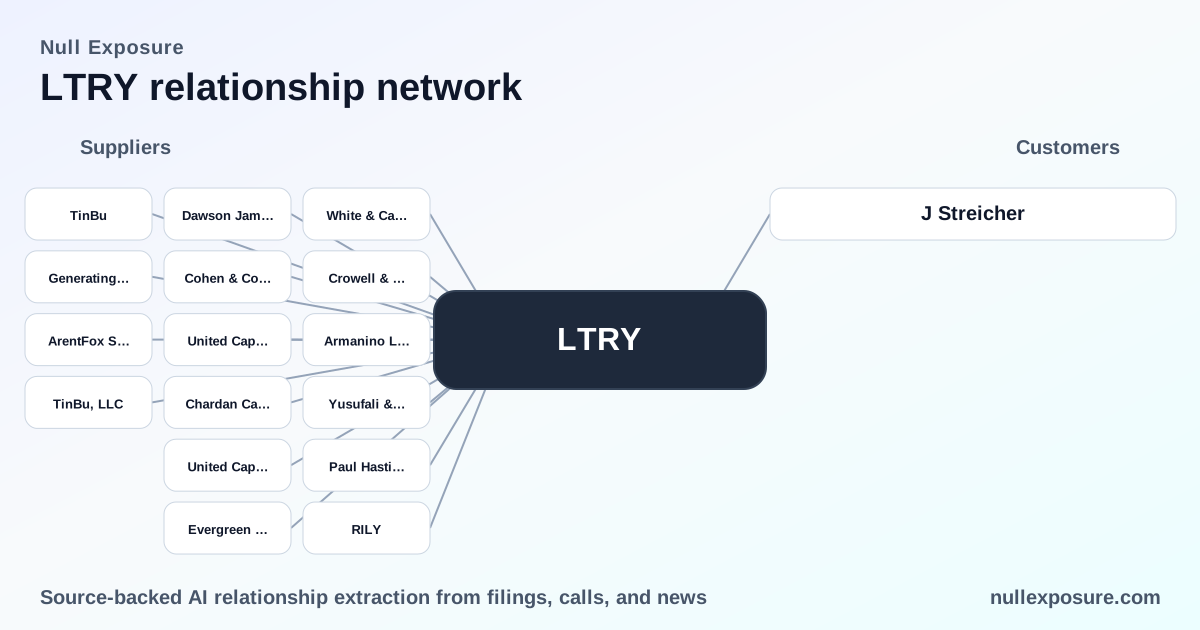
LTRY customer relationships: collection dynamics, counterparty risk, and what investors should watch
Lottery.com (LTRY) operates as a consumer-facing intermediary for lottery access and related digital services, monetizing primarily through transaction fees, commissions and partner agreements that convert ticket sales and service flows into recurring revenue streams. For investors, the most material variable in that model is the quality and enforceability of receivables and partner contracts—collections behavior and legal spend are direct indicators of revenue reliability and counterparty risk.
For a quick operational intelligence feed, see NullExposure’s platform for structured customer signals: https://nullexposure.com/
A single relationship that commands outsized attention
The public signals in this dataset focus on one counterparty: J Streicher. According to an iGamingBusiness report dated March 10, 2026, Lottery.com has spent more than $400,000 in legal fees to recover $16.5 million owed by J Streicher in FY2022 (source: iGamingBusiness, March 2026). This engagement is concrete evidence that Lottery.com actively enforces contractual claims when significant receivables are at stake.
Why this legally intensive recovery matters to investors
This collection effort reveals several company-level operating characteristics that influence valuation and risk assessment:
-
Contracting posture — litigious and enforcement-oriented. The willingness to incur substantial legal costs to recover a named receivable signals a corporate posture of enforcing contracts rather than writing off material exposures. That posture supports revenue quality when successful, but it also creates variability in near-term margin due to legal expenses.
-
Concentration sensitivity. Recovering $16.5 million from a single counterparty suggests potential receivable concentration that can amplify cash-flow volatility. Concentration risk is a natural consequence of partner-driven monetization when a few counterparties represent large balances.
-
Maturity of commercial controls. Deploying legal remedies demonstrates that the company has operational capacity—legal counsel, collections processes, and governance—to pursue remediation. That capability is a positive signal of corporate maturity, though it does not eliminate the underlying credit risk.
-
Criticality and recoverability trade-off. The decision to spend significant legal fees implies management judged the receivable sufficiently recoverable and economically important. That calculus is a forward-looking management choice that affects both liquidity planning and investor expectations for net revenue recognition.
No additional constraints or structured signals were provided in the dataset. Treat the above points as company-level signals rather than formal contractual disclosures.
How this should change your valuation and monitoring framework
Investors and operators should adjust models and due diligence priorities in the following ways:
-
Stress-test cash flows for concentrated counterparty defaults. A single $16.5 million receivable, if significant relative to working capital, changes short-term liquidity profiles and financing needs.
-
Budget for episodic legal and recovery costs. Legal spending to recover revenue is an operational line item that will depress margins in the quarter(s) when disputes are litigated; forecast legal expense variability rather than assuming steady-state SG&A.
-
Demand sharper disclosures. Public companies that depend on partner-collected revenues must disclose receivable concentration, aging, and reserve policies. Absent comprehensive disclosure, apply a higher risk premium.
-
Confirm governance around credit limits and counterparty onboarding. The presence of a large recoverable balance implies either elevated credit terms or lax limits; validate changes management has implemented since the recovery effort.
Relationship catalogue — every customer signal in the set
- J Streicher — Lottery.com has spent more than $400,000 in legal fees to secure $16.5 million owed by J Streicher in FY2022, reflecting active litigation and collections efforts (iGamingBusiness, March 10, 2026: https://igamingbusiness.com/people/people-moves/lottery-com-chair-forced-out-chief-compliance-officer-faces-fbi-investigation/).
This is the only named counterparty in the provided results; it deserves priority attention during financial due diligence.
Practical due-diligence checklist for operators and investors
- Request receivable aging and top-10 counterparty schedules, and quantify the proportion of receivables tied to legal recovery efforts.
- Inspect legal spend trends and litigation outcomes across the last three fiscal years to determine net recovery rates after legal costs.
- Validate contract terms that produce the receivable: termination triggers, indemnities, security/collateral, and dispute resolution venues.
- Reconcile management’s public statements with ledger-level reserves and write-offs; aggressive collections can coexist with weak provisioning.
- Survey counterparty onboarding and credit limit policy changes implemented after major recoveries.
Bottom line: enforcement capability is necessary but not sufficient
The J Streicher episode is a clear, actionable data point: Lottery.com enforces contracts and is prepared to spend materially to recover unpaid balances. That enforcement capability reduces the probability of permanent write-offs, but it also highlights exposure to counterparty concentration and expense volatility that investors must price into revenue stability and margins. For anyone valuing LTRY, incorporate higher earnings volatility around receivable recoveries and insist on enhanced disclosure around concentration, aging, and legal outcomes.
For a consolidated view of LTRY customer risk signals and deeper relationship tracking, visit NullExposure: https://nullexposure.com/