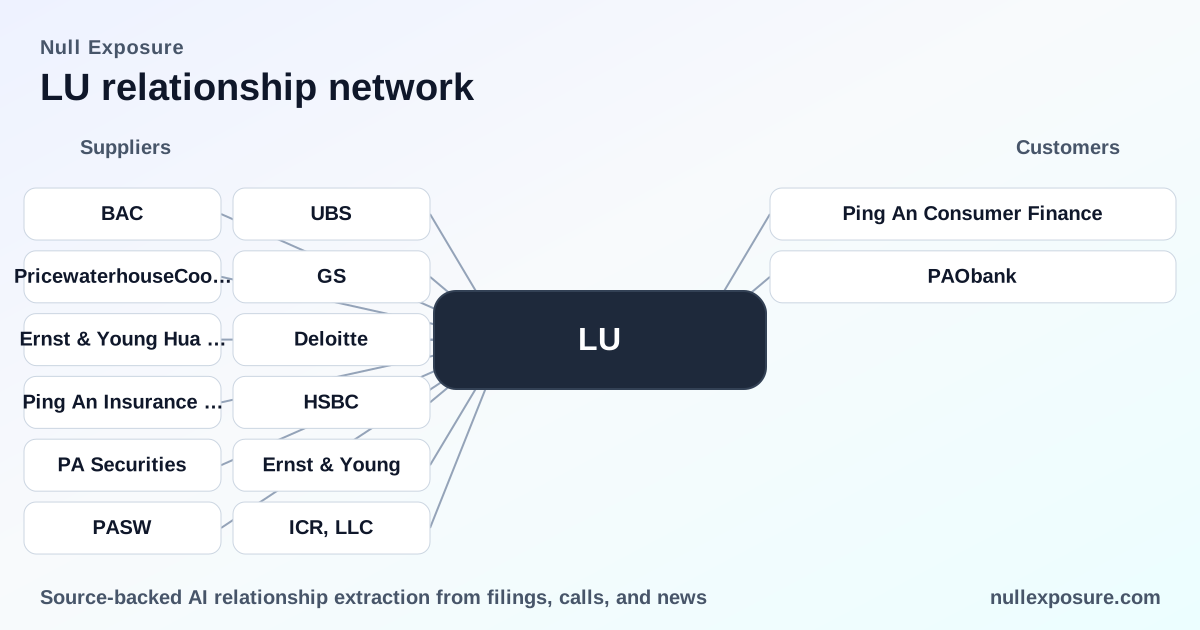
LU customer relationships: what investors need to know now
Lufax Holding Ltd (NYSE: LU) operates a technology-driven personal financial services platform in China and monetizes through fee income from account and loan management, guarantee and credit-support services, and strategic capital deployments into affiliated financial entities. Recent public disclosures and press reporting show Lufax executing contractual renewals and direct capital support that both stabilize fee revenue and concentrate financial exposure with a small set of related counterparties — a dual dynamic that drives upside to margins while concentrating counterparty and regulatory risk. For additional data and regular monitoring, visit https://nullexposure.com/.
Why these customer ties matter to investors
Lufax’s customer relationships are not arm’s-length retail accounts: they are contractual commercial arrangements with affiliated financial entities that influence both earnings composition and capital allocation. The company earns recurring fees through account and financial-services frameworks and takes on explicit credit-support obligations that convert fee income into contingent balance-sheet exposure. That operating posture delivers revenue predictability on the fee side but creates concentration and related-party risk on the liability and capital side, with attendant regulatory scrutiny in China’s evolving financial ecosystem.
How the public record maps to counterparties
Below I summarize every customer relationship called out in the available reporting and filings. Each entry includes a concise plain‑English description and the primary public reference.
Ping An Consumer Finance — a core, related-party commercial relationship
Lufax has renewed multi-year operational agreements with Ping An Consumer Finance that govern account management and a suite of financial services, and Lufax provides guarantee services that cover certain loan defaults for that entity, generating fee income while shouldering credit backstops. According to Lufax’s circular and reporting around the Extraordinary General Meeting and subsequent renewals (December 2025–March 2026), the company formalized annual caps and ratified the 2026 collaboration agreement (see the Yahoo Finance report, March 2026: https://sg.finance.yahoo.com/news/lufax-announces-results-extraordinary-general-110000319.html). A market analysis also notes that Lufax’s guarantee services create direct fee revenue while shifting default risk onto the Lufax balance sheet (SahmCapital commentary, July 2025: https://www.sahmcapital.com/news/content/lufax-has-plenty-of-ground-to-cover-to-win-investors-good-graces-2025-07-23).
PAObank — capital injections and strategic funding
Lufax has provided direct capital injections to PAObank, including a reported $500 million tranche, signaling an active role as an equity/credit backer to affiliated banking entities rather than a passive service supplier. News coverage indicates this infusion is part of ongoing support to the bank (AAStocks report on the capital injection, FY2025: http://www.aastocks.com/en/usq/quote/stock-news-content.aspx?symbol=LU&id=NOW.1491756).
What the relationship set tells you about Lufax’s operating model
There are no formal constraints disclosed in the dataset used here; that absence itself is an informative company-level signal. The public record shows:
- Contracting posture: Lufax operates as both a service provider and an explicit credit supporter to a narrow roster of affiliated financial entities, embedding fee-generation with contingent liabilities.
- Customer concentration: Revenue drivers are concentrated in a small number of related-party agreements, which increases revenue visibility but elevates counterparty and capital-concentration risk.
- Criticality of relationships: The agreements are operationally significant — account-management and financial-services frameworks govern day-to-day customer flows and create steady fee streams that materially affect profitability.
- Maturity and governance: The presence of renewal cycles, explicit annual caps and shareholder ratification (EGM materials) indicates a governed, formalized relationship structure rather than ad hoc support.
These company-level signals translate into a hybrid business model: predictable fee economics underpinned by concentrated, potentially capital-intensive support obligations.
Investment implications — what to watch and why it matters
- Earnings quality: Fee income tied to account and financial-services frameworks supports top-line stability, but investors should separate recurring fee revenue from earnings volatility driven by guarantee losses and provisioning.
- Capital allocation: Capital injections into affiliated banks like PAObank reduce liquidity available for other growth initiatives and heighten exposure to group-level credit cycles.
- Regulatory sensitivity: Related-party guarantees and cross-subsidies attract regulatory focus in China’s tightened financial oversight environment; governance disclosures and annual caps are useful proxies for regulatory risk mitigation.
- Concentration risk: A small number of large counterparties means that a deterioration at one partner can have outsized effects on Lufax’s capital and credit profile.
Key takeaway: Lufax’s commercial arrangements create a trade-off between stable fee revenue and concentrated credit exposure; investors should value the company on both recurring-service economics and potential loss scenarios from related-party support.
For investors and analysts who need ongoing tracking of Lufax’s counterparties and contractual disclosures, consider checking updates at https://nullexposure.com/ for structured alerts and source links.
Bottom line
Lufax’s customer relationships are strategically significant: they produce reliable fee streams while anchoring Lufax into concentrated, capital-intensive support roles for affiliate financial institutions. The public record shows active renewal and formal governance of these ties, plus material capital support transactions; the combination strengthens short-term revenue visibility but raises medium-term capital and regulatory questions that should be priced into valuation and stress scenarios.