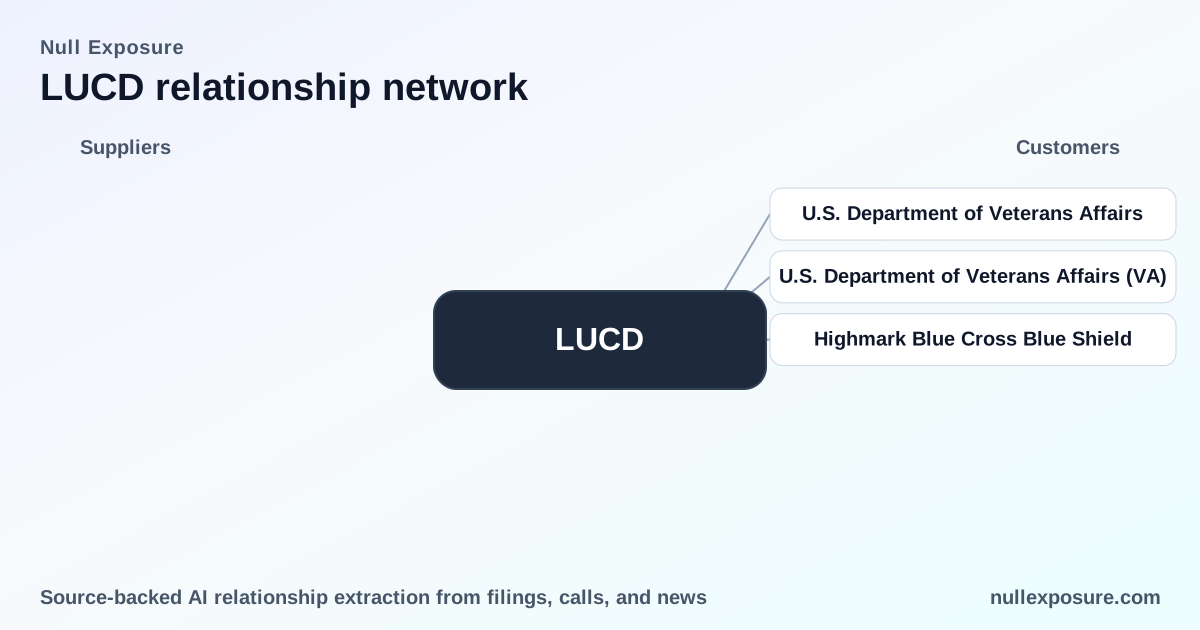
Lucid Diagnostics (LUCD): Commercial traction, payer gating, and a government contract that changes the adoption calculus
Lucid Diagnostics operates and monetizes by selling its EsoGuard and EsoCheck diagnostics to providers and patients, and by securing third‑party payer coverage and institutional contracts that reimburse testing at scale. Revenue is driven by direct sales of core esophageal cancer screening products, provider deployments, and payer coverage wins that convert out‑of‑pocket tests into reimbursed procedures. For investors, the near‑term value inflection is clear: expanding in‑network payer relationships and institutional contracts — particularly with the VA and major insurers — will convert proof‑of‑concept clinical utilization into repeatable revenue.
Visit the NullExposure research hub for ongoing LUCD tracking: https://nullexposure.com/
How Lucid’s operating model constrains outcomes (what investors should watch)
Lucid is a commercial‑stage medical diagnostics seller whose economics are tightly coupled to payer behavior and U.S. market penetration. The company expects substantially all revenues from EsoGuard and EsoCheck, which creates product concentration risk but also focused sales effort. Contracting posture is typical for an early commercial diagnostics firm: Lucid sells to providers and relies on third‑party payers and institutional procurement agreements to scale utilization and improve realized pricing.
Key company‑level signals drawn from filings and disclosures:
- Payer and government dependency: Lucid explicitly warns that inadequate reimbursement from private or government payors would materially restrict commercialization — a signal that payer coverage is a gating factor for revenue expansion.
- Customer mix: Lucid treats the patient as the end customer but does not contract directly with patients for reimbursement; third‑party payers and provider contracts are the commercial fulcrum.
- U.S. geographic concentration: The near‑term focus is on U.S. operations and a test center network across metropolitan areas in multiple states, indicating domestic rollout and regulatory/payer strategy will dominate performance.
- Seller role and product concentration: The company functions principally as the seller of its core diagnostic products, creating concentration in product revenue and raising the importance of each payer and institutional relationship.
These constraints translate into measurable risks and levers: coverage decisions, Medicare policy, and large institutional contracts are the most material drivers of revenue growth and margin improvement.
Customer relationships: every reported partner and what it means for LUCD
Below I list each relationship record captured in public reporting and news, with a concise, plain‑English takeaway and the source.
U.S. Department of Veterans Affairs (VA) — PR Newswire (March 10, 2026)
Lucid was awarded a VA contract to provide the EsoGuard Esophageal DNA Test across the VA health system, opening access to roughly nine million enrolled veterans and enabling reimbursement at Medicare pricing under that contract. (PR Newswire, March 10, 2026: https://www.prnewswire.com/news-releases/lucid-diagnostics-awarded-us-department-of-veterans-affairs-contract-for-esoguard-302666707.html)
U.S. Department of Veterans Affairs (VA) — Benzinga (March 10, 2026)
Market coverage amplified the VA award, which drove equity attention and re‑rated LUCD in short‑term trading; the item underscores institutional demand for EsoGuard. (Benzinga, March 10, 2026: https://www.benzinga.com/trading-ideas/movers/26/01/50042643/why-is-pavmed-stock-skyrocketing-wednesday)
US Department of Veterans Affairs (VA) — TradingView / Invezz (May 3, 2026)
Press releases and analyst notes reiterated that the VA engagement will expand EsoGuard access across the VA system, reinforcing the contract’s commercial significance. (TradingView/Invezz, May 3, 2026: https://www.tradingview.com/news/invezz:7fc5c2679094b:0-should-you-chase-the-rally-in-pavmed-stock-after-it-quadrupled-on-wednesday/)
U.S. Department of Veterans Affairs (VA) — Barchart (March 10, 2026)
A company statement framed the VA award as a key distribution milestone for the nation’s largest integrated healthcare system and a lever to drive scale. (Barchart, March 10, 2026: https://www.barchart.com/story/news/37147967/lucid-diagnostics-awarded-u-s-department-of-veterans-affairs-contract-for-esoguard)
U.S. Department of Veterans Affairs (VA) — Intellectia / ETF news (March 10, 2026)
Analysts emphasized that the VA contract, which allows offering EsoGuard at Medicare pricing, meaningfully improves Lucid’s competitive positioning versus out‑of‑network tests. (Intellectia, March 10, 2026: https://intellectia.ai/news/etf/lucid-diagnostics-provides-business-update-and-reports-third-quarter-2025-financial-results)
U.S. Department of Veterans Affairs (VA) — Quantisnow (March 10, 2026)
Business‑update notices reiterated the VA award as a core component of Lucid’s commercial expansion and coverage momentum narrative. (Quantisnow, March 10, 2026: https://www.quantisnow.com/insight/lucid-diagnostics-to-hold-a-business-update-conference-call-and-6009175)
Highmark Blue Cross Blue Shield — PR Newswire (March 2026, FY2025 disclosure)
Highmark issued a positive coverage policy in New York for EsoGuard consistent with professional guidelines, representing Lucid’s first favorable commercial insurer policy and an early-payor precedent. (PR Newswire, March 2026: https://www.prnewswire.com/news-releases/lucid-diagnostics-secures-first-positive-commercial-insurance-coverage-policy-for-its-esoguard-esophageal-dna-test-302400977.html)
Highmark / Commercial coverage momentum — TradingView 10‑K commentary (May 3, 2026)
Company filings and investor commentary list Highmark positive coverage alongside a Medicare LCD reconsideration and VA contract as pillars of payer adoption strategy. (TradingView summary of 2025 10‑K, May 3, 2026: https://www.tradingview.com/news/tradingview:35776de7e287a:0-lucid-diagnostics-2025-10-k-revenue-4-7m-net-loss-58-0m/)
Palmetto GBA MolDx group — BTIG / Investing.com (May 3, 2026)
Analyst notes flagged administrative obstacles with Palmetto GBA MolDx (the regional Medicare contractor), suggesting Medicare coverage is progressing but subject to administrative friction under the current CMS environment. (Investing.com / BTIG coverage, May 3, 2026: https://m.investing.com/news/analyst-ratings/btig-reiterates-lucid-diagnostics-stock-rating-on-q4-beat-93CH-4587416?ampMode=1)
UnitedHealthcare — Earnings call excerpts / InsiderMonkey (May 3, 2026)
Lucid has entered credentialing with UnitedHealthcare, positioning the company to begin contracting discussions that would secure in‑network status and reimbursement. (InsiderMonkey transcript of Q4 2025 earnings call, May 3, 2026: https://www.insidermonkey.com/blog/lucid-diagnostics-inc-nasdaqlucd-q4-2025-earnings-call-transcript-1726209/)
UnitedHealthcare — Investing.com transcript (May 3, 2026)
Earnings transcripts confirm UnitedHealthcare credentialing and that full contracting will follow, underscoring Lucid’s payer engagement pipeline. (Investing.com earnings transcript, May 3, 2026: https://www.investing.com/news/transcripts/earnings-call-transcript-lucid-diagnostics-q4-2025-sees-stock-rise-despite-eps-miss-93CH-4582772)
Blue Cross Blue Shield Association — InsiderMonkey (May 3, 2026)
Management reports “extensive engagement” with the Blue Cross Blue Shield Association, indicating active negotiations that aim to translate association‑level engagement into regional plan coverage. (InsiderMonkey, May 3, 2026: https://www.insidermonkey.com/blog/lucid-diagnostics-inc-nasdaqlucd-q4-2025-earnings-call-transcript-1726209/)
Blue Cross Blue Shield Association — Investing.com transcript (May 3, 2026)
Company commentary reiterated ongoing conversations with the BCBS Association that Lucid expects to yield future positive coverage policies through regional plans. (Investing.com, May 3, 2026: https://www.investing.com/news/transcripts/earnings-call-transcript-lucid-diagnostics-q4-2025-sees-stock-rise-despite-eps-miss-93CH-4582772)
Hoag — TradingView / 10‑K channel milestones (May 3, 2026)
Lucid lists expanded provider programs including Hoag and mobile test units as demonstration of scalable in‑office use, signaling provider adoption beyond early adopters. (TradingView summary, May 3, 2026: https://www.tradingview.com/news/tradingview:35776de7e287a:0-lucid-diagnostics-2025-10-k-revenue-4-7m-net-loss-58-0m/)
Highmark Blue Cross Blue Shield — PR NewsWire clinical utility note (FY2025)
Clinical utility publications and acceptance of studies are being used to support the Highmark coverage decision and ongoing payer engagements. (PR Newswire clinical utility release, March 2026: https://www.prnewswire.com/news-releases/lucid-diagnostics-envet-be-clinical-utility-study-of-esoguard-esophageal-precancer-testing-accepted-for-peer-reviewed-publication-302404474.html)
Palmetto GBA MolDx group — Investing.com (May 3, 2026)
Analyst commentary on Medicare channel notes Palmetto MolDx administrative delays under the newer CMS administration as a headwind to immediate national Medicare coverage. (Investing.com, May 3, 2026: https://m.investing.com/news/analyst-ratings/btig-reiterates-lucid-diagnostics-stock-rating-on-q4-beat-93CH-4587416?ampMode=1)
Cigna — InsiderMonkey (May 3, 2026)
Lucid identified Cigna as a target payer where the company can leverage endoscopy‑related policies to secure in‑network EsoGuard coverage. (InsiderMonkey transcript, May 3, 2026: https://www.insidermonkey.com/blog/lucid-diagnostics-inc-nasdaqlucd-q4-2025-earnings-call-transcript-1726209/)
Anthem — Investing.com transcript (May 3, 2026)
Anthem is mentioned as another major national payer Lucid is pursuing, with the company indicating clinical and policy strategies to obtain coverage via endoscopy policy levers. (Investing.com earnings transcript, May 3, 2026: https://www.investing.com/news/transcripts/earnings-call-transcript-lucid-diagnostics-q4-2025-sees-stock-rise-despite-eps-miss-93CH-4582772)
QVCD / CVB bed recall — iHeart (Sept 2024 reported)
An unrelated media item about recalled Lucid‑branded platform beds (CVB Inc. recall) appears in the capture set but is not connected to Lucid Diagnostics’ medical diagnostics business; treat as non‑operational noise for LUCD investors. (iHeart, Sept 20, 2024: https://www.iheart.com/content/2024-09-20-nearly-138000-beds-recalled-because-they-can-collapse-during-use/)
SPT — GlobeNewswire (FY2021)
An historical Lucid consumer study referenced in a 2021 release shows the company has conducted consumer research, but this older record is peripheral to current payer and institutional commercialization dynamics. (GlobeNewswire, June 15, 2021: https://www.globenewswire.com/news-release/2021/06/15/2247376/0/en/New-research-shows-social-media-has-created-a-more-competitive-landscape-for-brands-but-is-simultaneously-key-for-staying-ahead-in-their-industry.html)
Investment implications and headline risk-reward
- Growth lever: The VA contract and insurer coverage wins (Highmark) are the clearest paths to scale—these relationships convert clinical use into reimbursed volume and lower patient financial friction.
- Primary risk: Payer and Medicare policy. Palmetto MolDx administrative issues and ongoing credentialing/contracting timelines with major insurers create timing risk for revenue realization.
- Concentration: Revenue dependence on two core products underscores the importance of each payer/contract win; a small set of payers and institutional contracts will determine near‑term cash flow.
For ongoing monitoring and a consolidated view of Lucid’s evolving coverage and institutional relationships, consult our LUCD coverage page: https://nullexposure.com/ — we track payer events, contract awards, and filings that move the commercial adoption curve.