Lucky Strike Entertainment (LUCK): Customer Relationships That Drive an Experiential Leisure Business
Lucky Strike Entertainment operates upscale bowling and eatertainment venues, monetizing through a mix of walk-in retail, event bookings, food & beverage sales, subscription passes and long-term media/licensing agreements. The company’s scale—roughly 360 North American locations, $1.24 billion in trailing revenue and $274 million in EBITDA—creates a diversified revenue mix where high-margin hospitality and recurring event revenue complement spot consumer spend. For investors evaluating customer relationships, the important signal is a hybrid commercial posture: dominant retail cash flows supported by strategic long-term licensing and event bookings that stabilize cash generation. For deeper firm-level analysis, visit https://nullexposure.com/.
Recent relationship signals that matter to operators and investors
Below I parse every relationship item surfaced in third‑party reporting and explain their relevance to Lucky Strike’s go‑to‑market and customer exposure.
Pinstripes Holdings Inc. — taking on displaced events
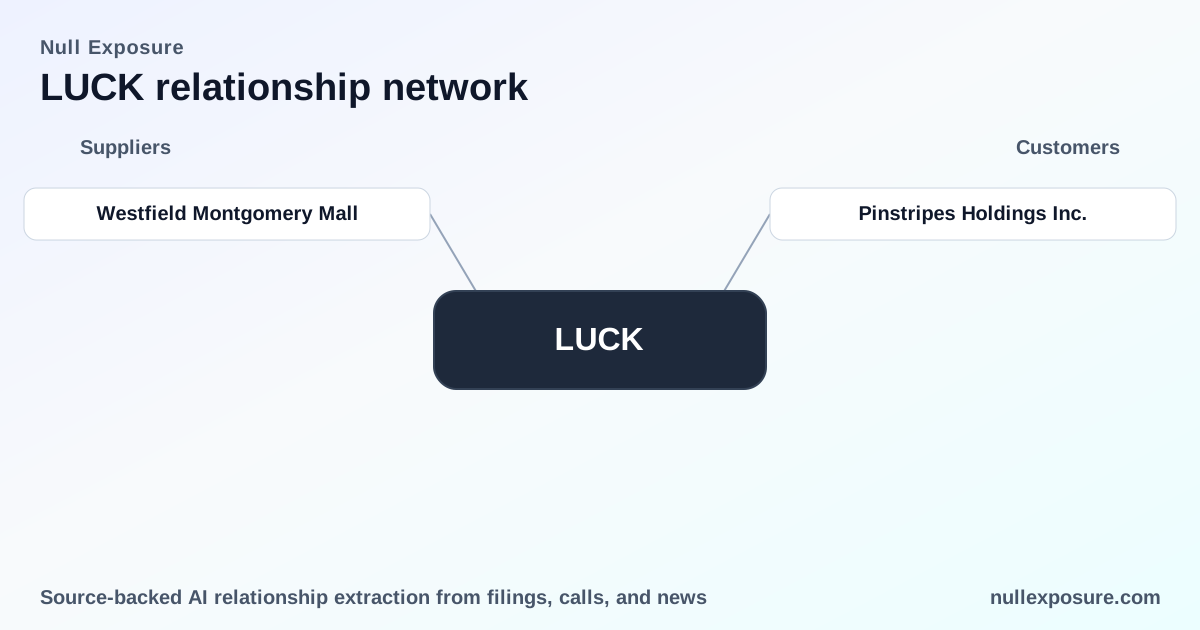
Lucky Strike publicly offered courtesy discounts exclusively for displaced Pinstripes clients so their events can still go on at one of Lucky Strike’s ~350 locations nationwide, positioning Lucky Strike as a ready alternative for corporate and private events when competitors fail to deliver. This action was reported in national outlets on March 10, 2026 (Yahoo News and Nation’s Restaurant News), and signals Lucky Strike’s willingness to capture incremental event volume from competitor dislocations while reinforcing its market role as an events host (Yahoo News, March 10, 2026; NRN, March 10, 2026).
Apex Entertainment — real estate turnover and local market adjustments
A Times Union report noted Lucky Strike closed a location for renovations and that Apex Entertainment planned to lease the 50,000‑square‑foot space, reflecting active site-level churn and market reallocation in the entertainment real‑estate footprint (Times Union, May 3, 2026). This episode illustrates how venue closures, renovations and third‑party leases affect local customer flows and the company’s capital deployment decisions.
What the relationship set tells you about contracting posture and revenue mix
The relationship items are limited in number but they illuminate an operational reality consistent with the company disclosures: Lucky Strike runs a retail-first business with targeted B2B/event capabilities and a media/licensing arm.
- Contracting posture: The company operates a mix of spot retail transactions (walk‑in guests), subscription-style passes (single day, annual, season passes) that provide recurring demand, and longer-term licensing agreements tied to media content and sanctioned events. The constraints data explicitly mentions multi‑year licensing contracts and season/annual pass structures, confirming a deliberate dual approach to monetization.
- Counterparty concentration and criticality: The dominant counterparty class is individual consumers, creating low counterparty concentration but elevated sensitivity to discretionary spending cycles. Event and licensing customers are fewer and more strategic, raising their relative per‑counterparty importance even as overall exposure remains diversified across locations.
- Geography and footprint maturity: The company’s operations are North American‑centric, with over 350 locations in the U.S., which creates geographic scale and operational repeatability while concentrating macroeconomic and leisure‑spend risk in one region.
- Maturity of relationships: Licensing relationships tied to sanctioned tournaments and broadcast rights are multi‑year and structured, whereas the consumer relationship base includes both immature spot transactions and more mature subscription pass lines that smooth volatility.
How the specific relationships affect commercial strategy
- Tactical customer capture: The Pinstripes outreach is an example of opportunistic volume capture—a low‑cost way to fill event calendar slots and introduce new customers to Lucky Strike’s ecosystem, boosting F&B and ancillary sales per event (Yahoo News; NRN, March 10, 2026). This is an explicit growth lever that leverages venue density.
- Real‑estate and local competition dynamics: The Apex lease and renovation item highlights the constant site optimization decisions management faces—closing for upgrades, re‑letting underperforming footprints or ceding space to competitors—each decision materially affects local demand and operating margins (Times Union, May 3, 2026).
Financial context that ties customer relationships to value creation
Lucky Strike’s scale underpins these customer strategies: $1.24B revenue TTM and $274M EBITDA indicate the business converts experiential demand into meaningful cash flow, even as net earnings show a negative EPS (-$0.66) and a modest negative profit margin (-7.09%). Operating margin sits positive at 11.7%, confirming that venue operations and F&B have healthy underlying economics while headline earnings are impacted by non‑operating items or capital structure. The combination of high institutional ownership (≈89%) and a market cap around $1.08B frames investor expectations around operational execution and growth through site optimization and event capture.
Constraints and what they imply for customer exposure and risk
The company constraints provided in filings and disclosures are best read as company‑level signals:
- Contract types: The business runs a mixed contract book—long‑term licensing (media and tournament rights), subscription passes, and predominantly spot retail transactions. This hybrid model reduces single‑channel dependence and smooths seasonality but preserves sensitivity to discretionary spend.
- Counterparty type: The largest counterparty group is individual consumers, which results in broad diversification but sensitivity to consumer confidence and local demand shocks.
- Geography: Operations are North American‑focused, concentrating macroeconomic and pandemic/recovery risk within one region.
- Relationship roles: Lucky Strike is simultaneously a service provider (venue, food & beverage, events), a buyer in the consumer sense (selling experiences), and a licensor for media rights—meaning revenue volatility can come from both B2C trends and B2B licensing cycles.
- Segment focus: The business sits in services/experiential leisure, not commodity retail, which gives it pricing power in experience upgrades but exposes it to discretionary spend cyclicality.
Investment implications and risk summary
- Upside drivers: Rapid event capture when competitors falter, a dense footprint enabling promotional scale, and durable licensing contracts that provide non‑seasonal revenue are core growth levers. Pinstripes‑related event capture is a live example of a scalable uplift tactic.
- Key risks: Heavy exposure to discretionary consumer spend, U.S. regional concentration, and location‑level churn that can impose capital costs for renovations or lease turnover. Apex’s lease event underscores the active real‑estate dynamism that can compress or expand local margins.
- Valuation context: Given the company’s revenue and EBITDA scale, investors should reconcile operational profitability at the venue level with headline EPS volatility when assessing downside protection and return potential.
For a structured view of relationship signals and to monitor how events like competitor closures or local leases change customer flow, review ongoing coverage at https://nullexposure.com/.
Conclusion: Lucky Strike’s customer relationships are operationally diversified and commercially pragmatic—a retail backbone of spot transactions reinforced by subscription mechanics and selective long‑term licensing. These characteristics produce predictable venue economics while leaving the company exposed to discretionary demand cycles, real‑estate turnover and the execution risks of converting displaced event volume into long‑term customers.