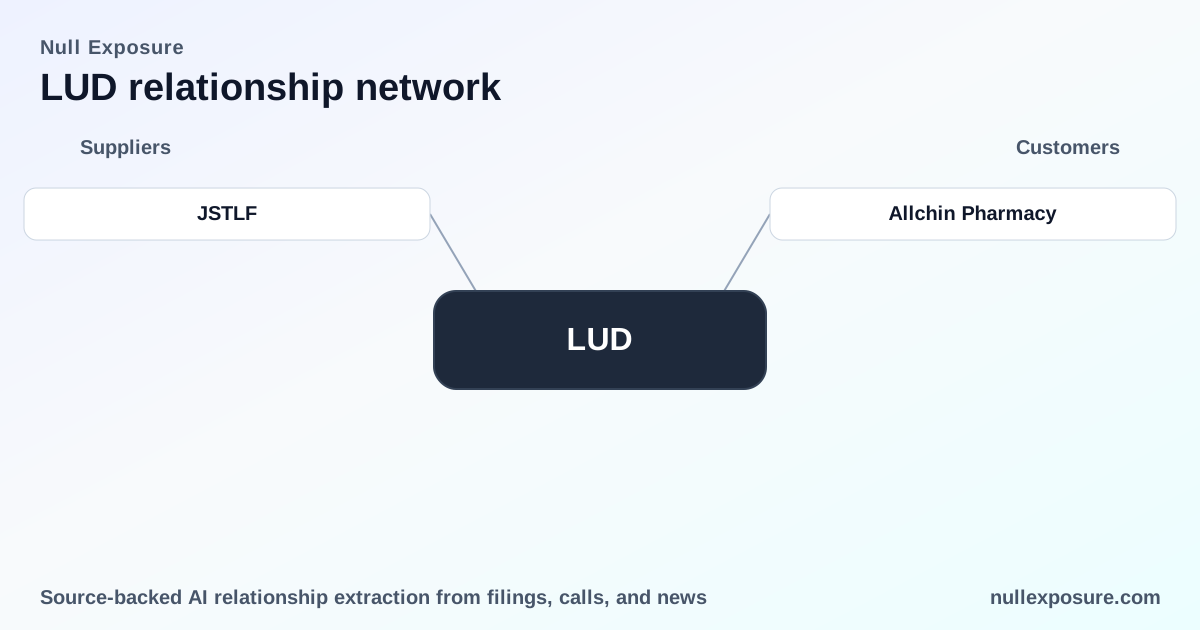
Luda Technology Group (LUD): Customer Relationships That Drive Near-Term Revenue and Execution Risk
Luda Technology Group monetizes through industrial product sales and project-based contracts via its operating subsidiaries — notably Luda Taian Industrial Company — and through digital partnerships that integrate its software/analytics offerings into commercial channels. The company wins revenue via certified product supply contracts for heavy industrial customers and targeted digital commercialization projects for retail and healthcare partners; recent public announcements show a mix of large engineering tenders and smaller channel partnerships that together determine both growth potential and execution risk. For a concise company view and sourcing on these relationship signals, visit https://nullexposure.com/.
How Luda makes money and what that implies for investors
Luda operates as a hybrid industrial-software vendor. Revenue derives from two visible streams: (1) project and product supply contracts with large industrial clients, and (2) commercial partnerships that distribute its software-enabled services to retail and healthcare outlets. The contract-driven nature of the business produces lumpy revenue recognition and exposes Luda to procurement cycles and delivery risk common in heavy-industry projects.
Company-level financial signals shape how investors should think about these customer relationships:
- High insider ownership (88%) and minimal institutional participation (0.28%) indicate concentrated control and limited public float, which constrains liquidity and the speed at which public investors can influence corporate strategy.
- Scale and margin profile are modest and loss-making: latest-quarter figures through 2025-06-30 show negative EBITDA and sub-5% profit margins on roughly $37.1 million of trailing revenue, creating sensitivity to single large contracts.
- Top-line volatility is material: quarterly revenue growth showed a significant year-over-year decline in the most recent period, underscoring reliance on successful contract execution and backlog conversion. These company-level constraints explain why customer wins are critical: a single large award materially changes near-term cash flow and valuation dynamics.
Customer relationships: the relationship list and what each means for revenue
The items below cover every customer relationship in the public results set and summarize the commercial significance and source for each.
China State Shipbuilding Corporation (CSSC)
Luda — through its Luda Taian Industrial subsidiary — will supply certified products for high-value ships such as LNG carriers, ultra-large container ships, chemical tankers, and luxury cruise ships under cooperation agreements with CSSC. This positions Luda to access steady, high-ticket manufacturing programs that can generate multi-year supply revenue. Source: Yahoo Finance report on May 3, 2026 (https://finance.yahoo.com/news/luda-partners-chinese-shipbuilders-ammonia-175644392.html).
COSCO Shipping Heavy Industry Company
COSCO Shipping Heavy Industry is named alongside CSSC as a shipbuilding partner that will receive Luda-certified products for major vessel classes, expanding Luda’s addressable market in maritime equipment supply chains. These industry OEM relationships are strategically critical because they embed Luda into long procurement cycles and certification processes. Source: Yahoo Finance report on May 3, 2026 (https://finance.yahoo.com/news/luda-partners-chinese-shipbuilders-ammonia-175644392.html).
Haiting (Nantong) Shipbuilding Company
Haiting (Nantong) Shipbuilding appears as the third shipbuilder in the cooperation set; the agreement captures regional shipyard demand and reinforces Luda’s industrial-sales channel through a dedicated operating arm. Inclusion of multiple builders reduces single-customer concentration within the shipbuilding vertical while concentrating exposure in a single industry. Source: Yahoo Finance report on May 3, 2026 (https://finance.yahoo.com/news/luda-partners-chinese-shipbuilders-ammonia-175644392.html).
Allchin Pharmacy (London pilot)
Luda’s digital partnership has a retail example in Allchin Pharmacy (Belsize Park, London), which joined a project enabling online orders via a delivery platform and began receiving initial live orders during pilot deployment. This demonstrates Luda’s commercializing of software/commerce integrations at small-to-medium retail scale and provides a low-capital channel to prove product-market fit for pharmacy customers. Source: pharmacy.biz feature (March 10, 2026) (https://www.pharmacy.biz/features/luda-partners-helps-pharmacies-digitalise-locate-medicines-in-short-supply-and-boost-online-sales/).
China Yulong Island Petrochemical Project (RMB 160 million tender)
Luda announced a RMB 160 million tender award for the China Yulong Island Petrochemical Project, a material engineering contract reported in April 2026; for a company with roughly $37.1 million in trailing revenue, this single tender represents a meaningful revenue event that can substantially alter the fiscal-year profile if executed and recognized. The award is repeatedly cited in market alerts and press summaries in early 2026. Sources: MarketBeat / TipRanks reporting (April 15, 2026) and related MarketBeat alerts (https://www.marketbeat.com/instant-alerts/luda-technology-group-limited-nyseamericanlud-short-interest-down-165-in-february-2026-03-03/ and https://www.marketbeat.com/instant-alerts/luda-technology-group-nyseamericanlud-stock-price-down-46-heres-why-2026-01-01/).
What these relationships mean for growth and risk
- Concentration and lumpy revenue. The mix of large industrial tenders (shipbuilding and petrochemical) plus patchwork retail pilots creates pronounced revenue lumpiness. Winning the RMB 160 million tender and the shipbuilder cooperation agreements is transformational in near-term revenue relative to current scale, but delivery risk is high.
- Execution and certification are critical. Industrial customers require certified products and demonstrated manufacturing quality; Luda’s positioning via Luda Taian Industrial Company shows the company has taken steps to meet those standards, but these contracts produce long lead times to cash.
- Channel diversification reduces single-point failure but increases operational complexity. Retail pharmacy pilots and maritime/petrochemical contracts operate on different margin and delivery models, forcing Luda to allocate managerial bandwidth across distinct businesses.
- Capital and liquidity constraints are meaningful. Negative EBITDA and a small public float constrain the company’s ability to self-fund large manufacturing scale-ups without external capital or prepayment from customers.
Investment implications and how to follow progress
Positive thesis: recent industrial partnerships and the RMB 160 million tender provide tangible, contract-level evidence that Luda is converting strategy into revenue-driving awards. Key risk factors are execution on large projects, working-capital needs to fulfill contracts, and the effect of concentrated insider control on governance and minority-investor liquidity.
Monitoring priorities:
- Contract performance and recognized revenue from the RMB 160 million petrochemical tender and shipbuilding delivery schedules.
- Progress reports or filings on Luda Taian Industrial Company’s production ramp and product certifications.
- Cash flow and margin trajectory in upcoming quarterly disclosures, since current TTM metrics show negative EBITDA and shrinking quarterly revenue. For additional context on contractual wins and to track further relationship disclosures, see https://nullexposure.com/.
Bottom line
Luda’s recent public relationships split into two clear vectors: large, high-value industrial contracts that can materially re-shape revenue, and smaller digital partnerships that validate software-enabled monetization models. Investors should weigh the upside from headline contract wins against execution and liquidity constraints driven by current financials and concentrated ownership. Follow contract milestones and quarter-to-quarter revenue recognition to determine whether announced awards convert into sustainable, profitable growth.