Lumen Technologies: enterprise pivot anchored by long-term fiber and hyperscaler contracts
Lumen monetizes by selling network capacity, managed connectivity and cloud interconnect services to enterprises, hyperscalers and public-sector clients, collecting a mix of long‑term capacity contracts (IRUs), recurring access subscriptions and usage‑billed services. The company’s operating story is capital‑intensive infrastructure monetized through sticky, multi‑year commercial agreements and growing hyperscaler interconnect relationships—offset today by a deliberate divestiture strategy that unlocked cash and materially de‑risked leverage. Learn more at https://nullexposure.com/.
How Lumen’s commercial model actually works (and what that means for investors)
Lumen deploys fiber and networking infrastructure and sells access to that capacity in three economic flavors: long‑term capacity rights (IRUs and lease-like arrangements), recurring subscription access, and usage‑billed services for ancillary or metered traffic. The company’s disclosures reference IRUs with multi‑decade terms and a weighted average remaining lease life on operating leases, signaling a contracting posture biased toward long‑dated, sticky revenue. At the same time, access services are billed one month in advance and usage services billed in arrears, giving Lumen a stable cash flow base complemented by variable revenue upside.
The business mixes end consumers, small business and mid‑market customers with large enterprise, hyperscaler and government counter‑parties. Divestitures of non‑core geography and consumer assets (EMEA, Latin America, and most recently its U.S. Mass Markets fiber business) demonstrate a maturity move from broad telco to focused enterprise and hyperscale infrastructure provider, improving capital allocation and reducing run‑rate capex pressure. Those corporate signals are company‑level: they reflect structural constraints—long contract tenors, diverse counterparty types (individual through hyperscaler and government), and geographic concentration in North America with APAC exposure—that shape revenue durability and downside protection.
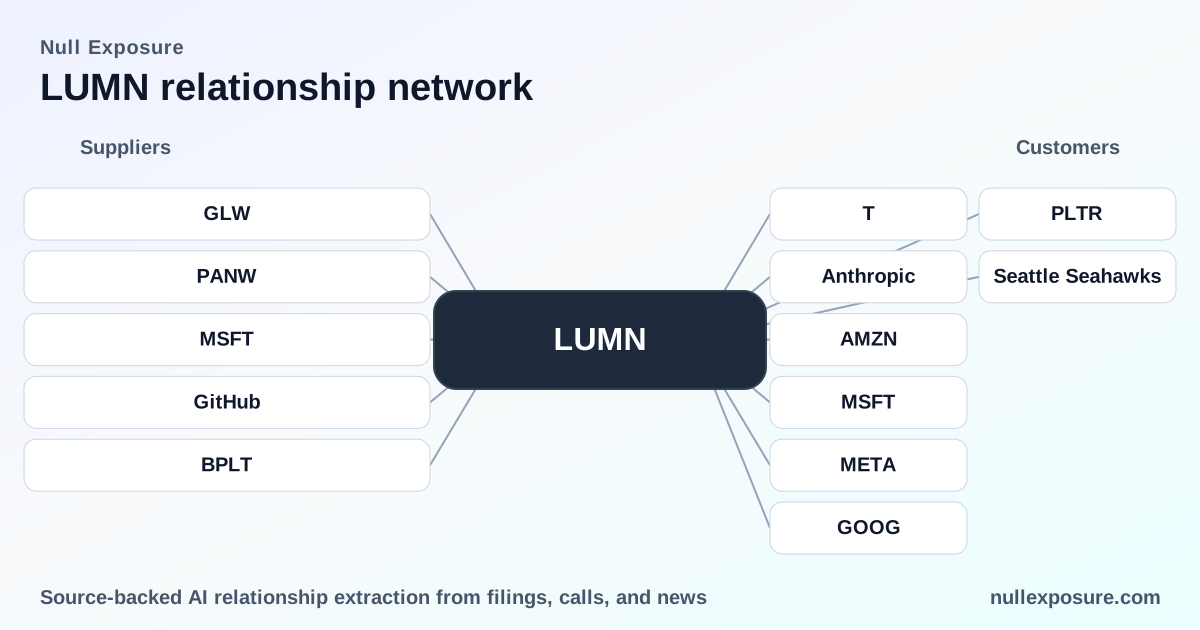
Relationship map: the customers and partners investors should be tracking
Below are every customer relationship captured in the recent coverage, summarized in plain English with source citations.
AT&T — buyer of Lumen’s Mass Markets fiber
Lumen completed the sale of its 11‑state Mass Markets consumer fiber business, including Quantum Fiber, to AT&T for $5.75 billion in cash; proceeds were used to pay down roughly $4.8 billion of debt and reduce interest expense. Source: StockTwits and CRN coverage (Mar–May 2026) and company commentary recorded in earnings notes.
Amazon Web Services (AWS) — launch partner for “last‑mile” Interconnect
AWS selected Lumen as an initial network operator for AWS Interconnect — last mile, using Lumen Cloud Interconnect to connect enterprise locations directly to AWS, positioning Lumen as a hyperscaler last‑mile supplier for private cloud connectivity. Source: CRN and IndexBox reporting on the AWS Interconnect announcement (May 2026).
Anthropic — major enterprise customer with government‑sensitive work
News outlets identify Anthropic as one of Lumen’s major customers expanding its fiber footprint, though Anthropic’s own regulatory issues with a Pentagon contract stirred volatility in related coverage. Source: Finviz and Fox Business coverage referencing Anthropic’s relationship with Lumen (Mar 2026).
Microsoft — private connectivity and PFC relationships
Lumen secured private connectivity work with Microsoft as part of a larger push to supply dedicated bandwidth to hyperscalers for AI and cloud workloads; Microsoft is repeatedly listed among hyperscaler customers in company reporting. Source: Markets FinancialContent and The Globe and Mail commentary (2024–2026 mentions in FY2026 coverage).
Google — hyperscaler bandwidth customer
Google is cited alongside Microsoft as a hyperscaler customer served by Lumen’s enterprise segment for large, latency‑sensitive workloads. Source: Markets FinancialContent analysis of Lumen’s enterprise strategy (Feb–Mar 2026).
Meta Platforms — hyperscaler deals referenced in coverage
Reports list Meta among the hyperscalers that have signed deals with Lumen for dedicated connectivity and large‑scale bandwidth solutions. Source: CoinCentral and Blockonomi summaries of Lumen’s hyperscaler engagements (Mar 2026).
Palantir — integration for government and enterprise platforms
Lumen has partnered with Palantir to integrate network services into Palantir’s AIP platform, a partnership presented as a route to secure government and enterprise contracts. Source: Tikr article summarizing the Palantir integration (Mar 2026).
TBB — counterparty referencing spectrum and fiber acquisition agreements
An earnings call transcript (tbb‑2025q4) references agreements to acquire spectrum licenses from EchoStar and fiber assets from Lumen, indicating transactional flows between Lumen and spectrum/fiber counterparties in support of network consolidation. Source: tbb 2025 Q4 earnings call transcript (2026).
ScanSource (SCSC) — channel and networking partner mention
Industry channel coverage lists ScanSource among companies that position contact‑center and network solutions with network partners like Lumen, indicating reseller/partner relationships in indirect sales channels. Source: CRN channel coverage (May 2026).
Seattle Seahawks — local/community engagement and stadium services
Lumen’s brand and infrastructure role at Lumen Field and with the Seattle Seahawks are noted as community and venue network partnerships that showcase the company’s enterprise and public‑facing deployments. Source: TradersUnion reporting on Lumen’s Seahawks collaboration (Mar 2026).
(Note: the dataset includes multiple duplicate mentions of the same counterparties across outlets; the above captures each distinct relationship referenced in the recent corpus.)
What these relationships mean for risk and upside
- Balance‑sheet de‑risking from the AT&T sale is material. The $5.75 billion transaction funded debt paydown (reported ~$4.8 billion) and cut annual interest costs—this directly improves free cash flow profile and reduces balance‑sheet sensitivity. Source: Tikr and 247wallst coverage (Feb–Mar 2026).
- Hyperscaler contracts are strategic and high‑value. AWS, Microsoft, Google and Meta references collectively suggest over $13 billion of hyperscaler‑linked deals in coverage; these relationships are high margin and mission‑critical for AI and cloud workloads. Source: Market and press summaries (Mar–May 2026).
- Contract tenor protects revenue but concentrates counterparty risk. Long‑term IRUs and lease‑style arrangements create durable revenue but concentrate economic exposure to a smaller number of very large counterparties (hyperscalers, government). Company disclosures explicitly flag IRUs and multi‑year lease profiles as a structural feature.
Investment implications and next monitoring items
- Track Lumen’s hyperscaler revenue recognition and contract renewal cadence, particularly AWS Interconnect rollouts and Microsoft/Google private connectivity expansions.
- Monitor post‑sale transition services to AT&T and remaining Mass Markets support obligations that could generate near‑term service revenue but also temporary costs (transition services agreements noted in filings).
- Watch customer concentration and government exposure—Anthropic and government contracts (via Palantir integrations) introduce policy and contract risk that can produce step changes in revenue visibility.
For a concise model of customer concentration and contract structure across Lumen’s enterprise pivot, visit https://nullexposure.com/ for deeper commercial intelligence and transaction chronologies.
Bottom line
Lumen’s current valuation narrative is driven by two simultaneous realities: deleveraging through asset sales and re‑rating based on hyperscaler interconnect wins. The company sells long‑dated capacity and recurring connectivity to a mix of retail, enterprise and hyperscaler customers—an operating model that offers durable cash flows but concentrates exposure to a handful of very large clients and government programs. Investors should price in improved balance‑sheet optionality from the AT&T sale while actively monitoring the commercial rollout with AWS, Microsoft and Google as the principal drivers of the next leg of value creation.