Lulu’s Wholesale Push: How LVLU Is Scaling Reach Without Abandoning DTC
Lulu’s Fashion Lounge (NASDAQ: LVLU) is a digitally native women’s apparel retailer that generates revenue by selling trend-led merchandise directly to end customers and increasingly through wholesale partnerships and third‑party storefronts. The company monetizes primarily via product sales at the point of shipping, with a growing wholesale channel that leverages major national retailers and a dedicated Amazon storefront to amplify reach and reduce acquisition costs. For investors, the key question is whether wholesale traction can accelerate revenue and margin recovery against an still-negative earnings base. Learn more at https://nullexposure.com/.
How Lulu’s business actually works and what drives revenue
Lulu’s operates as a single reportable segment focused on merchandise sales to consumers, supported by a brand and stylist-driven engagement model. Revenue is recognized on a spot-sale basis when control passes at shipping, meaning the company’s cash conversion is closely tied to order fulfillment rather than long-term contractual commitments. The direct-to-consumer engine remains the core of the model, but management is actively diversifying channels—wholesale partnerships and an owned Amazon storefront are now material go-to-market levers intended to broaden distribution and lower customer acquisition costs relative to pure DTC investment.
Wholesale relationships that change the risk-reward profile
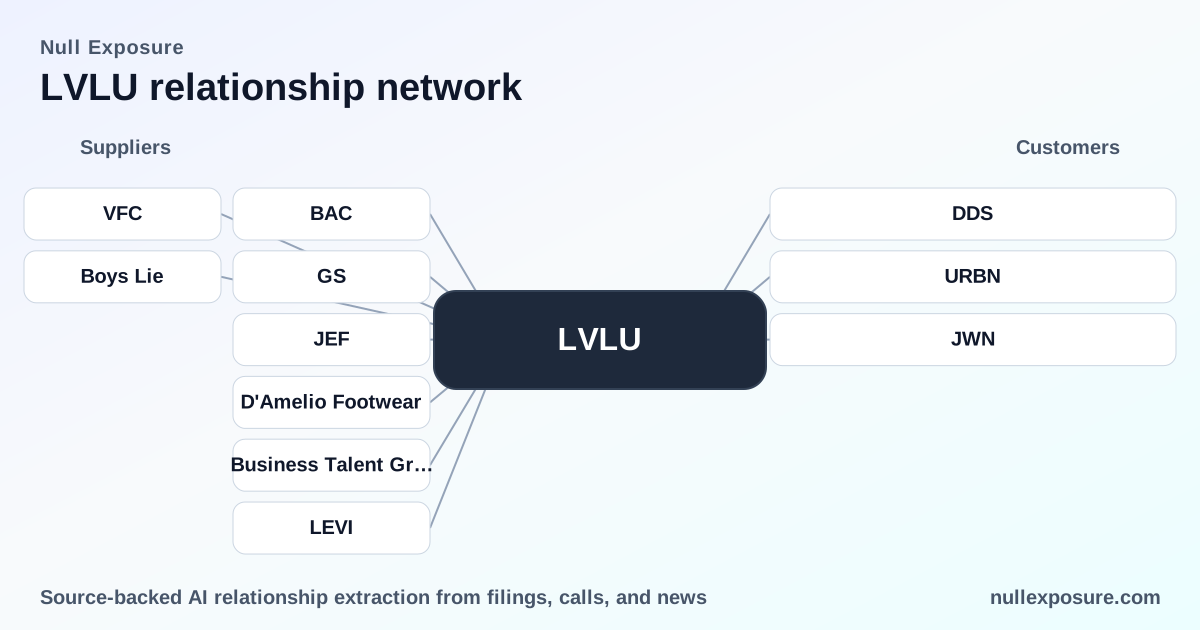
Below are Lulu’s reported retail and wholesale relationships referenced in public disclosures and press coverage; each entry includes a concise plain-English description and a short source note.
Nordstrom (JWN)
Lulu’s rolled out into all Nordstrom store doors nationwide, moving from initial in-store tests to full distribution and signaling retail partner confidence and in‑store demand; management also highlighted that roughly 55% of Nordstrom sales remain in physical locations. According to a GlobeNewswire press release (February 3, 2026) and subsequent coverage on March 10, 2026, this rollout follows strong wholesale momentum and supports Lulu’s omnichannel expansion.
Source: GlobeNewswire (Feb–Mar 2026) and Yahoo Finance reporting (Mar 10, 2026).
Amazon (AMZN)
Lulu’s launched a dedicated Amazon storefront offering a curated, largely exclusive assortment that preserves brand storytelling while leveraging Amazon’s reach and fulfillment convenience. Management framed the storefront as a channel that broadens reach without ceding merchandising control in the earnings call transcript and press release on March 17, 2026.
Source: GlobeNewswire press release (Mar 17, 2026) and earnings call transcript coverage (Q4 2025).
Victoria’s Secret (VSCO)
Lulu’s entered a new online wholesale partnership with Victoria’s Secret, expanding its presence into adjacent brand environments that cater to a large, fashion-oriented female shopper base. The partnership was highlighted in the company’s March 17, 2026 announcement as part of an intentional, brand‑accretive wholesale strategy.
Source: GlobeNewswire press release (Mar 17, 2026) and related May 3, 2026 coverage.
Dillard’s (DDS)
Lulu’s doubled its presence at Dillard’s to 100 store doors, including a Prom assortment with exclusive colorways and junior/occasion categories, marking targeted category expansion into department-store prom and occasion merchandising. This expansion was reported in early March 2026 and summarized in multiple trade outlets.
Source: Yahoo Finance (Mar 10, 2026) and GlobeNewswire (Feb–Mar 2026).
Urban Outfitters (URBN)
Following an initial Homecoming debut, Lulu’s expanded its online dress assortment with Urban Outfitters to reach a younger, fashion-forward customer and to leverage the retailer’s community-driven positioning. Coverage in March 2026 positions this relationship as another vector to lower DTC acquisition costs.
Source: Yahoo Finance and TradingView summaries (Mar 2026).
What these relationships collectively mean for the operating model
- Contracting posture: spot sales. Company disclosures state revenue is recognized at shipping point for product sales; this reflects a transactional, fulfillment‑driven revenue model rather than long-term subscription or licensing contracts.
- Counterparty mix: predominantly individual consumers. The enterprise is still primarily a DTC retailer with 2.6 million active customers as of year‑end 2024, though wholesale is scaling as a complementary channel.
- Geography: global reach with U.S. concentration. Lulu’s ships to ~150 countries and offers personalized services globally, but substantially all long‑lived assets and most revenue are U.S.-based, so exposure is weighted to North America.
- Materiality and segmentation: single merchandise segment. The company reports a single segment focused on merchandise sales and treats breakage and related items as immaterial in its revenue recognition.
- Relationship stage and maturity: active and scaling. Lulu’s maintains an active, engaged customer base while accelerating wholesale distribution—this is a strategic shift from pure DTC to a hybrid go‑to‑market.
These characteristics translate into a company whose revenue is transactional and fulfillment-dependent, increasingly diversified by retailer partnerships but still driven by direct customer economics and inventory execution.
Financial context and risk profile for investors
Lulu’s reported trailing twelve‑month revenue of roughly $282 million with gross profit of about $122 million, but earnings are negative—diluted EPS of -$4.90 and an EBITDA loss in the most recent reporting period. Wholesale growth is a key management narrative: coverage cites 143% year‑over‑year wholesale revenue growth in 2025, a sign that retail partnerships are beginning to move the top line. However, the company’s margins and profitability depend on inventory turns, promotional discipline, and wholesale terms that preserve AOV and margin.
- Upside drivers: accelerating wholesale penetration, Amazon storefront traction, and lower customer acquisition costs as partners carry merchandising and discovery.
- Key risks: small market capitalization and negative profitability, execution complexity of omnichannel distribution, inventory markdown risk if wholesale or in-store sell-through underperforms.
Source: company financials (FY‑2025 TTM) and press coverage noting wholesale growth (Mar–May 2026).
Investment takeaways — concise and actionable
- Wholesale expansion is real and measurable. Major retail partners (Nordstrom, Dillard’s, Urban Outfitters, Victoria’s Secret) plus an Amazon storefront materially extend Lulu’s distribution footprint and reduce marketing reliance on DTC channels (GlobeNewswire, Mar 2026; Yahoo Finance, Mar 2026).
- Economics are still recovery‑oriented. Revenue scale exists, but profitability remains constrained by negative EPS and a small market cap; wholesale growth must translate to sustained margin improvement.
- Operational focus will determine outcome. Execution across inventory, retail merchandising, and controlled assortment for partner channels will determine whether wholesale amplifies profitability or simply increases volume with compressed margins.
For detailed relationship analysis and continuous monitoring of partner disclosures and market signals, visit https://nullexposure.com/.
Conclusion: Lulu’s transition from a pure DTC challenger to a hybrid retailer with strategic wholesale partnerships is a meaningful inflection. If management sustains wholesale momentum while protecting brand economics, Lulu’s has a path to improved revenue quality; if not, growth could remain unprofitable. Investors should watch in-store sell-through, Amazon assortment performance, and wholesale margin mechanics as the proximate drivers of valuation.