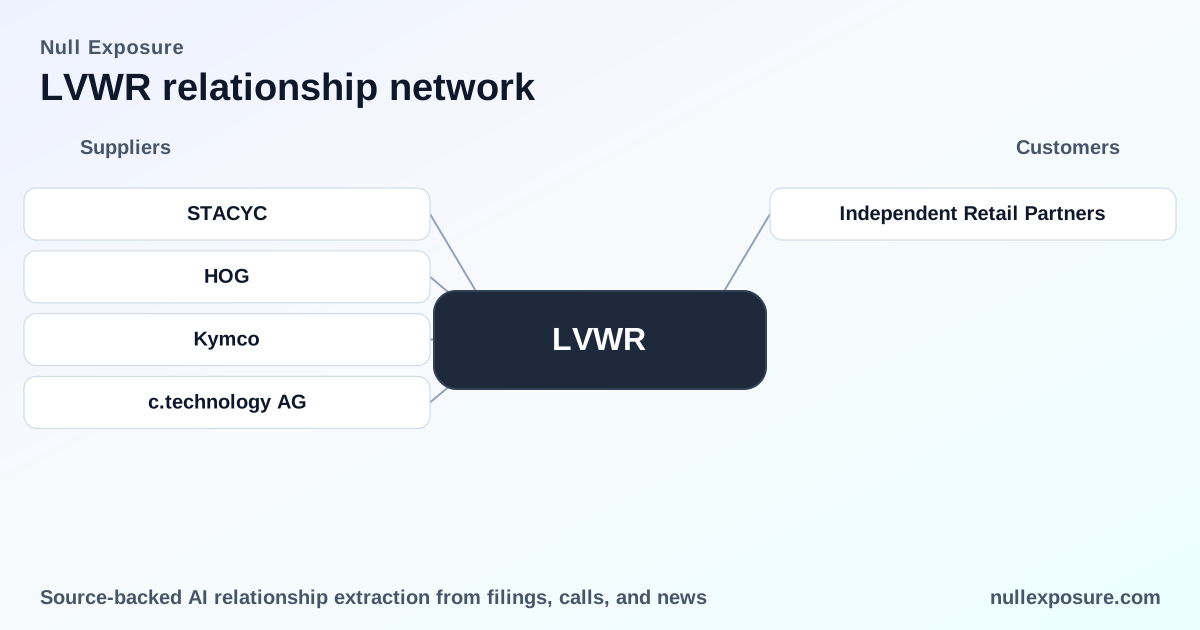
LiveWire Group (LVWR): Customer Relationships That Define the Distribution Play
LiveWire is an electric motorcycle manufacturer that monetizes through direct retail, e-commerce, and wholesale to independent dealers. The firm's revenue mix is wholesale distribution to Independent Retail Partners, company-owned retail, and online sales, with supplemental licensing and accessory revenues that can shift competitive dynamics through third‑party IP arrangements. For investors, the question is whether LiveWire’s distribution footprint and contractual posture give it durable channel reach without exposing the company to concentrated counterparty risk.
If you want a concise, deal‑level view of LiveWire’s customer posture and partner exposures, explore the company intelligence package at https://nullexposure.com/.
How LiveWire actually sells — the commercial model in one paragraph
LiveWire sells finished electric motorcycles and related parts, accessories and apparel through three channels: wholesale to a network of Independent Retail Partners, a company‑owned dealership, and direct online retail. Wholesale relationships position LiveWire to scale retail presence without large capital outlays for dealerships, while direct channels preserve margin and brand control. The company’s monetization therefore depends on successful dealer onboarding, inventory turns at partner retailers, and the growth of online sales and branded accessories.
Principal relationship: Independent Retail Partners — what it means for investors
LiveWire’s core go‑to‑market hinge is a network of Independent Retail Partners who buy motorcycles at wholesale and sell to end customers. According to LiveWire’s Form 10‑K for the year ended 2024, electric motorcycles are sold at wholesale to a network of Independent Retail Partners, and at retail through a company‑owned dealership and online. This channel structure accelerates geographic coverage while shifting inventory and retail operating risk to partners, but it also creates channel dependence on partner execution and local market demand (LiveWire 10‑K, FY2024).
Channel and geographic signals that govern risk and opportunity
LiveWire’s disclosures synthesize the company’s strategic footprint into clear regional priorities and channel roles:
- North America is a primary market. LiveWire describes the United States and Canada as priority markets for 2025 and reports that both its electric motorcycles and the STACYC segment operate materially in the U.S. (company filings citing 2025 priorities).
- EMEA is an explicit expansion focus. The company lists leading European markets (Germany, France, Switzerland, the Netherlands, U.K., Spain, Italy) as 2025 priority markets, signaling deliberate expansion rather than opportunistic exports.
- Distribution roles are formalized. The company sells balance bikes and other products wholesale to independent dealers and independent distributors, indicating standardized distributor agreements in at least portions of the portfolio (company disclosure).
These facts translate into operating model characteristics: low capital intensity for retail expansion (because partners hold retail sites), moderate counterparty concentration risk (networked independent dealers rather than many small ad‑hoc resellers), and scale risk tied to dealer inventory turns and international rollouts.
For more structured investor intelligence on how this channel exposure translates into revenue durability, visit https://nullexposure.com/.
Intellectual property and licensing: a strategic constraint with competitive implications
LiveWire’s filings disclose an Intellectual Property License Agreement that grants Harley‑Davidson (H‑D) rights to use LiveWire’s existing IP and incremental improvements. The filing notes that H‑D could develop competing products under that agreement and, in some cases, may be required to pay royalties for use of the IP. This contract is a two‑edged sword: it can generate royalty income and accelerate standards adoption but also raises competitive risk if the licensee leverages the IP in adjacent product lines (LiveWire 10‑K, FY2024).
This disclosure is a named constraint: H‑D’s licensee status is explicit in the company filing and therefore a direct relationship-level signal that investors should monitor for revenue offset (royalties) versus market share leakage.
Contracting posture, concentration and maturity — a synthetic read
The company’s statements about wholesale distribution and priority markets imply the following operational realities:
- Contracting posture: LiveWire uses standard wholesale reseller/distributor contracts to scale retail presence; these contracts transfer retail operating burden to partners but require effective channel management to protect margins and brand.
- Concentration: The dealer model reduces high fixed‑cost expansion, but revenue concentration risk can arise if a small number of Independent Retail Partners or regional dealers account for outsized sales in early rollouts.
- Criticality: For geography‑by‑geography market entry, independent dealers are mission‑critical — they are the primary customer-facing channel in many markets and thus central to unit growth.
- Maturity: The commercial model reflects early‑stage scaling: priority markets are explicitly targeted (2025), indicating the company still needs to prove consistent retail economics and international distribution execution.
These are company‑level signals drawn from the public filing language about channels and priority markets; they are not tied to one specific dealer entity unless the filing names that party.
Relationship detail — one line on every partner the filing lists
Independent Retail Partners: LiveWire sells electric motorcycles at wholesale to a network of Independent Retail Partners while also operating a company‑owned dealership and online retail channel (LiveWire Form 10‑K, FY2024).
(Disclosure: the company filing also documents an intellectual property license with Harley‑Davidson that grants H‑D rights to use existing IP and incremental improvements and contemplates royalties in some cases — LiveWire Form 10‑K, FY2024.)
Investment implications and what to watch next
- Growth leverage: If dealer adoption in North America and priority EMEA markets accelerates, LiveWire can scale retail distribution with limited capex, supporting higher unit volumes and accessory/aftermarket revenue.
- Execution risk: Monitor dealer inventory turns, order cancellations, and geographic revenue mix; these are the earliest and most reliable indicators of channel health.
- Competitive displacement via licensing: Track product roadmaps and announcements from Harley‑Davidson; the IP license is a latent source of competition that could reduce LiveWire’s pricing power or share if H‑D deploys the IP aggressively.
- Concentration metrics: Insist on counterparty concentration disclosure in future filings — a small number of Independent Retail Partners accounting for a large share of wholesale revenue would materially increase counterparty risk.
Bottom line
LiveWire’s commercial model is channel‑driven: wholesale to Independent Retail Partners plus direct retail and e‑commerce. That model enables rapid geographic reach but concentrates operational risk in partner performance and creates a strategic tension via the company’s IP license to H‑D. Investors should focus on dealer economics, regional rollout cadence, and any royalty or competitive outcomes arising from the IP license disclosed in the FY2024 10‑K.
For a detailed, analyst‑grade breakdown of LiveWire’s partner exposures and contract language, see the intelligence offering at https://nullexposure.com/.