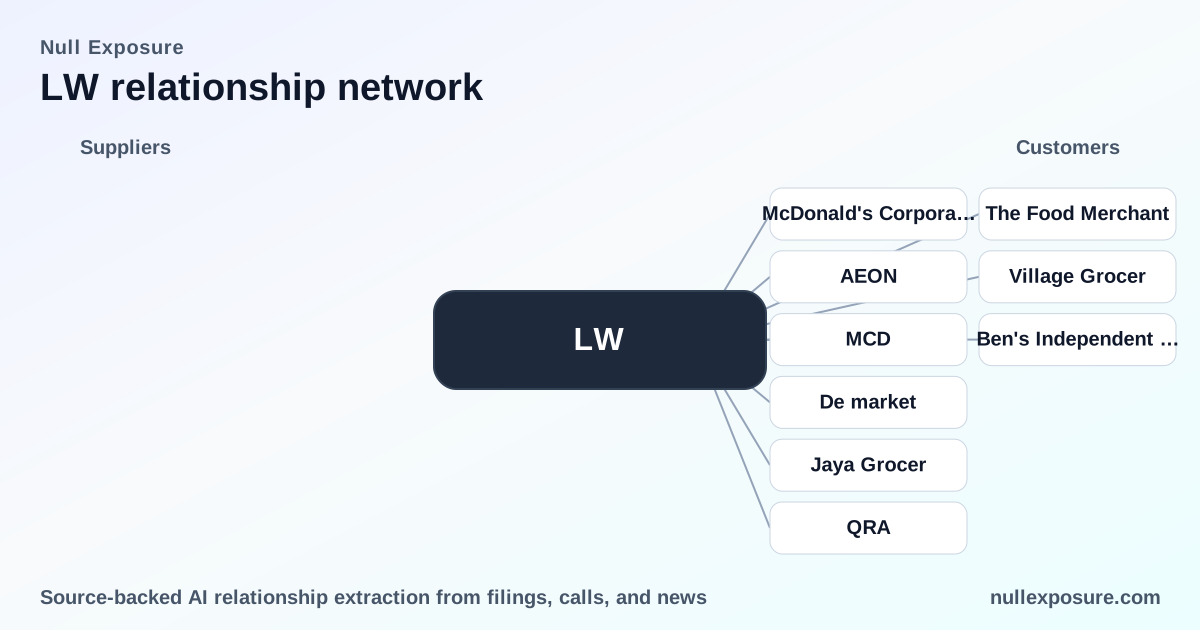
Lamb Weston (LW): Customer relationships that drive scale — and where the risk lives
Lamb Weston is a global producer, distributor, and marketer of frozen potato products that monetizes through high-volume, long-term supply contracts with quick-service restaurants, foodservice distributors, and major grocery chains. The company leverages manufacturing scale and category leadership to sell branded and co-manufactured frozen potato items into both restaurant and retail channels, earning stable gross margins from large recurring accounts—most notably McDonald’s, which accounted for 15% of net sales in FY2025.
If you evaluate counterparties and upstream exposure, start here: Lamb Weston’s commercial model is contract-driven, concentrated and operationally critical to its largest partners. Learn more at https://nullexposure.com/.
What the commercial footprint signals for investors
Lamb Weston’s filings and recent press combine to outline a clear operating profile that matters for valuation and downside scenarios:
- Contracting posture: long-term, high-volume supply agreements. The company highlights long-tenured relationships and explicit long-term supply arrangements with major chains, which underpin predictable volumes and working capital patterns.
- Concentration and criticality: top customers are material. Management discloses that its ten largest customers represented roughly 50% of net sales in FY2025, and that its single largest customer (McDonald’s) was ~15% of sales—a structural concentration that creates both bargaining leverage and counterparty risk.
- Counterparties skew large-enterprise and institutional. Lamb Weston targets large quick-service and fast-casual chains, global distributors, and mass grocery retailers—clients whose scale reduces credit risk but increases exposure to sectoral demand cycles.
- Geographic reach with a North American base. The business sells in over 100 countries but generates a majority of revenue in North America (roughly two-thirds), concentrating operational exposure to U.S./Canadian demand and supply-chain dynamics.
- Mature seller model—manufacturing + distribution. The company operates at the intersection of manufacturing scale and distribution reach, producing core frozen potato products while distributing through internal sales teams and external brokers/retail partners.
These factors make Lamb Weston a play on scale and distribution economics, while exposing equity holders to customer-concentration and commodity/supply risks. For a deeper look at partner-level exposure, read on.
Customer map — every relationship in the public record (concise takeaways)
McDonald’s / MCD
Lamb Weston identifies McDonald’s as its largest customer, representing approximately 15% of consolidated net sales in fiscal 2025 and accounting for material, high-volume supply under long-term arrangements. This relationship is central to Lamb Weston’s North American volumes and margin profile (Lamb Weston FY2025 10-K; multiple FY2026 press items).
AEON
Lamb Weston’s retail launches in Malaysia list AEON among major grocery retailers carrying its restaurant-quality frozen fries, reflecting the company’s push into international retail channels beyond foodservice (PotatoPro, March 2026).
Village Grocer
The Malaysian retail rollout names Village Grocer as a distribution point for Lamb Weston’s new retail fries, indicating targeted national retail partnerships in Southeast Asia (PotatoPro, March 2026).
Ben’s Independent Grocer
Ben’s Independent Grocer is cited as a retail partner in the Malaysian introduction of Lamb Weston’s product, demonstrating the company’s use of established regional grocery chains for market entry (PotatoPro, March 2026).
The Food Merchant
The Food Merchant appears on the Malaysian availability list for Lamb Weston’s retail line, showing a strategy of placing products with specialty and premium grocers as part of channel diversification (PotatoPro, March 2026).
Jaya Grocer
Jaya Grocer is listed among national retailers carrying Lamb Weston’s new retail offering in Malaysia, evidencing the company’s effort to scale consumer-facing distribution internationally (PotatoPro, March 2026).
De market
De market is named as a local outlet stocking Lamb Weston’s launch products in Malaysia, supporting the company’s regional go‑to‑market footprint in retail (PotatoPro, March 2026).
QRA
QRA outlets are included in the Malaysia retail distribution list for Lamb Weston, indicating partnerships across a range of retail formats in that market (PotatoPro, March 2026).
KLM
Lamb Weston’s Snap Fries, originally developed for airlines, are already listed on KLM, signaling the company’s penetration into travel/airline foodservice and suitability for constrained, high-throughput channels (PotatoPro UK, May 2026).
American Lorain / PLAG
A historical item notes that Lamb Weston’s subsidiary TaiMei Potato agreed to manufacture American Lorain (PLAG) brand fries, showing past third‑party manufacturing and co‑packing arrangements that expand utilization of Lamb Weston’s manufacturing footprint (PotatoPro company page, FY2019 reference).
What this customer list means for risk and upside
- Upside: Retail rollouts (Malaysia) and airline/channel placements expand Lamb Weston’s addressable market beyond quick service; international grocery listings can deliver margin mix improvements as branded retail grows. Recent product innovations like Snap Fries support premiumization in non-traditional channels.
- Risk: Customer concentration remains the dominant structural risk—McDonald’s alone is ~15% of sales—so changes in menu strategy or vendor consolidation would be immediately material. Geographic expansion reduces single-market cyclicality but does not remove the underlying concentration.
Investment implications and monitoring checklist
- Monitor renewal terms and length of supply agreements with major chains, particularly McDonald’s, because contract cadence drives volume visibility and capital allocation.
- Watch the retail expansion cadence and international rollouts for signs of margin diversification; successful shelf placement in multiple countries would reduce single-channel exposure.
- Track commodity and input-cost pass-through mechanics, which are critical given the manufacturing-heavy cost base.
- Follow any incremental third-party manufacturing or co-packing deals that increase capacity utilization without heavy capital spend.
For institutional research access to structured partner exposure and to monitor changes in Lamb Weston’s counterparty map, visit https://nullexposure.com/ for more.
Bold customer exposures and contract dynamics will determine whether LW trades as a scale-defensive food processing story or as a concentration-risk structural play.