LightWave Acquisition (LWAC) — Customer relationships that define a SPAC’s transactional footprint
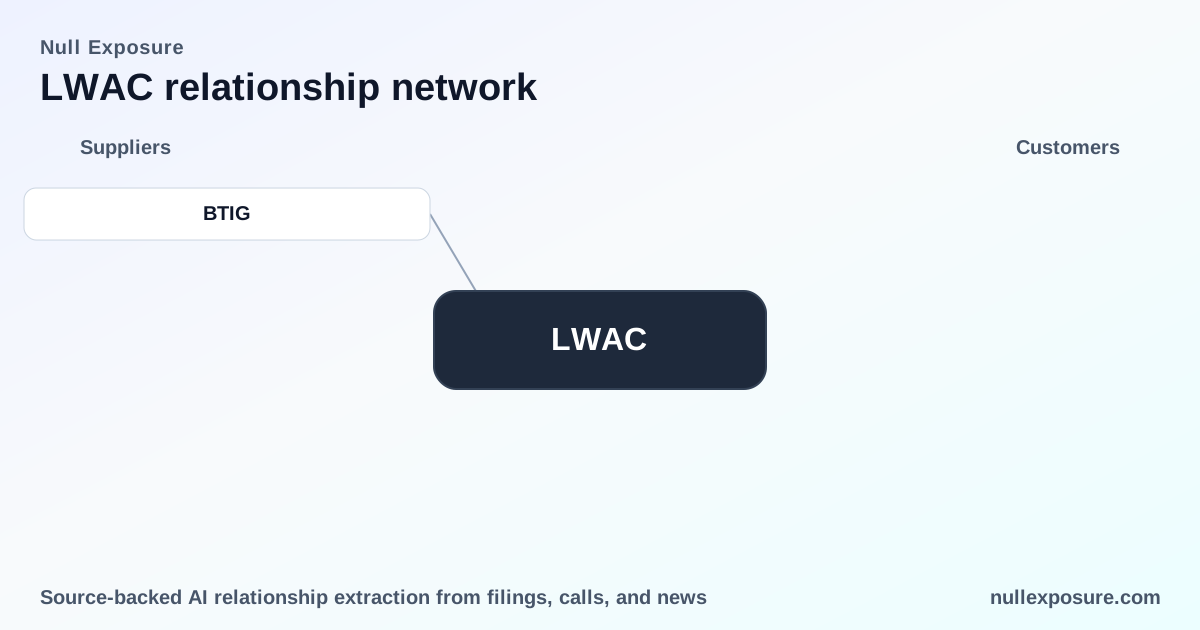
LightWave Acquisition Corp. operates as a special purpose acquisition company that raises capital through an IPO and private placements, then monetizes by executing a business combination with a target in communications or media, capturing value through sponsor economics and transaction-related proceeds. LWAC’s customer relationships are not product-sales channels but transactional counterparties—underwriters, sponsors and PIPE/anchor investors whose commitments determine deal execution, valuation and timeline. For investors evaluating counterparty risk, the BTIG underwriting participation in the company’s unit private placement is the primary relationship documented in the public customer dataset. Learn more about how we map these relationships at https://nullexposure.com/.
How LWAC’s customer map differs from an operating company’s clients
A SPAC’s “customers” are fundamentally financial counterparties rather than recurring buyers. LWAC’s monetization depends on successful capital raises and a completed merger: the IPO converts investor commitments to trust assets, sponsor capital and underwriter-led private placements bridge funding and underwriting credibility. Concentration is an operational feature, not an anomaly—each underwriting syndicate and sponsor purchase is critical during formation and deal execution but intrinsically transitory. Public filings reflect zero operating revenue and a balance sheet dominated by trust proceeds rather than commercial contracts, consistent with a pre-combination lifecycle.
BTIG, LLC — representative underwriter and private-placement purchaser (FY2025)
BTIG purchased 215,625 units at $10.00 per unit as the representative of the underwriters in LWAC’s private placement, executed concurrently with the IPO. The sponsor purchased an additional 390,625 units in the same placement, leaving LWAC with strengthened initial capital structure and underwriting support for its listing. This transaction is documented in the SEC filing reported by Investing.com on May 3, 2026. (Investing.com, SEC filing coverage, May 3, 2026.)
What the relationships tell investors about LWAC’s contracting posture
LWAC’s documented customer footprint signals a transactional, short-duration contracting posture typical of SPACs:
- The company’s counterparty engagements are front-loaded around the IPO and private placement; counterparties are financial intermediaries rather than recurring commercial customers.
- Concentration risk is inherent: a small number of counterparties (sponsor, underwriters like BTIG, PIPE investors) exert outsized influence on capital availability and the timeline for a business combination.
- Criticality is high during formation and deal execution: underwriting commitments and sponsor contributions are essential to completing the SPAC lifecycle; after a combination, this set of relationships is replaced by the operating company’s commercial base.
- Maturity is early and transactional: public financials list zero revenue and zero operating margins, underscoring that LWAC’s commercial maturity is contingent on completing a merger and transitioning to an operating entity.
Because the dataset contains no formal contractual constraints tied to customer relationships, the company-level signal is clean: LWAC’s customer side is governed by standard SPAC mechanics rather than diversified, long-term commercial contracts.
Risk and governance implications drawn from the relationship set
Investors should treat underwriting and sponsor participation as governance signals as well as capital inputs. BTIG’s role as representative of the underwriters is both a credibility and execution indicator: underwriter participation increases market access and underwrites distribution, while sponsor purchases align promoter incentives with listing success. However, the transactional nature creates two structural risks:
- Timing risk: SPACs operate under statutory windows to complete a business combination; delayed execution converts underwriting and sponsor commitments into time-limited benefits or liquidity pressures.
- Concentration and dilution risk: Sponsor economics and anchor/private-placement terms can materially affect post-combination ownership and dilution for public shareholders.
LWAC’s shareholder base composition — 75.522% institutional ownership and insiders holding about 8.045% — reinforces that institutional commitments drive the SPAC’s capital formation and secondary-market liquidity. The company’s market capitalization of roughly $383 million and zero operating revenue position LWAC as a finance-first vehicle where counterparty trust and transaction design determine investor outcomes.
How operators and acquirers should read the BTIG relationship
For an operator or potential target, BTIG’s participation is an operational signal: an underwriter representative that commits capital and distribution capacity facilitates deal certainty and market reception for the combined entity’s public debut. BTIG’s purchase of 215,625 units at IPO pricing shows active underwriting support, and the sponsor’s contemporaneous 390,625-unit purchase demonstrates promoter commitment to a successful listing. This alignment reduces execution friction during the fundraising phase, but it does not substitute for rigorous diligence on the target’s commercial viability post-merger.
Key takeaways for investors evaluating LWAC
- LWAC is a transaction-first vehicle: its customers are underwriters, sponsors and anchor investors who determine capital and deal cadence rather than recurring commercial buyers.
- BTIG is the principal documented counterparty in the public customer dataset; it purchased 215,625 units in the IPO-related private placement (Investing.com, SEC filing coverage, May 3, 2026).
- Concentration and timeline risk are the dominant operational risks: a small set of counterparties create high leverage at the point of a business combination.
- No formal customer constraints recorded in the dataset — this is a company-level signal consistent with SPAC mechanics rather than an operating company’s supplier or customer contracts.
- Institutional ownership is high (75.522%), which supports distribution but concentrates influence among large holders.
Explore deeper analysis and relationship mapping at https://nullexposure.com/ for investors tracking SPAC counterparty exposures.
Conclusion: relationship-driven value and transient risk
LWAC’s value proposition is entirely relationship-driven: underwriting representation and sponsor purchases create the capital runway for a business combination, and those same relationships represent the primary operational risks until a target is acquired. Investors should evaluate BTIG’s underwriting participation as a credibility enhancer that materially affects distribution and fundraising execution, while remaining attentive to concentration, timing and sponsor economics that will determine post-combination shareholder outcomes.