Lifeway Foods (LWAY): Retail-led kefir growth with concentrated customer exposure
Lifeway Foods operates as a vertically integrated manufacturer and distributor of probiotic kefir and cultured dairy products, monetizing through direct retail sales, distributor channels, and growing licensing/supply agreements. The company drives revenue by expanding shelf presence in national and regional retailers, partnering on co-branded smoothies and foodservice placements, and increasingly monetizing intellectual property via ingredient supply and royalties.
For a concise view of Lifeway’s customer positioning and how it translates to commercial risk and opportunity, visit https://nullexposure.com/ for the full coverage and data offering.
How Lifeway’s commercial model actually functions
Lifeway’s operating model is straightforward: manufacture core drinkable kefir products, sell them through two primary routes (retail-direct buyers and distributors), and expand reach via co-branded retail and foodservice partnerships. Company disclosures show retail-direct accounts for roughly 52% of net sales while distributors account for about 46%, indicating a balanced but concentrated go-to-market posture. Two customers represented roughly 25% of sales in 2024, underscoring customer concentration as a material operating constraint for investors. Geographically, Lifeway is primarily North America with international sales under 5% of revenue, which limits foreign market diversification but simplifies logistics and distribution focus.
- Contracting posture: mix of wholesale purchase orders with large retail chains and distributor agreements; new licensing and royalty deals indicate movement toward ingredient monetization and recurring royalty income.
- Concentration: two large customers contribute material share of sales — a clear single-buyer risk that investors must monitor.
- Criticality: products are consumer-facing staples for health-conscious segments, but dependence on shelf placement and club rotation (e.g., Costco) makes retail relationships strategically critical.
- Maturity: core product (drinkable kefir) is established; recent partnerships and licensing deals show the company is moving up the value chain into co-branded, foodservice and pet ingredient categories.
Explore a deeper relationship map and additional signals at https://nullexposure.com/ if you want a structured investor briefing.
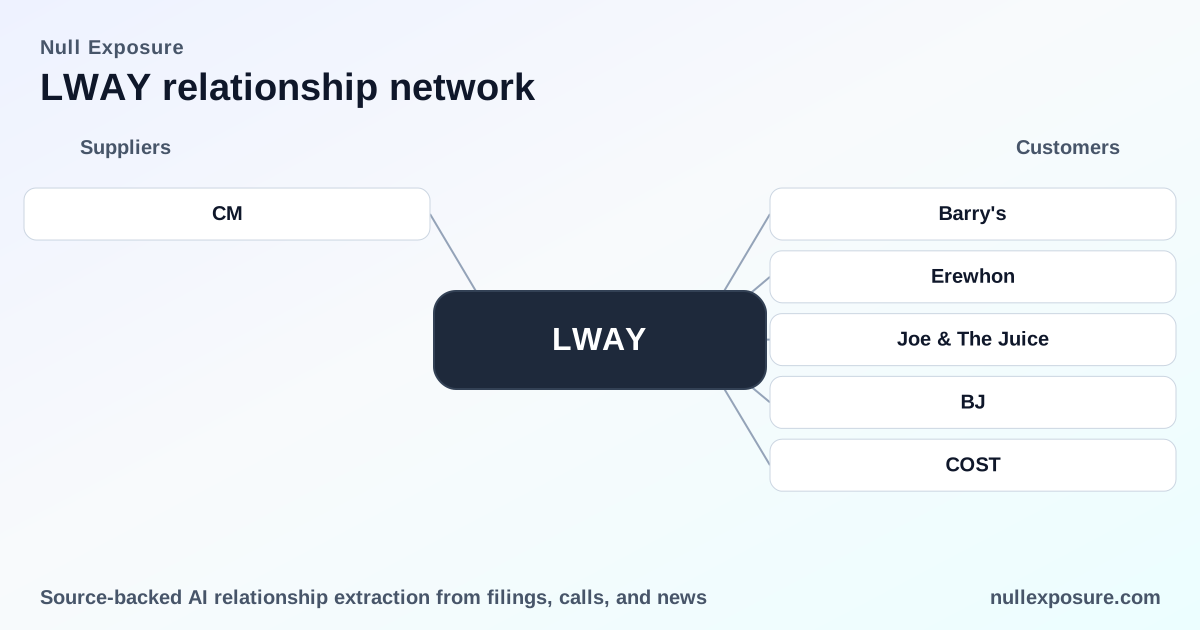
Customer relationships: who buys Lifeway and what they mean
Below I summarize every customer relationship flagged in recent reporting and news — concise, investor-focused notes with source references.
Costco
Lifeway expanded distribution into select Costco stores across multiple U.S. states with twin packs of Whole Milk Plain Kefir and maintained rotation in key club regions, signaling important club-channel traction and bulk-trial economics. (Multiple retail announcements and news summaries, Q1–Q2 2026; see TradingView and TradersUnion coverage and company remarks in earnings call transcripts.)
Source: TradingView coverage of Lifeway’s annual meeting (FY2025) and multiple TradersUnion/press items reporting Costco rollouts (FY2026).
Walmart
Lifeway announced distribution of Lifeway Farmer Cheese to approximately 2,000 Walmart stores nationwide, a milestone that substantially increases footprint and trial for a newer product line. This placement represents a meaningful step into mainstream grocery channels. (Management remarks on Q4 2025 earnings call.)
Source: Investing.com transcript of Lifeway Foods Q4 2025 earnings call (FY2026 commentary).
BJ’s
Lifeway reported expanded distribution into new retailers including BJ’s to broaden market presence beyond traditional specialty channels; this plays to the company’s club and mass-channel strategy. (Company presentation at annual shareholders meeting, FY2025.)
Source: TradingView recap of Lifeway’s annual shareholders meeting (FY2025).
Target
Analyst and coverage pieces link Lifeway’s strategy to expanding shelf space at national chains such as Target as part of a broader expansion narrative tied to a revenue run-rate north of $200M. This underlines Lifeway’s focus on large-format national grocers for scale. (Analyst commentary and coverage, FY2026.)
Source: Simply Wall St analysis of Lifeway expansion (FY2026).
Whole Foods
Coverage groups Whole Foods alongside Target, Costco and Publix as retailers where Lifeway is seeking/expanding shelf presence, suggesting penetration into premium organic and natural channels. (Analyst and coverage notes, FY2026.)
Source: Simply Wall St coverage referencing retailer expansion (FY2026).
Publix
Publix appears in commentary as a target for expanded shelf space, reinforcing Lifeway’s strategy to pursue regional supermarket chains to complement national accounts. (Analyst coverage, FY2026.)
Source: Simply Wall St analysis of retailer expansion (FY2026).
Erewhon Market / Erewhon
Lifeway partnered with LA-based Erewhon Market to create a Tropical Lifeway Smoothie featuring Organic Lifeway Kefir, and previously launched a limited-edition pumpkin-spice smoothie in collaboration with Erewhon, showing strength in high-end, health-focused foodservice partnerships. (Partnership announcement and PR releases, 2025–2026.)
Source: PerishableNews and PR Newswire coverage of the Erewhon partnerships (FY2025–FY2026).
Joe & The Juice
Lifeway collaborated with Joe & The Juice to develop the “Trust Your Gut” smoothie and later limited-edition smoothies, demonstrating repeatable foodservice co-branding that targets daily-wellness consumers. (PR release and earnings remarks, FY2025–FY2026.)
Source: PR Newswire and earnings transcript references to Joe & The Juice partnerships (FY2025–FY2026).
Barry’s
Lifeway supplied a kefir-packed Power Play shake for Barry’s Fuel Bar locations nationwide during Barry’s “Find Your Strength” challenge, a promotional partnership that drives sampling in fitness-focused outlets. (Press release and earnings commentary, early 2026.)
Source: PR Newswire and DairyFoods article on the Barry’s partnership (FY2026).
Open Farm
Lifeway announced a new supply agreement and its first-ever licensing and royalty deal with Open Farm, which will source ingredients from Lifeway for a premium pet food product called GoodGut — an early signal of product diversification and IP monetization beyond human food. (Management disclosed on the Q4 2025 earnings call.)
Source: Investing.com transcript of Lifeway Foods Q4 2025 earnings call (FY2026).
Drugstore
Lifeway launched a limited edition Lifeway Probiotic Sunrise Smoothie in collaboration with a retailer referenced as Drugstore, indicating experimentation with limited runs and retail partners beyond grocery and clubs. (Earnings call narration of limited-edition launches.)
Source: Investing.com earnings call transcript referencing the Drugstore launch (FY2026).
What investors should watch next
- Concentration risk is real: Two customers accounted for ~25% of 2024 net sales; monitor renewal, pricing, and slotting economics with large retailers.
- Distribution balance: The roughly equal split between retail-direct (52%) and distributor channels (46%) provides resilience, but retail placements (Costco, Walmart, Target) are the immediate lever for scale.
- Margin and product mix: Expanding into club pack formats and co-branded smoothies supports volume but can compress margins; recent commentary flagged margin pressure tied to growth investments.
- Diversification upside: Licensing and ingredient supply to Open Farm (pet food) is a strategic positive, creating potential recurring royalty streams and use-case expansion beyond beverages.
Bottom line: Lifeway executes a retail-first growth play built on an established kefir franchise with smart co-branding and emerging licensing opportunities; the model scales with club and national retail penetration but retains material customer concentration risk that will determine near-term earnings durability.
If you want a detailed matrix of each partnership, channel economics, and contract maturity schedules, review our investor-grade relationship mapping at https://nullexposure.com/.