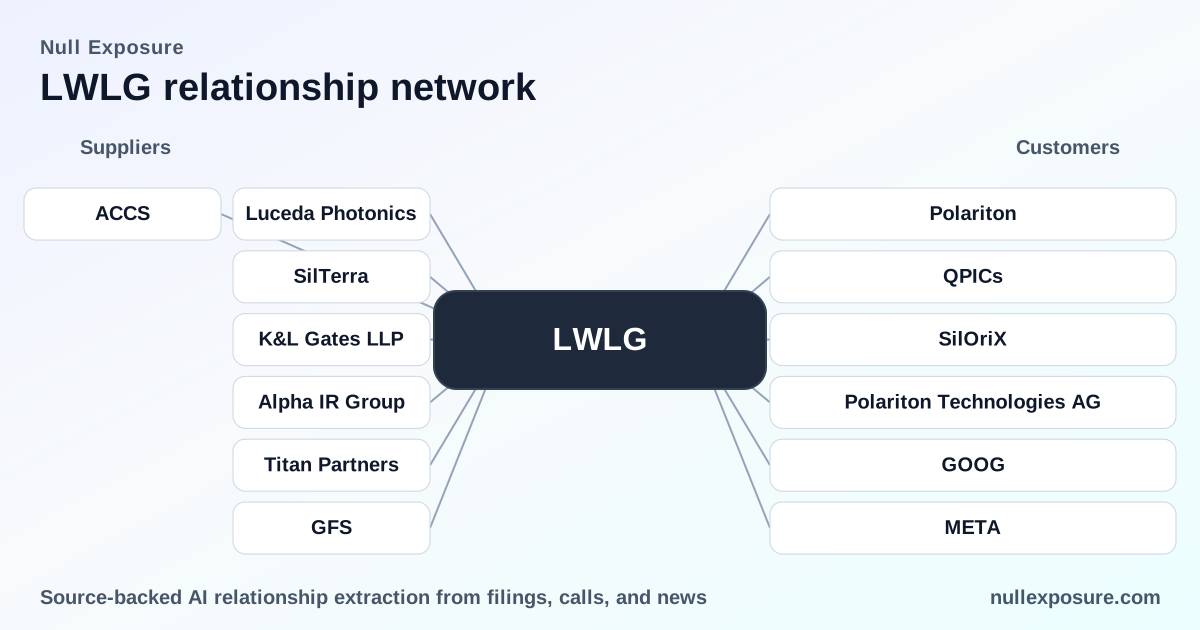
Lightwave Logic (LWLG): Customer Relationships That Drive a Materials‑to‑Silicon Strategy
Lightwave Logic develops and licenses high-performance electro‑optic polymers and supplies Perkinamine® chromophores to photonic device makers; the company monetizes through material supply agreements and technology licenses that embed its polymers into photonic integrated circuits (PICs) and silicon photonics platforms. For investors, the revenue profile is concentrated, recurring in nature, and tied to commercialization partnerships with foundries, PIC houses and quantum‑photonics integrators—making customer relationships the primary vector for scaling revenue and validating the technology roadmap. Learn more about the company’s coverage and client signals at https://nullexposure.com/.
Why customers are the growth engine, not just revenue lines
Lightwave Logic’s commercial model is not traditional product sales; it is a supplier‑licensor hybrid: the company both sells proprietary chromophores and grants non‑exclusive, royalty‑bearing licenses to use its electro‑optic polymer platform. That positioning creates multiple commercial levers — upfront material supply revenue, license fees and potential volume royalties — but also concentrates financial exposure on a small number of strategic partners. Public filings show one customer accounted for at least 10% of revenue, and the firm recognized early revenue from a four‑year license and material supply agreement that began in 2023. Given the small base of current revenue, each customer relationship functions as both proof of concept and a scaling catalyst.
Explore LWLG relationship analytics and original source documents at https://nullexposure.com/.
Customer relationships: who Lightwave Logic is working with and why each matters
Polariton / Polariton Technologies AG
Lightwave supplies EO polymer materials and integration expertise to Polariton as part of an expanded technical partnership targeting 400 Gb/s per lane datacenter optical links, positioning the polymers as a performance enabler for next‑generation transceivers. A Lightwave press release on PR Newswire (FY2025) described the supply and integration relationship supporting AI/datacenter optical upgrades.
Polariton (earnings mention)
Management flagged Polariton again on the Q4 2025 earnings call as a long‑time customer and partner advancing plasmonics toward commercialization, reinforcing an active engineering and supply relationship. The company referenced this during the LWLG 2025 Q4 earnings call transcript (reported March 2026).
QPICs
Lightwave signed a Memorandum of Understanding with QPICs to develop Process Design Kits (PDKs) that incorporate Lightwave’s polymer platform and encapsulation processes, accelerating PIC production timelines for quantum computing customers. The MOU and its objectives were announced in a January–March 2026 wave of coverage, including a markets.financialcontent.com release (January 15, 2026) and follow‑ups on The Quantum Insider and Quantum Computing Report (January 2026).
Tower Semiconductor Ltd (TSEM)
Lightwave announced a development agreement to integrate its electro‑optic polymer modulators into Tower Semiconductor’s PH18 silicon photonics platform, establishing a pathway to commercial foundry ramp and broader market access through Tower’s silicon photonics supply chain. Multiple news outlets covering the development and related insider trading notices ran in spring 2026, including Sahm Capital and Investing.com (April–May 2026).
GlobalFoundries (GFS)
Lightwave’s modulator integration was reported as being integrated into the GDSFactory PDK used by GlobalFoundries' silicon photonics manufacturing platform, which creates a direct routing from polymer IP to GlobalFoundries’ process flows for customer tape‑outs. Industry commentary and coverage on Simply Wall St and StockstoTrade (FY2026 reports) document this integration.
GDSFactory
Lightwave and GDSFactory collaborated to integrate Lightwave’s polymer‑based modulators into the GDSFactory PDK, enabling PIC designers to include high‑speed EO polymer modulators for tape‑out on GlobalFoundries’ silicon photonics platform. A Bitget article and other industry reports in 2026 described this PDK integration and the tape‑out enabling effect.
SilOriX
In a 2022 collaboration highlighted by PR Newswire, SilOriX supplied Perkinamine™ chromophores and worked with Lightwave and partners to achieve world‑record performance for green ultra‑high‑speed slot modulators, demonstrating the materials’ competitiveness in SOH (silicon‑organic hybrid) devices. PR Newswire coverage from FY2022 documents the technical collaboration and its performance claims.
Google (GOOG)
Lightwave has signaled technology transfer paths to hyperscalers, with PredictStreet and industry commentary in December 2025 noting potential partnerships with hyperscalers like Google to integrate polymer modulators into custom transceiver or hardware solutions. This framing positions hyperscalers as prospective very‑large enterprise counterparty targets rather than firm customers at publication.
Meta (META)
Alongside Google, Lightwave has cited hyperscaler opportunities such as Meta in its go‑to‑market narrative; PredictStreet coverage in December 2025 describes these targets as strategic end markets for polymer‑enabled transceivers. The mention signals strategic market orientation toward large cloud/hyperscale buyers.
How these relationships shape LWLG’s operating model and investment profile
Lightwave’s customer relationships reveal several actionable characteristics for investors:
- Contracting posture — licensing plus supply: The company’s commercial operations center on a material supply and license agreement model; filings show the first commercial revenues derived from such agreements. This structure creates both recurring material revenue and licensor economics through license fees and potential royalties.
- Concentration risk with high strategic upside: One customer accounted for at least 10% of sales in recent filings, indicating material revenue concentration even as partnerships with foundries and PIC houses offer scalable market access.
- Longer‑term contracts and active engineering stage: Filings document a four‑year material supply and license agreement beginning in 2023 and active recognition of revenue and cash collections through 2024. Relationships are commercial and active, combining engineering integration and low‑volume supply today with commercialization potential.
- Global footprint and hyperscaler target market: Geographic revenue is predominantly international (86% outside the U.S. in 2024), and company narrative targets hyperscale datacenters as end markets, signaling global go‑to‑market ambitions and large counterparty targets.
- Role complexity — seller and licensor: Lightwave operates as both seller of critical polymer materials and licensor of proprietary IP, positioning it as a supplier to device manufacturers and as a technology partner to foundries and integrators.
- Core product focus: The company’s revenue to date is tightly coupled to its core Perkinamine® chromophore and polymer product line, which functions as both the technical differentiator and the commercial backbone.
Investment implications and principal risks
Lightwave’s partnership network — integration with Tower, GlobalFoundries/GDSFactory PDK inclusion, MOU with QPICs, and supply agreements like Polariton and SilOriX — de‑riscos technical adoption and create multiple commercialization paths (foundry ramp, PIC houses, hyperscalers, and quantum photonics). However, the company’s current revenue base is small, concentrated, and dependent on successful scale‑up at foundries and adoption by large OEMs and hyperscalers. Investors should weigh the upside of platform adoption against concentration, execution risk at scale, and the typical long timelines for silicon photonics supply chain commercialization.
For deeper relationship mapping and continuous monitoring of partner developments, visit https://nullexposure.com/.
Bold takeaway: Lightwave Logic’s customer relationships are the company’s product-market proof — commercial licenses and supply deals convert lab IP into potential recurring revenue, but scaling requires successful foundry integrations and expanded customer concentration beyond the singular material‑license customer reported to date.