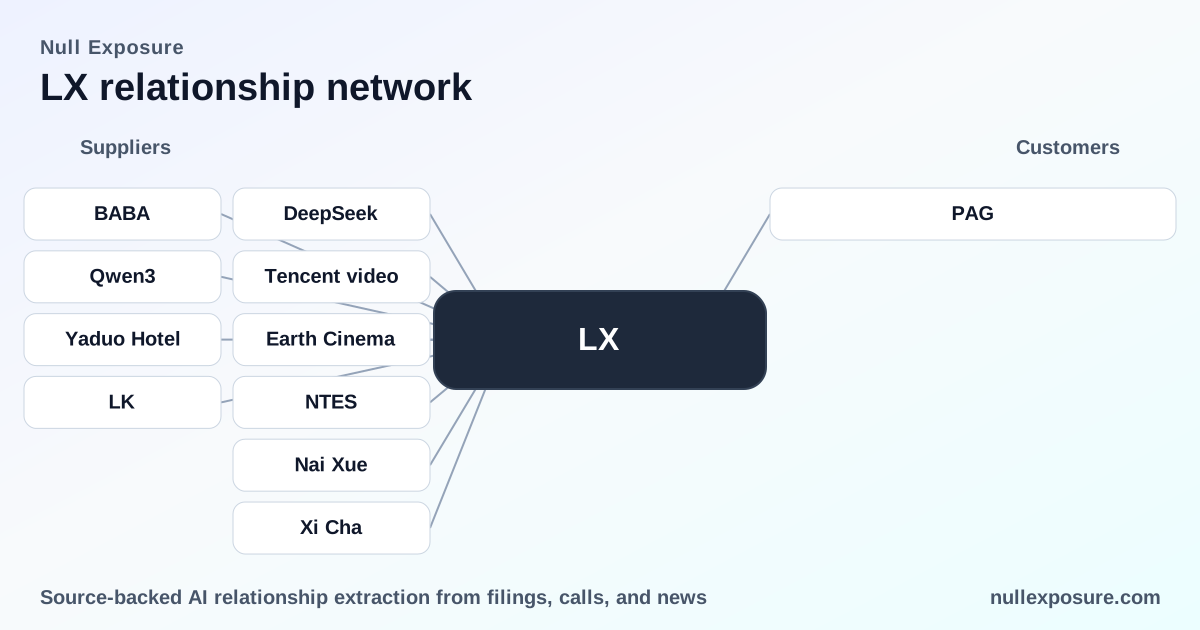
LexinFintech (LX) — Customer and stakeholder map for investors and operators
LexinFintech (LX) operates an online consumer finance and consumer services platform focused on young professionals in China, monetizing through lending interest, platform fees and ancillary consumer services. The company generates substantial top-line scale (Revenue TTM: 13.15 billion) while trading at deeply compressed multiples (Trailing P/E ~1.5, Price-to-Sales ~0.0261), creating a risk/reward profile driven more by governance, capital structure and regulatory exposure than by classic growth narratives. For a concise dossier and ongoing tracking of LX relationships, visit https://nullexposure.com/.
What the business looks like to a capital allocator
LexinFintech’s public financials paint a distinct picture: large revenue base with thin operating leverage and volatile growth. Revenue TTM stands at 13.152 billion and gross profit at 5.083 billion, while net profit margins are positive (Profit Margin ~12.8%) and Return on Equity registers at ~14.8%. Yet quarterly trends show contraction: quarterly revenue growth is negative (-16.8% YoY) and quarterly earnings growth is down (-39.8% YoY), indicating cyclical pressure or portfolio re-pricing. Valuation multiples are low across the board: Trailing PE 1.507 and EV/EBITDA 2.231.
Key financial signals for investors:
- Scale with margin pressure: High revenue and reasonable gross profit but slowing top-line and declining quarterly earnings growth.
- Valuation dislocation: Extremely low price-to-sales and P/E multiples relative to peers, implying market skepticism or hidden risks.
- Income profile: The company pays a substantial cash dividend per share (Dividend Per Share: 2.672; Dividend Yield: 18.2% per the profile), with recent dividend and ex-dividend dates in 2026 reported.
These facts suggest a thesis where the company’s intrinsic cash generation and asset base are central to value, and governance or sponsor relationships materially affect investor returns.
Customer and stakeholder relationships: what is on the record
The public relationship mapping for LX in the available records is compact. Below is every relationship captured in the search results, summarized plainly and tied to source reporting.
PAG — private equity investor and governance designee
PAG purchased convertible notes from LexinFintech in a transaction announced on September 11, 2019 and completed on September 16, 2019; in connection with that investment the firm designated Mr. Suining Xiao for appointment to the company, and that appointment was reported in a press release. A Futunn press release covering the company’s disclosures referenced the PAG designee appointment on March 10, 2026. This is a classic investor-governance link that signals active sponsor involvement rather than a simple creditor relationship. (Source: Futunn press release, March 10, 2026 — reporting the company announcement.)
Operating-model constraints and what they imply for counterparties
No explicit contract-level constraints were captured in the relationship records provided. That absence is itself a company-level signal: either LX’s customer and partner contracts are not disclosed at a granular level in the sources aggregated here, or LX does not have single-counterparty commercial dependencies recorded in this search. For diligence, investors must evaluate contracting posture and concentration through more detailed filings and shareholder disclosures.
From the public financial and relationship signals, operators and buyers should assume the following about LX’s operating model:
- Contracting posture: Institutional investors such as PAG have taken debt-equity hybrid positions; governance influence exists through investor designees rather than commercial supplier lock-ins.
- Concentration: Public records do not show critical single-customer dependencies; revenue scale suggests a broad retail consumer base rather than enterprise customers concentrated by contract.
- Criticality: Customer relationships are operationally critical (loan book and platform engagement drive cash flow), but the public relationship set does not point to any third-party single point of failure.
- Maturity: The company exhibits mature financial metrics (positive ROE, dividend program) while showing near-term revenue contraction—consistent with a platform moving from rapid growth to consolidation.
Implications for investors and operators
The intersection of low market valuation, positive but pressured profitability, and visible sponsor governance activity produces a clear set of investment and operational considerations.
- Governance monitoring is priority one. The PAG convertible-note investment and board designee appointment indicate that external sponsors can influence strategy and capital allocation; investors should track board composition and any changes to capital structure arising from convertible instruments. (Source: Futunn press release, March 10, 2026.)
- Capital allocation and dividend sustainability are central. LX reports a substantial per-share dividend; given declining quarterly growth and operating margin compression, operators must model cashflow sensitivity to loan performance and funding costs before assuming dividend persistence. Company filings through Q1 2026 provide the numbers for stress testing.
- Valuation arbitrage exists but is conditional. Extremely low multiples imply upside if governance stabilizes and revenue trends reaccelerate, but the return is contingent on resolving contract-level risk and regulatory exposure in Chinese consumer finance.
- Operational counterparty diligence remains necessary. Absence of disclosed contract constraints means counterparties should validate collections, underwriting standards and third-party dependencies directly; public investor involvement does not substitute for operational due diligence.
If you want a deeper mapping of LX’s counterparties and disclosed governance events, see the full tracker at https://nullexposure.com/ — it consolidates public relationship signals and filings for active monitoring.
A concise risk-reward synthesis
- Risk: Declining quarterly revenue and earnings growth, regulatory and macro sensitivity for Chinese consumer lending, and dependence on external capital markets or sponsor financing for balance-sheet flexibility.
- Reward: Large revenue base and positive ROE with cash-generative operations, paired with depressed market multiples and clear investor sponsorship that could unlock value via restructuring or asset monetization.
Bottom line: LexinFintech is a cash-generative consumer finance platform trading at severely compressed multiples, with governance-driven investor influence on the record. For investors and operators, the investment case hinges on governance execution, the durability of loan performance under stress, and clarity on capital structure—areas where further primary diligence is essential.