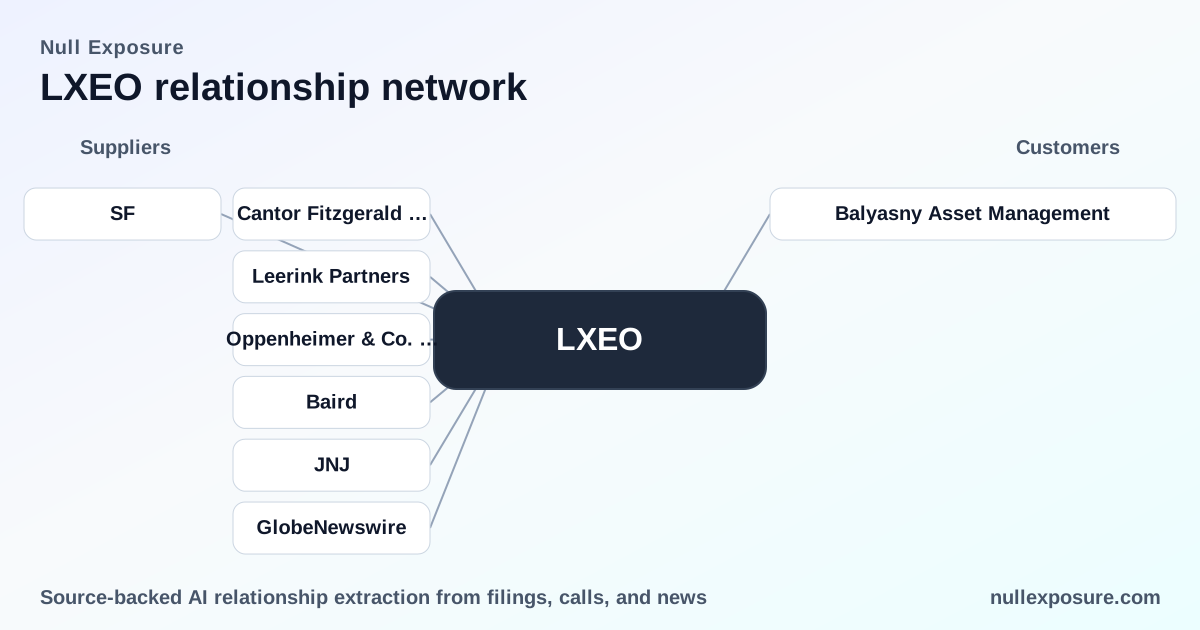
Lexeo Therapeutics: financing-driven model with institutional underwriting
Lexeo Therapeutics is a clinical-stage genetic medicine company that develops therapies for hereditary and acquired diseases and currently monetizes almost entirely through capital markets and transactions with institutional investors and partners rather than product revenue. The firm is pre-revenue, with a negative EBITDA and ongoing R&D cash burn, so investment rounds and structured equity instruments shape both liquidity and ownership dilution. For focused customer-relationship intelligence and deal-level signals, visit https://nullexposure.com/.
The institutional investor deal that matters right now
Lexeo completed a public offering with a concurrent private placement in which it sold pre-funded warrants to institutional investors as part of the financing package. According to a GlobeNewswire press release dated October 20, 2025, Lexeo sold prefunded warrants to Balyasny Asset Management to purchase 1,250,015 shares of common stock at $7.9999 per pre-funded warrant as a private placement exempt from registration requirements. That tranche represents roughly $10.0 million of proceeds from that single institutional counterparty. (GlobeNewswire, October 20, 2025.)
What the Balyasny transaction means for operators and investors
Lexeo’s sale of prefunded warrants to Balyasny Asset Management reflects conventional life‑science financing mechanics: the company is using hybrid equity instruments to broaden its investor base while providing institutional buyers with immediate conversion flexibility. The GlobeNewswire filing (Oct. 20, 2025) documents the specific terms—1,250,015 pre-funded warrants at $7.9999 each—showing direct institutional support during the offering.
All named counterparty relationships in the record
- Balyasny Asset Management purchased prefunded warrants to acquire 1,250,015 shares at $7.9999 per pre-funded warrant as part of Lexeo’s public offering and concurrent private placement, representing close to $10.0 million in cash proceeds. This was documented in Lexeo’s offering disclosure via GlobeNewswire (October 20, 2025).
This dataset contains a single named counterparty event: the Balyasny transaction above. There are no other customer or material counterparty relationships listed in the provided results.
How the relationship set informs Lexeo’s operating model
- Contracting posture: Lexeo operates with a financing-first contracting posture. The firm relies on securities offerings, private placements, and institutional investors for near-term capital rather than recurring customer contracts or product revenues.
- Concentration: With the available records naming only one institutional purchaser in the latest offering, funding sources are concentrated on capital markets and a small set of institutional backers during discrete financings.
- Criticality: External capital is critical to sustaining R&D and clinical programs; the Balyasny instrument is a material example of that dependence.
- Maturity: Lexeo is a classic clinical-stage, pre-commercial biotech: no product revenue and operating losses are the dominant financial reality.
Note: the relationship data provides no discrete customer contracts that shift cashflow dependency away from capital raises; the single documented transaction is an investor financing rather than a commercial customer engagement.
Company-level financial signals that matter to counterparties
- Pre-revenue profile: Lexeo reports RevenueTTM = 0 and a negative gross profit for the trailing period, confirming product sales are not yet part of the revenue model (company data, latest quarter 2025-12-31).
- Balance-sheet and valuation context: Market capitalization is listed at roughly $455 million, with negative EBITDA and operating losses reported. These figures underline why equity financings and instruments such as prefunded warrants are central to the company’s capital plan.
- Analyst sentiment: Sell-side coverage is skewed positive: aggregate analyst target price sits near $19.64 with multiple Buy/Strong Buy recommendations recorded, indicating market interest despite clinical-stage risk.
These financials explain why Lexeo structures deals like prefunded warrants—investors receive conversion mechanics while the company secures funds without immediate dilution of outstanding shares until warrants convert.
Risk and governance implications for investors and operators
- Dilution risk: Prefunded warrants and concurrent underwriter option exercises expand potential share count; investor returns will depend on successful clinical outcomes and subsequent commercial traction.
- Counterparty concentration risk: The record shows institutional support concentrated among a small set of investors at a time; future financings will test the depth of demand and pricing leverage.
- Operational leverage: With no recurring customer revenues, Lexeo’s runway and program continuity are directly tied to capital-raising success and cash management discipline.
Actionable takeaways
- Capital markets are the product: For now, Lexeo monetizes primarily through financings—investors should treat institutional transactions as the company’s principal revenue proxy and gauge sentiment by who participates and on what terms.
- Single-deal visibility: The Balyasny prefunded-warrant purchase is the only listed counterparty event in the provided returns, making each such transaction important for short-term liquidity signaling.
- Clinical risk dominates value creation: Any valuation appreciation depends on advancing clinical programs; financing terms such as those in October 2025 trade immediate capital for potential future dilution.
For deeper, deal-level intelligence on institutional counterparty participation across life-science financings, explore further at https://nullexposure.com/.
Final read
Lexeo is executing a standard clinical-stage financing play: secure capital through staged offerings and structured instruments while advancing pipelines toward clinical inflection points. The Balyasny prefunded-warrant purchase is a concrete illustration of that approach—institutional underwriting provides near-term cash while preserving optionality via warrants, but it also increases potential dilution and ties the company’s survival to future market windows and clinical progress. Investors and operators should prioritize monitoring follow-on financings and any emergence of recurring commercial relationships that would materially change the company’s contracting posture.