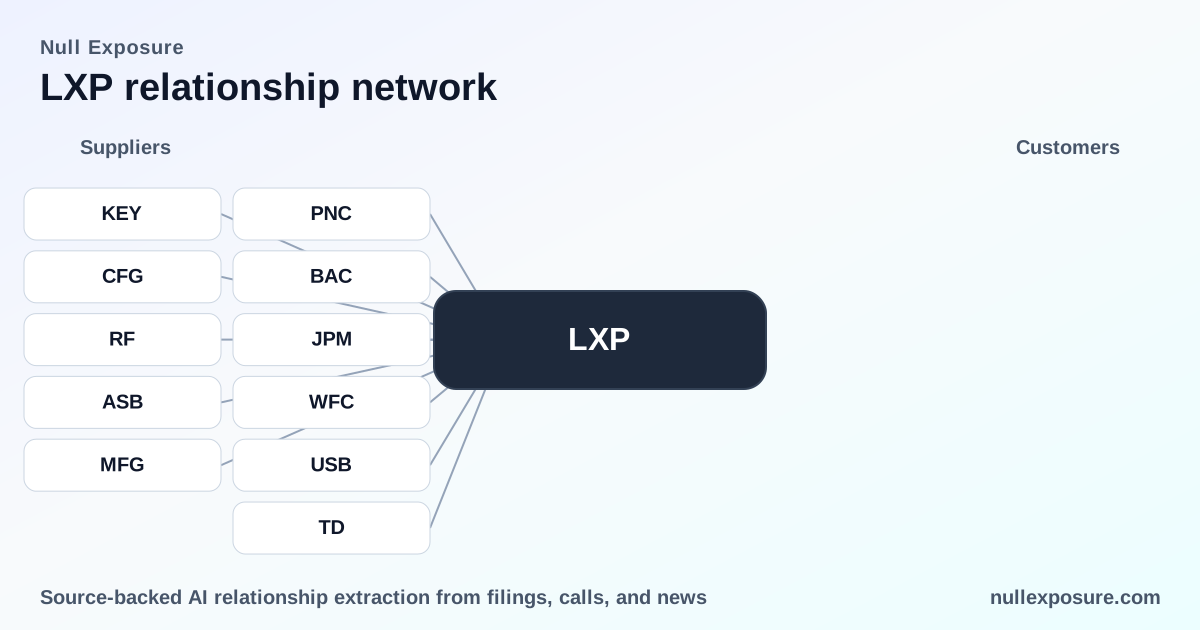
LXP Industrial Trust: tenant signals, lease posture, and what Nissan tells investors
LXP Industrial Trust (LXP) operates as a Class A industrial REIT that owns and manages a nationwide portfolio of warehouse and distribution facilities and monetizes primarily through long‑term net leases that produce recurring rental cash flow and long‑run capital appreciation. For investors evaluating customer relationships, the firm’s operating leverage comes from predictable fixed rents, concentrated rollover cohorts, and tenant credit profiles that shape near‑term cash flow volatility and re‑letting upside. For a consolidated view of customer signals and regulatory disclosures, visit https://nullexposure.com/.
Snapshot: the business model in plain language
LXP generates cash flow as a landlord of industrial real estate positioned for logistics and e‑commerce demand. Key financial and structural facts that matter for customer analysis:
- Portfolio focus: Class A warehouses and distribution facilities across North America (company filing).
- Revenue profile: Rental income concentrated in long‑term leases with fixed future receipts through 2030 and beyond (company filing as of December 31, 2025).
- Capital metrics: Market capitalization roughly $2.98 billion, trailing EV/EBITDA ~25.8, and a dividend yield around 5.3% (company financials, latest quarter).
- Tenant posture: LXP reports a number of large leases that roll in 2027, giving near‑term concentration of renewal risk and opportunity (earnings call transcript).
These facts establish LXP as a cash‑flow oriented landlord whose investor thesis hinges on lease renewals, tenant credit, and the company’s ability to re‑price or re‑let large “chunky” boxes when leases expire.
Customer relationship found: Nissan
Nissan — automotive manufacturer
LXP cited Nissan as one of the tenants tied to several large lease expirations in 2027; management stated they are in advanced negotiations and expect a very high renewal rate for those large boxes that include Nissan. According to an earnings call transcript posted by InsiderMonkey on May 3, 2026, Nissan is explicitly listed among the tenants involved in the 2027 renewal cohort.
What the disclosed relationships collectively tell you about LXP’s operating posture
The relationships and company disclosures produce a consistent set of operating signals:
- Contracting posture — long‑term net leases. Company filings state a material portion of rental income derives from long‑term net leases and show fixed future rental receipts by year (data through December 31, 2025). This structure creates high visibility into cash flows but also gives tenants significant operational discretion under net lease terms.
- Geographic footprint — North America only. Filings note that all properties operate within North America, which concentrates regulatory and market risk but benefits from a large, liquid logistics market.
- Role — landlord/seller of real estate exposure. LXP’s subsidiaries act as property owners and landlords; the company’s business model is to sell or lease high‑quality industrial assets rather than operate tenant businesses.
- Relationship stage — active portfolio management. Descriptions of the portfolio as primarily net‑leased and the public discussion of negotiations for 2027 expirations indicate active lease management rather than a purely passive hold strategy.
- Segment positioning — infrastructure and logistics. LXP classifies its assets as Class A warehouse and distribution facilities, an infrastructure‑like segment that supports industrial supply chains.
Combine these signals and the result is a clear landlord model with durable income but meaningful timing concentration—lease expirations create episodic risk and pricing opportunity.
How the Nissan relationship fits strategic and risk frameworks
- Credit and sector mix: Nissan, as a large industrial tenant, brings a relatively high‑credit profile compared with smaller logistics operators, which reduces counterparty risk on the specific exposure noted in the earnings call (InsiderMonkey transcript, May 3, 2026).
- Concentration risk and timing: Management flagged several “chunky” leases concentrated in 2027; Nissan is part of that cohort. That creates a near‑term renewal event that will materially affect 2027 cash flow depending on renewal terms and rental step‑ups.
- Operational implications for LXP: A successful high renewal rate for large boxes preserves cash flow and reduces re‑letting downtime; conversely, non‑renewal would force re‑marketing in a cycle‑sensitive leasing market for big‑box facilities.
Key takeaway: Nissan’s presence in the 2027 cohort is constructive from a tenant-credit perspective, but the timing concentration raises re‑letting risk that will determine near‑term valuation sensitivity.
Practical implications for investors and operators
For investors: focus on two vectors — lease rollover timing and tenant credit. The next major inflection is the 2027 renewal cohort, where outcomes will determine whether LXP sustains steady cash flow or faces transitional vacancy and leasing mark‑to‑market risk.
For operators and asset managers: prioritize negotiation outcomes on large boxes and manage the marketing pipeline for re‑lets; the more efficiently LXP converts expirations to new, market‑rent agreements, the more it captures sector rental growth.
Actionable monitoring items
- Monitor published lease rollover schedules and any updated commentary on renewal progress.
- Watch how LXP captures rental rate concessions or premiums in re‑lets for post‑2027 expirations.
- Track tenant credit events among large occupiers in LXP’s portfolio.
If you want a structured review of tenant signals and lease timing for LXP’s portfolio, explore our platform for consolidated relationship analytics at https://nullexposure.com/.
Bottom line
LXP is a classic industrial landlord: predictable cash flow from long‑term net leases but episodic concentration risk tied to clustered expirations such as the 2027 cohort that includes Nissan. The company’s North American, Class A warehouse focus positions it to capture secular logistics demand, but near‑term returns will be driven by lease renewal outcomes and the firm’s ability to re‑let or re‑price large boxes. Investors should treat upcoming lease maturities as the primary catalyst and measure management’s renewal execution closely.