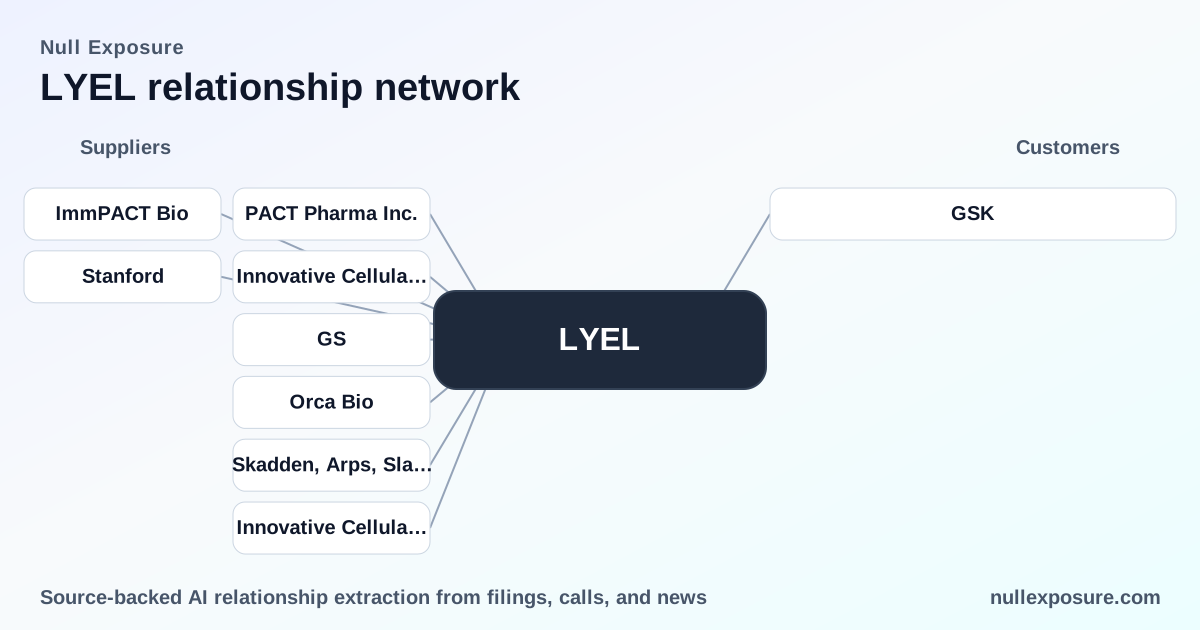
Lyell Immunopharma (LYEL): Customer Concentration, Collaboration Risk, and What GSK’s Exit Changes
Thesis — Lyell is a T‑cell reprogramming company that monetizes its science through research and development services, strategic biopharma collaborations, and milestone/upfront payments; the firm’s commercial footprint is extremely concentrated, and corporate partnerships drive both near-term cash and strategic valuation. For investors and operators evaluating LYEL customer relationships, the central story is collaboration-driven revenue with high single-customer dependency and early-stage commercial maturity.
If you want a concise companion to this read, visit https://nullexposure.com/ for more relationship intelligence and signal-backed briefings.
How Lyell makes money and why partner deals matter
Lyell operates as a developer and provider of engineered T‑cell therapies for solid tumors and books revenue mainly as a seller of research and development services to strategic partners. The company’s most meaningful cash flows historically have come through collaboration arrangements that include upfront payments and equity components, rather than from product sales—an operating model typical of pre‑commercial biotech where partnerships substitute for recurring commercial revenue.
Financial signals reinforce the business model: Lyell’s reported trailing revenue is immaterial (RevenueTTM: $36,000) while operating losses and negative EBITDA dominate the income statement (EBITDA: -$186.7M), indicating a company still funded predominantly through non‑product financing events and partner transactions. That funding and valuation trajectory makes partner wins and partner stability materially consequential for investors.
Relationship snapshot: GSK — termination of a key collaboration
- GSK: A major collaboration with GSK was terminated; when the agreement was originally executed, GSK paid Lyell a combined $250 million in upfront and equity consideration. According to a BioSpace report published in March 2026, GSK formally ended the cell therapy collaboration with Lyell, removing a previously important source of strategic capital and clinical validation (BioSpace, March 2026).
Source: BioSpace news report, March 10, 2026 — https://www.biospace.com/gsk-terminates-cell-therapy-collaboration-with-lyell
This single two‑sentence summary captures the concrete customer/partner outcome recorded in the public record: Lyell lost a high‑visibility partner that had provided a large upfront/equity infusion.
Company-level constraints that shape customer risk and contracting posture
The publicly disclosed relationship evidence and Lyell’s filings generate a clear set of company-level operating signals:
-
High customer concentration across periods. For the year ended December 31, 2024, approximately 73% of revenue is attributable to a single U.S. customer and 27% to a single customer headquartered in China; in 2023 revenues were attributed to a single U.S. customer; and in 2022 virtually 100% of revenue was derived from a single U.K. customer. These statements indicate that revenue flows have been dominated by one partner at a time rather than a diversified customer base (company filings, FY2022–FY2024).
Evidence: Lyell’s fiscal disclosures for 2022–2024. -
Contracting posture: seller of R&D services. Lyell’s sole reportable segment generates revenue by providing research and development services, which positions the company as a service provider to larger pharma partners rather than as a multi‑product commercial seller. This influences contract terms, negotiating leverage, and exposure to partner program decisions (company filings).
-
Geographic footprint is concentrated but has shifted across regions. Filings indicate material counterparties headquartered in North America, EMEA, and APAC across different years, signaling that Lyell’s partner base is global in selection but narrow in count (company filings, FY2022–FY2024).
-
Early commercial maturity and cash dependence on partnerships. Financials—near‑zero product revenue, large negative margins, and heavy operating losses—point to a company in the pre‑revenue or early commercial phase that relies on collaboration payments and capital markets support for operations. This growth stage increases sensitivity to partner exits and milestone delays.
Taken together, these constraints create a profile of a company whose business continuity and near‑term valuation are highly correlated with the stability and progression of a very small number of partner relationships.
What GSK’s termination changes for investors and operators
-
Immediate cash and validation impact. The termination removes a partner that previously provided a large upfront/equity infusion and the intangible benefit of validation from a global pharma player; that loss increases the importance of other partners and of financing options to replace the cash equivalency reported earlier (BioSpace, March 2026).
-
Concentration risk remains the dominant threat vector. Given the company’s historical single‑customer revenue pattern across years and regions, any partner change—addition, upgrade, or termination—translates into outsized revenue and strategic effects. Companies like Lyell trade on the binary outcomes of their few collaborations.
-
Negotiating leverage shifts to the buyer/partner. As a seller of R&D services with limited commercial revenue, Lyell’s negotiating power is constrained; partner terminations crystallize that asymmetry and raise the bar for better long‑term economics in future deals.
Operational implications for management and potential mitigants
Operators should prioritize:
- Diversifying counterparties to reduce single‑partner revenue dependence and geographic concentration.
- Shifting the revenue mix over time from one‑off collaboration payments toward multi‑partner sponsored programs and eventual product‑led revenues.
- Preserving optionality through capital markets readiness: with EBITDA deeply negative and revenue immaterial, access to financing is a leading operational risk under partner volatility.
For investors, the clearest signal is this: valuation and downside are governed more by counterparty dynamics and financing cadence than by recurring sales metrics.
Final read for allocators
Lyell’s model is classic early‑stage biotech: collaboration revenue and strategic investments drive cash and market value, and the company’s fortunes pivot on a very small set of partners. The public termination of the GSK collaboration (BioSpace, March 2026) is a concrete example of how a single deal can materially alter near‑term outlook. Evaluate LYEL with a focus on the pipeline of new partnerships, the timeline for clinical inflection points that can attract diversified partners, and the company’s financing runway.
If you want continuous monitoring of partner flows and relationship‑level signal extraction for Lyell and comparable targets, see https://nullexposure.com/ for subscription options and relationship dashboards.