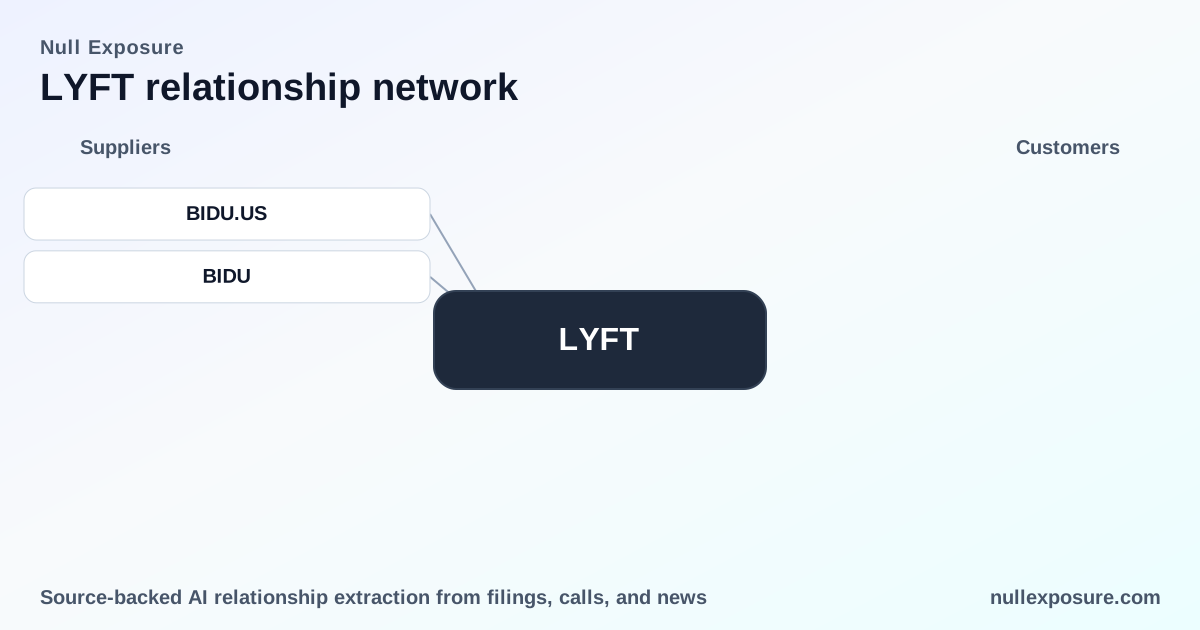
Lyft’s customer relationships: marketplace economics, embedded partnerships, and where risk concentrates
Lyft operates a two-sided transportation marketplace that connects drivers who supply vehicles with individual riders and organizational buyers who purchase rides or mobility services on behalf of employees or customers. The company monetizes primarily through usage-based fare commissions and fees collected at ride completion, supplemented by subscription products, enterprise Concierge fees, hardware sales for micromobility, and advertising or licensing arrangements. This mix produces a high-volume, low-ticket revenue stream anchored to ride frequency and average fare, with incremental margin enhancement from subscriptions and enterprise contracts.
Learn more about how we map customer relationships at Null Exposure: https://nullexposure.com/
Why the customer posture matters to investors
Lyft’s revenue profile is fundamentally transactional: the controlling accounting language is recognition on ride completion, which enforces a usage-based contracting posture and makes revenue highly correlated with mobility demand and fare levels. At the same time, subscription and enterprise contracts add a recurring element, helping stabilize gross take and improve lifetime value for high-frequency riders and business accounts. For investors, that combination means growth is driven by both trip volume and successful upsell into higher-margin products.
Key operating signals observed across company filings and disclosures:
- Usage-first monetization: Lyft recognizes revenue upon completion of each ride, establishing a short revenue cycle tied to actual service delivery.
- Subscription and enterprise diversification: The company receives subscription fees from riders, platform fees from drivers, and Concierge or licensing revenue from organizations.
- Customer mix includes individuals and public buyers: Lyft serves individual riders at scale while also contracting with organizations—including government-funded entities—which introduces different procurement and termination dynamics.
- Global footprint and multimodal scope: While North America remains central, Lyft has expanded internationally and into micromobility hardware and software sales, broadening addressable markets but adding regulatory and operational complexity.
These are company-level operating characteristics; they influence how individual partnerships contribute to top-line stability and capital allocation decisions.
The Alaska Airlines relationship: loyalty linkage with concrete mechanics
Alaska Airlines integrated Lyft spending into its Atmos Rewards loyalty program so that Lyft base-fare dollars convert directly to airline status points at a 1:1 rate (one status point per $1 of Lyft base fare). According to an Alaska Airlines press release announcing the Atmos Rewards expansion (March 2026), the program explicitly cites Lyft spend as an earning source and gives an example where $800 of Lyft base fares yields 800 status points. This linkage turns Lyft transactions into a demand driver for airline loyalty, improving cross-platform stickiness between travel and ground mobility.
Source: Alaska Airlines press release on Atmos Rewards expansion, March 2026.
How each observable relationship fits the business model
- Alaska Airlines (loyalty integration): This partnership converts Lyft ride spending into airline loyalty points, effectively co-marketing mobility spend and broadening Lyft’s appeal to travel-focused customers and frequent flyers. Source: Alaska Airlines press release, March 2026.
Each relationship like the one above is incremental to Lyft’s core marketplace economics: it augments demand by tying ride purchases to adjacent loyalty incentives, and it leverages Lyft’s usage-based revenue model to generate measurable benefits for partner programs.
Contracting posture, concentration, criticality and maturity — what the constraints tell investors
The company-level constraints extracted from Lyft’s disclosures form a coherent picture:
-
Contracting posture—usage-first with subscription layering. Lyft’s predominant revenue recognition upon ride completion signals a highly transactional revenue stream. Concurrently, subscription fees and enterprise platform agreements provide pockets of recurring revenue that increase customer lifetime value and reduce churn sensitivity.
-
Concentration and counterparty types. The customer base skews toward individual riders as the primary counterparty, generating the bulk of trip volume, while the existence of government or government-funded buyers introduces counterparty risk associated with public-sector procurement and termination rights.
-
Criticality of the ridesharing marketplace. Lyft states that substantially all revenue is generated from the ridesharing marketplace, making the core platform a critical asset. Any disruption to driver supply, regulatory access, or platform reliability would therefore have immediate revenue impact.
-
Operating maturity and global reach. Lyft’s footprint has expanded beyond North America into Europe and other regions; the company now operates multimodal services. Expansion increases market opportunity but raises regulatory heterogeneity and capital intensity, especially where hardware (bikes/stations) is part of the offering.
-
Role multiplicity. Lyft acts as seller, service provider and buyer in different contexts—connecting riders to drivers (seller/service provider), receiving fees from drivers for platform services, and supplying enterprise mobility solutions—indicating a complex set of commercial relationships and contract forms.
-
Product segmentation matters for margin construction. The company’s revenue streams cross core rideshare services, software/platform fees, hardware sales for micromobility, and enterprise services; each segment has different margin profiles and working capital implications.
These constraints imply a platform that is mature in its core product, but one that derives longer-term margin improvement from subscription and enterprise adoption while remaining sensitive to cyclical demand and regulatory shifts.
Investor implications: what to watch and why it matters
- Revenue sensitivity: Given the usage-based recognition model, quarterly results will track macro mobility trends and fare changes closely; a stable or rising take rate from subscriptions and enterprise deals is essential to margin recovery.
- Partner leverage: Loyalty integrations like Alaska Airlines convert fare spend into broader demand signals, supporting retention and incremental trips; investors should track partnership rollouts and co-marketing metrics.
- Regulatory/regional execution risk: Global expansion increases addressable market but introduces regulatory execution risk that can affect service availability and cost structures across jurisdictions.
- Counterparty mix risk: Government customers add revenue diversity but also the potential for abrupt contract terminations or delayed payments; public-sector exposure requires monitoring of contract terms and budget cycles.
- Capital allocation for multimodal hardware: Micromobility hardware sales provide strategic control over last-mile options but require capital investment—evaluate returns against recurring software and services margins.
Practical next steps for analysis
- Review quarterly metrics for subscription ARR, Concierge enterprise growth, and driver-side fees to quantify the recurring component of revenue.
- Monitor partnership announcements and loyalty integrations; each durable cross-brand tie increases gross transaction volume and stickiness.
- Model scenario sensitivity to trip volumes under macro stress and evaluate how subscription and enterprise revenue buffers could stabilize EBITDA.
If you want a structured view of Lyft’s commercial linkage map and how these relationships affect loss-given-default and revenue concentration metrics, visit Null Exposure for deeper coverage: https://nullexposure.com/
Bottom line
Lyft is a usage-first marketplace that has begun to de-risk revenue through subscriptions, enterprise contracts and strategic partnerships such as airline loyalty integrations. For investors, the core questions are whether Lyft can expand higher-margin recurring revenue fast enough to offset the inherent cyclicality of a ride-by-ride revenue model, and whether partnerships materially lift transaction volumes without diluting take rates.