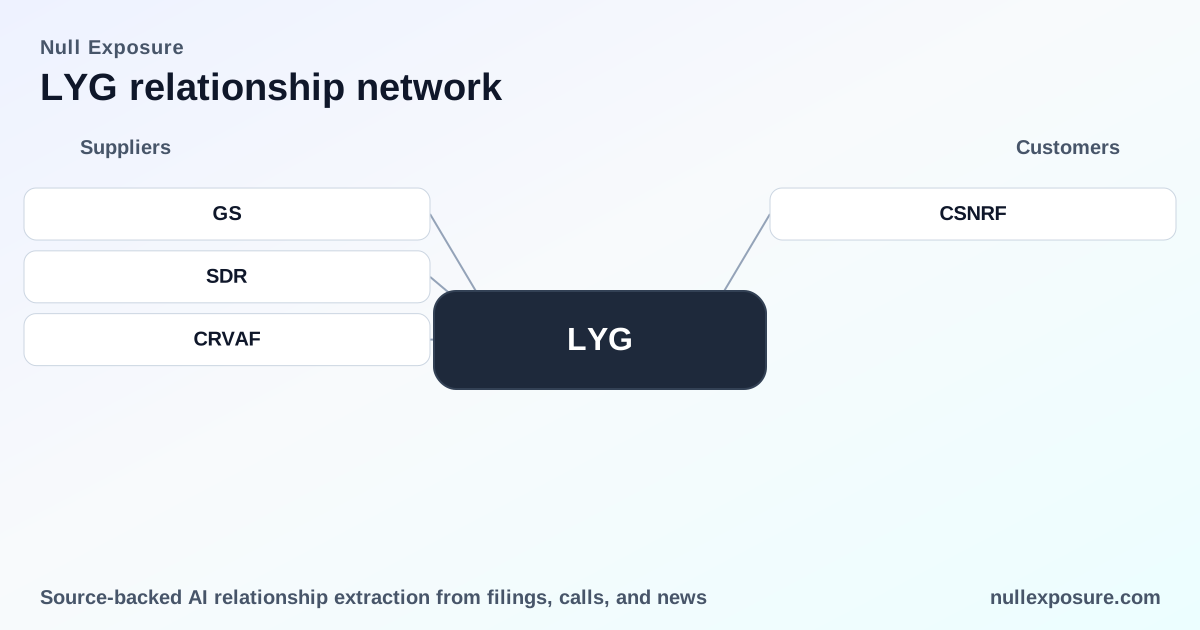
Lloyds Banking Group (LYG) — Customer Relationships and Strategic Implications
Lloyds Banking Group operates as a large, predominantly UK-focused retail and commercial bank that monetizes through deposit gathering, mortgage and loan origination, fee income, and interest margin on its lending portfolio. Recent customer-relationship data highlight a strategic move to divest non-core insurance assets, consistent with a focus on core banking franchises and balance-sheet efficiency. For investors evaluating counterparty and revenue concentration, the sale of insurance operations reshapes Lloyds' customer and partner ecosystem and alters sources of fee and insurance-related revenue.
If you want a structured view of Lloyds’ counterparty moves and how they translate to franchise risk, see the research hub at https://nullexposure.com/ for consolidated tracking and alerts.
A single deal is driving the customer signals you need to know
The relationships surfaced in the customer feed are narrowly concentrated around one transaction: the disposal of Scottish Widows Europe. Both entries in the results reflect the same market development and should be treated as a single strategic action with two recorded identifiers.
- Lloyds has agreed to dispose of Scottish Widows Europe to Chesnara PLC, signaling an exit from a portion of the group’s continental life and pensions exposure. According to a Simply Wall St news report on 10 March 2026, the deal was reported as an agreed disposal of Scottish Widows Europe to Chesnara PLC (news item first seen 2026-03-10).
- The feed also lists CSNRF as the inferred symbol for the counterparty, which is the market identifier tied to Chesnara PLC in the news feed; the same Simply Wall St item documents the counterparty under that ticker (first seen 2026-03-10).
Both entries reference the identical press coverage and represent the same counterparty relationship: Lloyds is transferring a defined insurance business to Chesnara. The duplication in the feed is an operational artifact; the underlying commercial relationship is a single buyer–seller transaction reported in March 2026.
Why this divestiture matters for Lloyds’ operating model
This insurance disposal is a targeted simplification of Lloyds’ business mix. Several operating-model and business-model characteristics follow from the move:
- Contracting posture: Lloyds is reducing exposure to complex, longer-dated insurance liabilities and associated contract administration. This strengthens its posture as a traditional deposit-and-lending bank, where customer contracts are shorter in tenor and more directly tied to interest income and fee flows.
- Concentration: The group remains highly concentrated in the UK retail and mortgage market. Divesting a continental insurance arm reduces geographic and product diversification, increasing reliance on domestic retail, SME, and mortgage customers as revenue drivers.
- Criticality of relationships: Core banking relationships (deposits, mortgages, payments) remain mission-critical and sticky; insurance distribution was valuable but structurally peripheral to Lloyds’ capital-light, service-driven retail franchise. The sale reduces operational complexity while leaving critical bank–customer touchpoints intact.
- Maturity: Lloyds operates a mature, low-growth banking franchise with predictable cash flows. The disposal is consistent with portfolio pruning typical of a mature financial services group optimizing returns on equity and capital allocation.
These company-level signals are supported by Lloyds’ financial profile: market capitalization roughly $76.5 billion, trailing P/E ~13.1, return on equity ~10.8%, and a profit margin of 26.5% on TTM revenues of approximately $19.1 billion—figures that reflect a stable, cash-generative banking business with limited appetite for non-core, capital-intensive insurance operations.
What investors should watch next
The sale to Chesnara has several immediate and medium-term implications for revenue, capital, and risk:
- Short-term P&L and capital: Expect one-off disposal proceeds and potential reduction in insurance-related reserves on the balance sheet; these will impact capital ratios and possibly create a funding window for share buybacks or higher ordinary dividends. Monitor FY2026 filings for the exact gains and capital treatment.
- Fee-income profile: Annual fee and commission income tied to the Scottish Widows Europe unit will transfer to the buyer; this reduces Lloyds’ non-interest income base but simplifies earnings volatility tied to insurance underwriting cycles.
- Distribution and customer touchpoints: If the insurance unit provided cross-sell opportunities into Lloyds’ retail base, the bank will need to secure alternative distribution partnerships or accept lower cross-sell incidence. That operational trade-off is deliberate and aligns with a strategy to double down on core retail banking economics.
- Counterparty risk and service continuity: The buyer, Chesnara (CSNRF), is a specialist acquirer of life and pension books; the transition should preserve policyholder servicing but shifts long-duration liability risk off Lloyds’ balance sheet. Investors should review transitional service agreements and indemnities disclosed in regulatory filings for contingent exposure.
Relationship-by-relationship drilldown (complete coverage)
Chesnara PLC — Lloyds has agreed to dispose of Scottish Widows Europe to Chesnara PLC, transferring an insurance business unit out of the bank’s portfolio; this was reported in a Simply Wall St article on 10 March 2026. The move reduces Lloyds’ insurance footprint and concentrates the group on core banking operations.
CSNRF — The relationship feed also references CSNRF as the inferred symbol for Chesnara in the news item; the underlying transaction is identical to the Chesnara PLC entry and reflects the same March 2026 press report. The duplicate entry represents a feed-level identifier linking the counterparty to its market identifier.
(Both items are sourced to the same Simply Wall St report first seen 2026-03-10.)
Risk factors and monitoring checklist
- Execution risk on the sale: Confirm whether the disposal closed and whether any post-sale liabilities or transitional arrangements create residual risk for Lloyds. Review Lloyds’ FY2026 and subsequent quarterly filings for final terms and capital impact.
- Revenue concentration: With non-core insurance divested, Lloyds’ revenue concentration on mortgages and retail banking increases; stress scenarios in the UK housing market or margins compression would have larger effects.
- Regulatory and policyholder outcomes: Regulatory approvals for transfers of insurance books can impose conditions; track UK and relevant European regulatory announcements tied to the transaction.
- Capital redeployment governance: Watch management commentary on use of proceeds—whether to shore up capital buffers, return cash to shareholders, or invest in digital and branch optimization.
Bottom line: streamlined franchise with clearer risk-reward
Lloyds is executing a clear re-focus on its banking franchise by divesting Scottish Widows Europe, shifting long-duration insurance liabilities to a specialist buyer, Chesnara (CSNRF). This simplifies the balance sheet, tightens strategic concentration on UK retail banking, and creates a cleaner investor proposition centered on interest-margin and fee-generation from core customer relationships. Investors should treat the move as a portfolio optimization that reduces diversification but enhances clarity on Lloyds’ capital deployment and return-on-equity objectives.
For ongoing alerts, model inputs, and to track how this and similar counterparty moves alter franchise risk across portfolios, visit https://nullexposure.com/ for more curated intelligence and signal tracking.