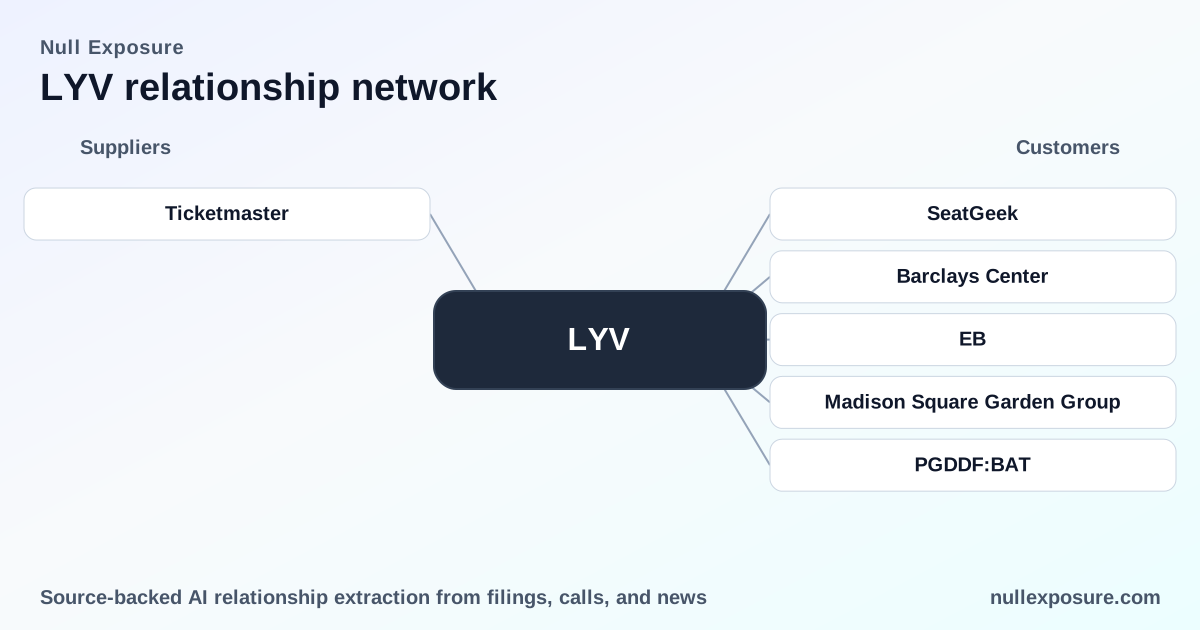
Live Nation (LYV) — customer relationships and what they imply for investors
Live Nation Entertainment operates the global live-entertainment ecosystem: it promotes and produces concerts, manages artists and venues, and runs Ticketmaster — a ticketing and distribution business that charges service fees and sells sponsorship and advertising. Revenue flows from promotion margins, ticketing service fees (Ticketmaster), venue operations and sponsorship/advertising, with Ticketing contributing roughly $3.0 billion — about 13% of consolidated revenue in 2024. For investors, Live Nation’s value derives from scale in promotion and ticketing, cross-selling across venues and sponsorships, and control of distribution; legal and competitive developments that change access to Ticketmaster’s platform are therefore direct financial levers.
Explore more company relationship intelligence at NullExposure.
How Live Nation contracts, competes and concentrates risk
Live Nation’s commercial posture blends multi-year, contractual relationships with venues and sponsors and transactional, event-level ticketing for third‑party clients. Company disclosures describe written primary-ticketing agreements typically lasting three to five years while ticketing service charges are recognized at the time of sale — this structure creates a mixed revenue profile: stable annuity-like streams from long-term venue/sponsorship deals and volatile, event-driven ticket fees.
- Contracting posture: combination of long-term engagements (3–5 years) and spot-level sales for third-party ticketing.
- Geographic footprint: global operations with a heavy North American event load (company figures cited estimated North America 36,673 events vs international 18,014 in a comparative period), supporting both local-market scale and global touring economics.
- Materiality and concentration: Ticketing is material to the business (13% of revenue in 2024) but Live Nation reports no single customer accounted for more than 10% of consolidated revenue, indicating diversified client exposure.
- Role complexity: Live Nation functions as both service provider (ticketing platform and venue operations) and seller (promotion, sponsorship inventory), which embeds it deeply into venue economics and third‑party monetization.
- Relationship maturity: many relationships are active and mature given the multi-year contracts and entrenched distribution assets; however, regulatory settlements and platform openness introduce new competitive dynamics.
These characteristics define risk and upside: long-term deals underpin predictable sponsorship and venue cashflows, while Ticketmaster’s platform advantages drive high-margin fee revenue that is, nonetheless, politically and legally sensitive.
See more on customer relationships and commercial signals at NullExposure.
Relationship roll‑call: counterparties investors should track
Below are concise, source-linked notes on each counterparty referenced in recent reporting; these relationships shape booking pipelines, platform competition and distribution economics.
-
WMG (Warner Music Group) — In a 2025 Q4 earnings call, WMG observed an acceleration of product rollouts across streaming and ticketing platforms and explicitly referenced Ticketmaster exploring ways to leverage AI, signaling vendor-level innovation conversations between labels and Live Nation’s ticketing arm (WMG 2025 Q4 earnings call, first seen March 7, 2026).
-
CPHC (Canterbury Park Holding Corporation / Swervo Development) — Multiple releases in 2025–2026 note construction progress on a 19,000‑capacity amphitheater that Live Nation will operate, with an expected June 2026 opening; these agreements illustrate Live Nation’s role as operator for new outdoor venues (Canterbury Park press releases, 2025; Globe and Mail / TradingView coverage, May 2026).
-
SeatGeek — Coverage across local and national outlets describes a regulatory settlement requiring Ticketmaster to provide a standalone ticketing system and allow third‑party sellers such as SeatGeek to access Ticketmaster technology, changing distribution dynamics for secondary and primary sales (NBC Connecticut, UPI, LiveForLiveMusic, Fox Business — March–May 2026).
-
VENU (Venu Holding Corporation) — Venu publicly discloses strategic partnerships and a multi-event incentive agreement with Live Nation that allows Live Nation to book and promote Live Nation‑approved events on a non‑exclusive basis, illustrating Live Nation’s role as an external promoter/operator in third‑party venues (Venu press releases and investor Q&A, March–May 2026; basentinel coverage).
-
Barclays Center — Testimony and reporting show Barclays Center experienced a decline in Live Nation‑promoted shows after switching ticketing providers to SeatGeek in 2021 and later returned to Ticketmaster, underscoring the competitive and contractual tug-of-war over venue ticketing contracts (NBC New York, ClaimsJournal, BloombergLaw reporting, March 2026).
-
TKO (WWE / TKO Group Holdings) — WWE’s ticketing notices route fans to Ticketmaster, confirming Live Nation/Ticketmaster’s continued role as primary ticketing channel for large-scale sports/entertainment partners (WWE corporate release, March 2, 2026).
-
T‑Mobile (TMUS) — Promotional programs such as early access windows for T‑Mobile customers tie carrier partnerships to Ticketmaster’s customer acquisition and presale channels; a Yahoo story described early access dates tied to a Live Nation promotion (Yahoo Entertainment, April–May 2026).
-
Eventbrite (EB) — Multiple outlets cite the DOJ settlement language that allows third‑party sellers including Eventbrite to list tickets through Ticketmaster’s technology, signalling a structural change in distribution access and potential revenue sharing or integration opportunities (UPI, Fox Business, LiveForLiveMusic — March–May 2026).
-
StubHub — Reporting on the settlement notes Ticketmaster’s requirement to provide a standalone ticketing system for platforms like StubHub, which has implications for secondary-market access and inter‑platform competition (NBC Connecticut coverage, May 2026).
-
Spotify (SPOT) — Industry reporting highlights Spotify’s partnerships with dozens of ticketing companies, including Ticketmaster, indicating continued integration between streaming discovery and ticket distribution as part of the live-event funnel (MLQ.ai coverage, March 2026).
-
FWONA (Liberty Media / F1 partners) — Historical reporting shows Live Nation’s promotional collaboration with Formula 1 on the Las Vegas race, reflecting Live Nation’s occasional alignment with major global sporting events for promotion and cross‑marketing (Sportico, 2022 referenced in later coverage).
-
SM Entertainment (STEAF) — Live Nation produced the global aespa world tour, evidencing its role as a promoter for major international K‑pop acts and demonstrating cross‑regional touring capabilities (Live Nation newsroom, May 2026).
-
TNL (Travel + Leisure / Travel + Leisure Co.) — Company statements reference partnerships with Live Nation to deliver differentiated experiences for venues and customers, indicating brand and experiential tie‑ins beyond pure ticketing (TNL earnings-call coverage, March 2026).
-
Madison Square Garden Group / Barclays / PGDDF:BAT references — Testimony and reporting connect venue executives and legacy relationships to Ticketmaster and Live Nation, reinforcing that institutional venue relationships remain central to Live Nation’s booking and promotional scale (NBC New York, BloombergLaw, March 2026).
Notes on duplication and multi‑source mentions: several counterparties (SeatGeek, Eventbrite, VENU, CPHC and Barclays/Barclays Center) appear across multiple news items and regulatory coverage; investors should treat repeated mentions in different outlets as confirming signals rather than independent new relationships.
Investment implications and watchlist
- Regulatory re‑balancing is the primary operational risk: the DOJ settlement forcing Ticketmaster to open platform access changes distribution economics and competitive barriers; investors must model potential fee erosion or new integration revenue from third‑party listings.
- Venue pipeline and operator economics matter: Live Nation’s operator agreements for new amphitheaters (e.g., Canterbury Park/Swervo and Venu deals) are growth levers that expand promotion and sponsorship inventory.
- Partnerships with telcos, streaming and sports brands (T‑Mobile, Spotify, WWE/TKO, F1) drive customer acquisition and presale economics, supporting margin resilience if cross‑sell remains effective.
- Diversification reduces single‑counterparty concentration, but the firm remains sensitive to macro event demand cycles and legal outcomes affecting Ticketmaster’s fee structure.
For investors evaluating Live Nation’s commercial moat, focus on platform access changes, the cadence of venue openings and renewals, and sponsorship contract backlogs reported in filings and earnings calls. For deeper counterparty mapping and signal-driven monitoring, visit NullExposure’s customer intelligence hub.