Lifezone Metals (LZM): Customer footprint and what it signals for investors
Lifezone Metals operates as a metals technology and services company focused on the battery metals value chain — extraction, hydrometallurgical processing and recycling — and monetizes through project-level technology deployment, engineering services and downstream metals recovery. The company’s commercial traction is concentrated in a small number of engineering and project relationships that validate its hydrometallurgical approach, so investor returns will track technical execution at those projects, timely contract conversion, and subsequent scale-up of processing revenues. For a deeper look at counterparties and relationship risk, visit https://nullexposure.com/.
Why the customer list matters more than headline revenue
Lifezone’s reported revenues are modest relative to market capitalization (Revenue TTM US$1.06m versus Market Cap ~US$497m), and operating metrics show the company is in an early commercial stage with negative operating margins and EBITDA. That profile turns every customer engagement into a value inflection point: pilot work that becomes an operating plant or licensed process can justify future upside; conversely, delays or failed scale-up create outsized downside.
From an operational perspective, investors should treat these characteristics as firm-level signals:
- Contracting posture: Project and engineering agreements dominate over recurring product sales; the commercial stance is transaction- and milestone-driven rather than subscription-style.
- Concentration: A small number of high-profile project relationships creates client concentration risk, amplifying revenue volatility if any single engagement stalls.
- Criticality: The company’s hydrometallurgical expertise is a specialized, technically critical input for customers converting ore into refined battery metals — a high-importance, high-technical-barrier service.
- Maturity: Financials show early-stage maturity: limited revenue run-rate, negative EPS and operating losses indicate the company is still converting technical IP into stable commercial streams.
These are company-level signals supported by the customer relationships described below.
Customer relationships that define the roadmap
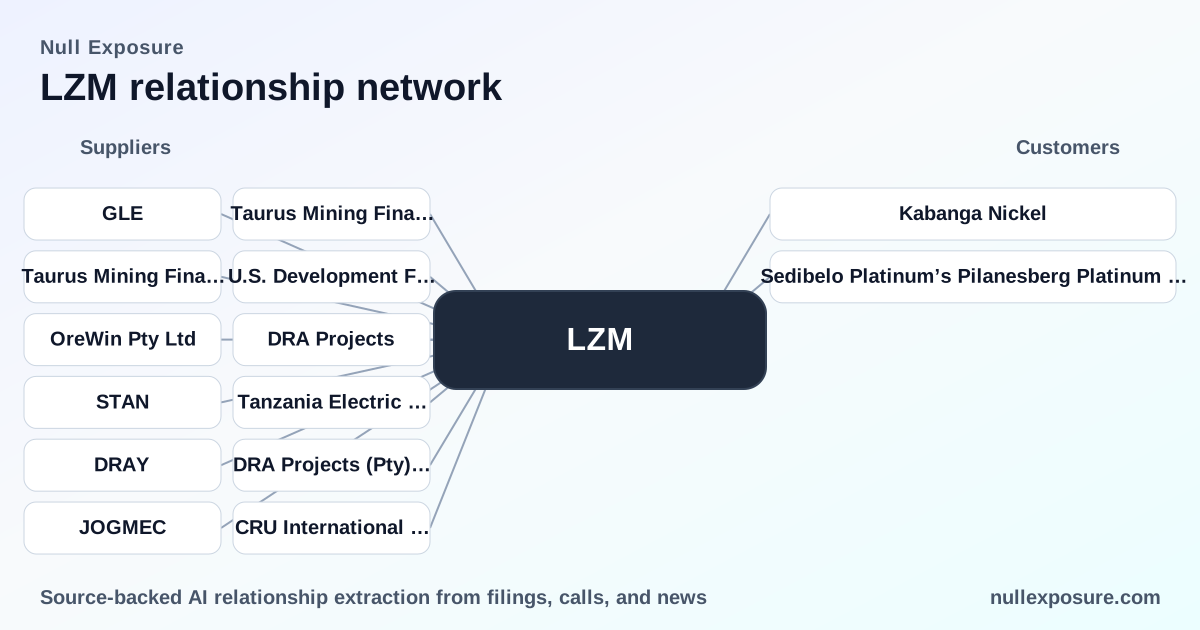
Lifezone’s reported customer relationships are limited but strategically relevant; each interaction signals technical validation or industry attention. Below I cover every customer relationship referenced in the available results.
Kabanga Nickel — hydromet validation in Tanzania
Lifezone’s hydrometallurgy expertise is being applied to the Kabanga Nickel project in Tanzania as a blueprint for pole refining capability, positioning the company on the pathway from process concept to in-field technical validation. According to an IM-mining report dated December 13, 2021, Kabanga Nickel is putting Lifezone’s hydrometallurgical approach to the test at the project (https://im-mining.com/2021/12/13/lifezone-hydromet-tech-blueprint-puts-kabanga-nickel-pole-refining-position/).
Sedibelo Platinum — visibility at Pilanesberg Platinum Mines (PPM)
Industry commentary places Lifezone’s process discussion alongside developments at Sedibelo Platinum’s Pilanesberg Platinum Mines (PPM) on the Bushveld Complex, where a 110,000 t/y beneficiation plant employing the Kell Process is under construction; this linkage signals sector attention to Lifezone’s processing approach as beneficiation and hydrometallurgy converge. IM-mining’s December 13, 2021 piece referenced the PPM operation and the Kell Process in the same analysis that covered Lifezone’s hydromet tech (https://im-mining.com/2021/12/13/lifezone-hydromet-tech-blueprint-puts-kabanga-nickel-pole-refining-position/).
How to translate these relationships into an investment view
The two relationships above create a clear investor playbook: technical validation at Kabanga and industry visibility at PPM are necessary precursors to recurring revenue, but they are not yet sufficient to re-rate the equity. Key concluding signals for investors:
- Execution is binary and concentrated. With limited customers, wins are material and losses are material. The company’s valuation already reflects an expectation of successful scale-up — Price-to-Sales and EV/Revenue multiples are extreme versus current revenue (PriceToSales ~470x; EV/Revenue ~521x).
- Technical criticality increases bargaining power but raises delivery risk. Hydrometallurgical services are specialized; that criticality can support attractive contract economics if Lifezone secures firm offtake or licensing agreements, but it requires flawless engineering and regulatory approvals.
- Ownership and liquidity nuances matter. Insider ownership is high (~57.8%) while institutional ownership is modest (~25.6%) and float is limited (~34.1m shares), which concentrates control and can restrict secondary-market liquidity and pricing dynamics around material news.
- Financial maturity is nascent. Current operating losses and a negative EBITDA position mean the company will remain sensitive to capital markets and the timing of revenue conversion from pilot projects to operating plants.
Practical next moves: what to watch for over the next 12–18 months
- Finalized commercial contracts and their fee structure at Kabanga — confirmation of milestone payments, licensing fees, or production-linked royalties.
- Evidence of recurring processing revenue (plant operations rather than one-off engineering payments).
- Any engineering, procurement and construction (EPC) or offtake partners tied to PPM or similar South African projects that cement long-term income streams.
- Capital raises and dilution risk, given current operating losses and the need to fund scale-up.
- Regulatory and environmental approvals at project sites, which are material for schedule and cost.
For trackers and deal-level intelligence, consider a focused partner intelligence service that aggregates contract filings and project notices; more detail is available at https://nullexposure.com/.
Bottom line
Lifezone’s commercial case is straightforward: the company sells specialized hydrometallurgical know-how to project operators and seeks to convert that know-how into recurring processing and recovery revenue. Current customer links to Kabanga Nickel and the industry attention around Sedibelo’s PPM give technical validation and market visibility respectively, but the business still faces concentrated customer risk, execution-dependent revenue conversion, and early-stage financials. Investors should prioritize contract clarity and project delivery milestones as the primary drivers of re-rating or downside.