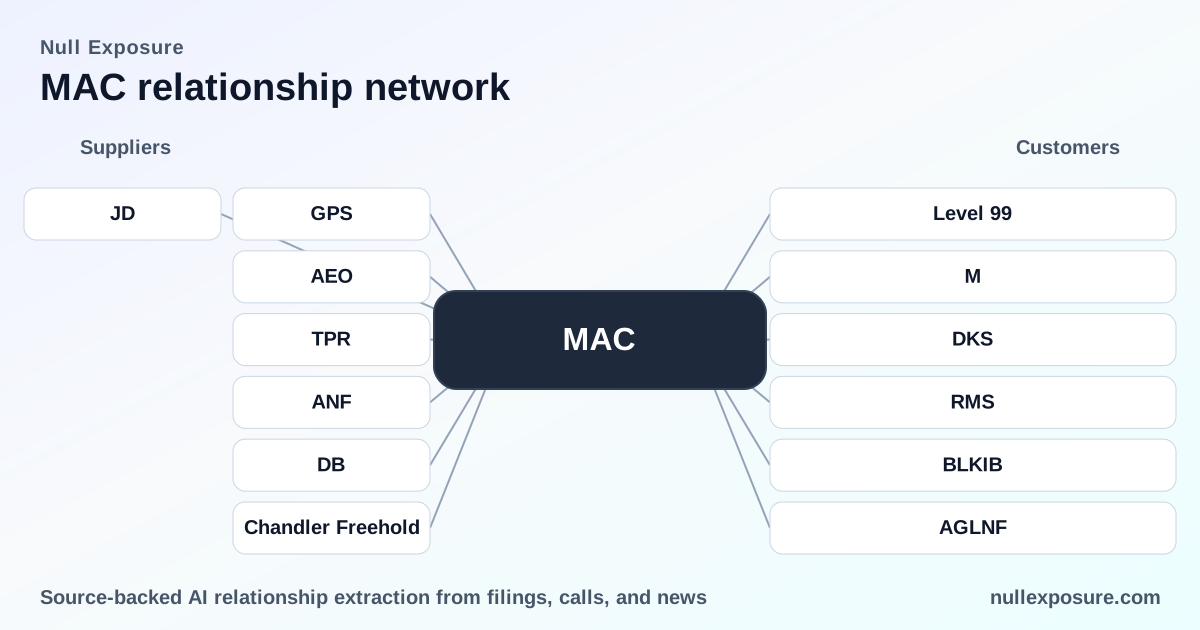
Macerich’s customer map: anchors, experiential bets, and where cash flow comes from
Macerich is a mall-focused REIT that monetizes premium retail real estate through a combination of long-term base leases, variable percentage rents tied to tenant sales, and fee-based property management/redevelopment services. The company’s value proposition is concentrated: curate high-performing anchors and experience-oriented tenants, capture upside through percentage rent and redevelopment, and stabilize cash flows with multi-year lease rolls and management contracts. For investors, the key questions are how tenant mix and anchor renewals translate into rental visibility, where variable rents create upside or volatility, and how redevelopment and third-party services expand margins.
If you want a consolidated view of Macerich’s tenant momentum and leasing narrative, see the company overview at https://nullexposure.com/.
Business model signals investors should read first
- Contracting posture: long-duration anchors with built-in variability. Macerich’s leasing program combines straight-line minimum rents with percentage rents that rise with tenant sales; that structure produces steady base cash flow while preserving upside during stronger consumer demand. The company’s disclosures identify anchors that either own their sites or sign long-term leases at rates below inline mall-store tenants, creating durable tenancy at key locations.
- Revenue mix: stable base + meaningful variable component. Macerich reported material variable leasing revenue historically—variable payments are explicitly recognized and were a sizable component of leasing revenue, signaling that same-store tenant performance feeds through to landlord earnings.
- Geography and concentration: U.S.-centric, major regional malls. All operations and leasing activity are focused on U.S. regional and community/power centers, concentrating both opportunity and regional risk within North America.
- Service provider role and maturity: On a selective basis Macerich operates as a fee-based manager for third-party centers, indicating a second revenue pillar beyond lease income and an organizational capability in property management and redevelopment.
- Relationship stage and visibility: Future minimum rents are disclosed across multi-year horizons, providing observable cash-flow visibility for 2025–2029 and beyond.
For a deeper look at Macerich’s positioning and how tenant execution drives value, visit https://nullexposure.com/.
Tenant relationships that define the operating thesis Below I cover every customer relationship mentioned in the company’s recent filings and media coverage, with a concise investor-focused takeaway and the source of the statement.
Level 99 — experiential entertainment anchor at Tysons Corner
Macerich opened a 42,000 square-foot Level 99 location at Tysons Corner, signaling continued investment in experiential tenants that drive traffic to premium centers. The detail is disclosed in Macerich’s 2025 Q3 earnings call transcript (first seen March 8, 2026).
Macy’s — productivity anchor that stabilizes assets
Macerich cites a “very productive Macy’s store” as an element that “solidifies the asset,” underlining Macy’s role as a high-performing anchor that supports overall mall economics and investor confidence. This comment is from the company’s 2025 Q4 earnings call (first seen March 7, 2026).
Kohl’s reference to “MAC” cosmetics — brand mention unrelated to the REIT
A separate news item notes Kohl’s launched the MAC cosmetics brand in over 850 Sephora at Kohl’s locations; this mention refers to the MAC cosmetics brand rather than Macerich’s company operations and should not be conflated with a retail-tenant relationship to the REIT. The item appeared in a news transcript covering Kohl’s FY2026 activity (InsiderMonkey, first seen May 3, 2026).
DICK’S Sporting Goods — expanding “House of Sport” footprint
Macerich reports multiple planned or under-construction Dick’s locations across properties including Crabtree Valley Mall, Tysons Corner Center, Washington Square and Valley River, reflecting a strategic roll-out of DICK’S House of Sport concepts that anchor redevelopment efforts. That commentary was made in Macerich’s 2025 Q4 earnings call (first seen March 7, 2026), and the company reiterated expectations for openings in 2026 in subsequent news coverage (NationalToday, Feb 27, 2026).
Dick’s House of Sport — committed pipeline and recent openings
Dick’s House of Sport has nine committed locations with Macerich and recently opened at Freehold in a former department-store box, illustrating the REIT’s strategy of replacing legacy anchors with modern, destination-format retailers. This was discussed in Macerich’s 2025 Q3 earnings call (first seen March 8, 2026).
Hermès — luxury flagships remain strategic traffic generators
Macerich opened an 11,000 square-foot Hermès at Scottsdale Fashion Square, a high-end tenant that serves as a traffic and prestige driver for the property’s luxury cohort. This opening was described in the company’s 2025 Q3 earnings call (first seen March 8, 2026).
Belk — consolidation and long-term lease extension at Crabtree
Belk announced consolidation of two Crabtree locations into a single remodeled flagship with a long-term lease extension, a renovation that preserves an anchor tenancy and reduces vacancy and churn risk at the property. Macerich discussed the Belk consolidation in its 2025 Q4 earnings call (first seen March 7, 2026).
Primark — fast-fashion entrant that revitalizes tenant mix
Primark joined the tenancy at Freehold, contributing to a revitalization alongside new entertainment and fitness concepts and signaling that value-oriented fast fashion remains an important traffic driver for select Macerich centers. Macerich referenced Primark’s opening during its 2025 Q3 earnings call (first seen March 8, 2026).
Constraints and operating implications for investors
- Long-term leases provide downside protection but create change cost: Anchors frequently occupy owned land or long leases at below-market anchor rates, giving Macerich stability but limiting near-term rent re-pricing unless redevelopment occurs.
- Usage-based rents add cyclicality and upside sensitivity: The mix of minimum and percentage rent means Macerich’s cash flows scale with tenant sales, amplifying returns in strong consumer cycles and compressing cash in weak ones.
- U.S.-only footprint focuses both opportunity and idiosyncratic risk domestically: Concentration in U.S. regional malls means macro U.S. retail cycles, travel patterns, and local redevelopment dynamics materially affect outcomes.
- Service-provider revenue is complementary but selective: Fee-based management is small and selective today, indicating optionality for margin expansion if Macerich scales third-party management or JV redevelopments.
- Active, observable lease roll-through: The company publishes future minimum rents and lease schedules, creating forecastable cash-flow ladders that investors can model with reasonable confidence.
Investment takeaway Macerich executes a hybrid model that balances durable minimum rents with defined upside through percentage rents and redevelopment-driven re-tenanting. The recent leasing activity shows a clear tilt toward experiential and higher-end flagships—Hermès, Level 99, and DICK’S House of Sport—that align with the REIT’s premium mall positioning. The operating risks are straightforward: concentration in U.S. malls, exposure to tenant sales volatility, and the capital intensity of redevelopments. For investors focused on cash flow quality and growth from re-tenanting, Macerich’s tenant pipeline and long-term lease book offer both visibility and levers for upside.
For a consolidated investor view and ongoing coverage of Macerich tenant developments, visit https://nullexposure.com/.