MAIA Biotechnology: Customer relationships that matter for investors
MAIA Biotechnology develops immune-based oncology therapeutics and monetizes primarily through staged financing, licensing and clinical partnerships rather than commercial product sales today. The company operates as a pre-revenue clinical-stage biotech: value is created through advancing candidates (not through recurring customer revenues), and near-term returns depend on successful trial enrollment, funding events and partnering outcomes. For investors and operators evaluating MAIA’s customer relationships, the relevant signal set is therefore clinical site activation and financing counterparties that provide runway and validation.
If you want a consolidated view of MAIA’s relationship coverage, visit NullExposure for our portal and data services.
What MAIA actually sells to the market (and how that shapes customer relationships)
MAIA’s commercial model is not B2B product sales; it is an R&D- and capital-intensive biotech model where customer-like relationships take the form of:
- Clinical sites and investigator networks that provide patient access and data for trials.
- Capital providers and placement agents that underwrite equity financings and provide short-term liquidity.
- Potential future partners for licensing or commercialization once clinical proof points are achieved.
These relationship types define contracting posture and risk. Contracting is predominantly project-based, short-to-medium term, and highly conditional on regulatory and clinical milestones. Concentration is naturally high because a handful of active clinical sites and a small set of financing counterparties can materially affect near-term execution. Maturity is low: MAIA is pre-revenue and dependent on external capital and clinical partnerships to de-risk programs.
Quick company-level operating signals investors should keep front-of-mind
- Pre-revenue clinical-stage profile: Fiscal data shows RevenueTTM = 0 and negative EPS (DilutedEPSTTM = -0.73), confirming no product sales to date.
- Balance and capitalization dynamics: Market capitalization around $84.3M with 60.7M shares outstanding and insider ownership ~14.3% and institutional ownership ~4.1%, indicating management has meaningful skin in the game while institutional penetration remains low.
- Valuation posture: Price-to-Book of 34.22 and very low trading beta (0.226) reflect a small-cap, idiosyncratic biotech priced on future optionality rather than current cash flows.
These company-level signals imply high criticality of individual financing and clinical sites for near-term survival and progress.
The customer and partner relationships on record
Below I summarize every customer/partner relationship in our coverage for MAIA and provide concise sourcing.
Summit Medical Group — U.S. site activation for THIO-101 Phase 2 expansion
MAIA activated Summit Medical Group (New Jersey) as the first U.S. clinical site for the THIO-101 Phase 2 expansion, thereby opening U.S. patient access for the program. This is an operational milestone that directly affects trial enrollment timelines and the company’s ability to generate pivotal clinical data. (TradingView news report, 2026-05-03: https://www.tradingview.com/news/tradingview:40e5b47655e25:0-maia-biotechnology-activates-first-u-s-site-for-thio-101-phase-2-expansion-nih-funds-2-3m/)
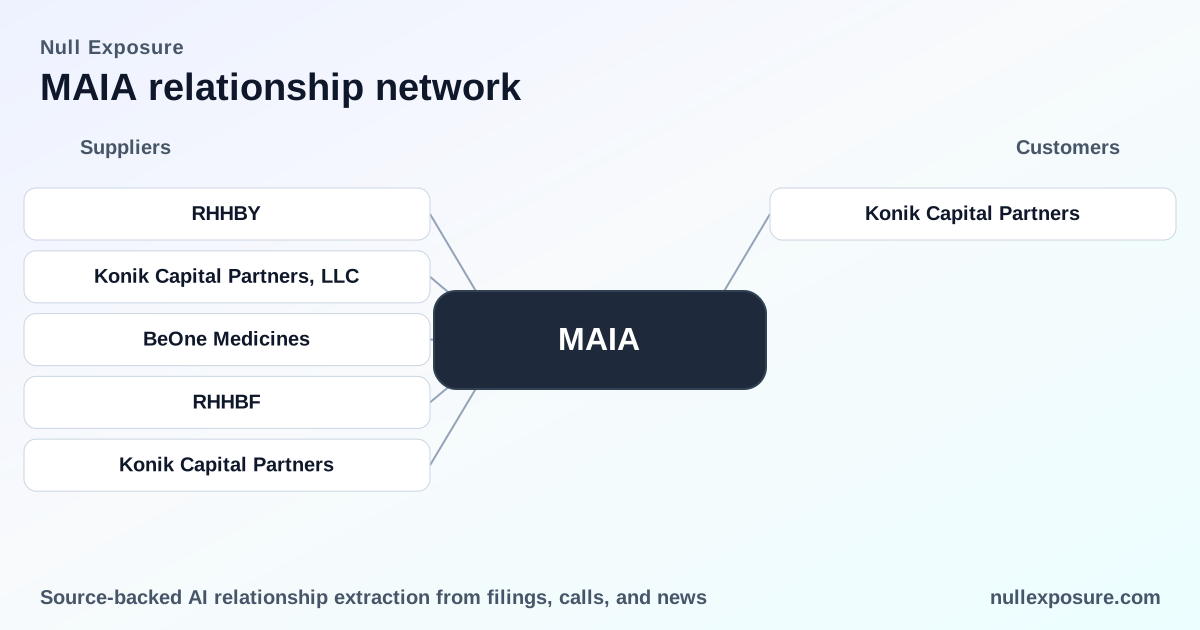
Konik Capital Partners — placement buyer in a $30 million share offering
Konik Capital Partners, a division of T.R. Winston and Company, agreed to purchase shares in a $30 million offering and bought at $1.425 per share with a 30‑day option to acquire up to 3,000,000 additional shares for over-allotments. This financing relationship provides immediate capital and optional incremental liquidity, improving MAIA’s runway and underwriting near-term R&D spend. (TradingView news report, 2026-03-10: https://www.tradingview.com/news/tradingview:f441826c8c191:0-maia-biotechnology-prices-30-million-offering-of-20-million-shares-at-1-50/)
What these relationships mean for valuations and execution risk
- Clinical site activation is a direct execution lever. Activating Summit Medical Group materially raises the probability of timely enrollment in the U.S. cohort for THIO-101 Phase 2; patient accrual speed will influence the timing of readouts and future partnering interest. For a pre-revenue biotech, individual site activations carry outsized operational importance.
- Equity placements set the near-term financial runway. The Konik transaction is a capital-raising mechanism that dilutes shareholders but reduces the probability of disruption from cash scarcity. The presence of an over-allotment option adds optionality for incremental funding without re-opening a lengthy capital-marketing process.
Contracting posture, concentration, criticality and maturity — company-level read
There are no explicit external constraint extracts listed in our relationships feed; however, company-level indicators demonstrate the following operating characteristics:
- Contracting posture: Project- and milestone-driven contracts dominate (clinical site agreements, investor subscriptions). Contracts are typically short-term and contingent on trial progress. This implies negotiation leverage swings toward counterparties when clinical data is sparse.
- Concentration risk: MAIA’s operations show high concentration in both clinical and capital relationships; a small number of activated sites and financing counterparties can materially influence outcomes and runway.
- Criticality: Relationships are highly critical to value: patient access (sites) and committed capital (placement buyers) are essential to move from preclinical/early clinical work to registrational milestones.
- Maturity: The business is immature commercially—no revenue and negative margins—so the focus is on de-risking through trials and strategic financings.
Key risk takeaways for investors and operators
- Execution is binary and site-sensitive. Trial timelines hinge on site activations and enrollment; delays at a small number of sites will translate directly into delayed milestones and potential funding gaps.
- Financing concentration creates valuation pressure. Reliance on a handful of placement buyers increases negotiating pressure and can force dilutive financings if clinical progress is slower than planned.
- Limited institutional ownership suggests thin institutional support. With institutional ownership under 5%, liquidity and follow-on institutional demand for secondary raises could remain constrained.
If you are tracking MAIA’s operational cadence or modeling financings, use centralized monitoring for site activations and placement transactions—these are the primary drivers of short-term valuation moves. For access to structured coverage and alerts, visit NullExposure.
Bottom line for investors
MAIA is a classic pre-revenue clinical biotech where customer-like relationships are clinical sites and capital providers rather than end-market buyers. The Summit Medical Group activation improves the company’s operational posture for THIO-101 Phase 2 in the U.S., while the Konik placement strengthens near-term liquidity. Investors should weigh the immediate de-risking from site activations and committed capital against the persistent concentration and execution risk inherent in a small, early-stage biotech.