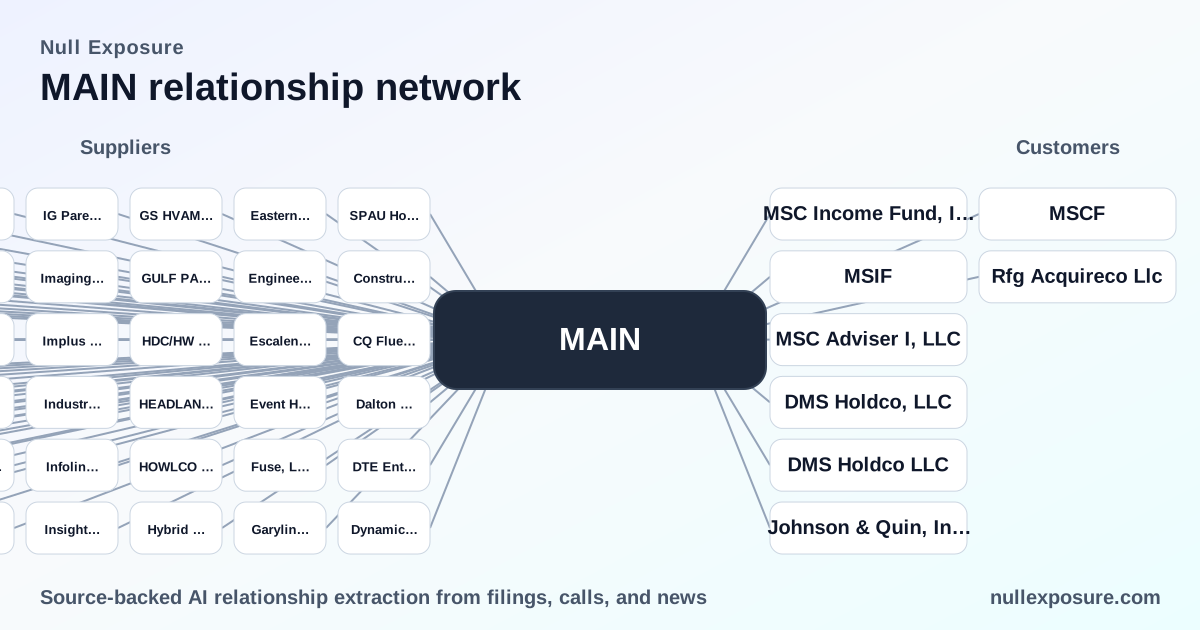
MAIN: The customer map that underpins a lower‑middle‑market financing franchise
Main Street Capital Corporation (MAIN) is a publicly traded business development company that originates and holds long‑term debt and equity positions in lower middle‑market companies and also generates fee income by managing third‑party funds. The company monetizes through net investment income and distributable earnings on its portfolio plus recurring management and incentive fees earned by its wholly‑owned adviser entities. For investors, the critical questions are concentration and counterparty quality across the portfolio and the balance between investment yield and asset‑management fee growth.
If you want a concise dashboard on these customer and investment relationships, visit https://nullexposure.com/ for expanded signals and source mapping.
How MAIN structures customer and partner relationships in plain language
Main Street operates a hybrid model: a principal investor in lower middle‑market companies and an external investment manager that runs third‑party vehicles. The firm underwrites secured, customized financings (private loans and preferred/equity co‑investments) typically structured for multi‑year hold periods, and it captures recurring income from management fees and upside through incentive fees. This dual revenue stream makes MAIN’s customer set a mix of portfolio companies (borrowers/equity partners) and externally managed funds (clients of its advisory business).
Key commercial posture: MAIN contracts with companies on multi‑year terms and sizes that are meaningful to each borrower, while its external management relationships produce recurring, contractually governed fee streams.
Operating constraints and what they imply for risk and upside
- Long‑term contracting posture. Main Street’s LMM debt investments typically have terms of five to seven years, indicating a patient, hold‑to‑maturity posture that amplifies interest income stability but increases duration exposure to interest‑rate cycles (company filing, FY2024).
- Counterparty concentration in the mid‑market. MAIN targets lower middle‑market companies with annual revenues broadly in the tens to low hundreds of millions, signaling moderate borrower sophistication and sensitivity to sector cycles (company filing evidence).
- Deal size and exposure per investment. MAIN’s private loan ticket sizes generally range from $10 million to $100 million, so single transactions can be material to both MAIN’s and the borrower’s capital structure (company signals).
- Dual role: principal and service provider. Through MSC Adviser I, LLC, Main Street explicitly operates as an external investment manager providing fee‑based services to third parties — a source of diversified, recurring revenue but one that is contractually dependent on client relationships and fund performance (MSC Adviser naming in company materials).
- Seller/underwriter activities. MAIN also acts through affiliated vehicles to issue and sell debt securities into capital markets, which is a separate distribution and funding channel for its investment activities (company disclosures).
Collectively, these constraints imply moderate maturity and criticality of relationships: investments are large and long dated (critical to income), but counterparty mix across many mid‑market borrowers reduces single‑counterparty concentration risk.
Relationship map — counterparties, one‑line takeaways and sources
Below are the counterparties called out in MAIN’s public record and news coverage. Each entry is a concise business summary with a source reference.
MSC Income Fund, Inc. (also shown in filings and press as MSIF / MSCF)
Main Street acts as the adviser and strategic capital partner to MSC Income Fund, a publicly traded BDC that co‑invests and sources private loan opportunities consistent with MAIN’s lower‑middle‑market strategy; Main Street acquired and manages MSC Income Fund shares under a fund‑of‑funds arrangement described in its 2024 10‑K. According to MAIN’s FY2024 10‑K, the Fund of Funds Investment Agreement governs Main Street’s acquisition of MSC Income Fund shares (MAIN 2024 10‑K). CityBiz and multiple March–April 2026 press reports confirm that Main Street, via MSC Adviser I, manages investments for MSIF and has been a key capital and operational partner (CityBiz, Mar 2026; Morningstar, Q1 2026).
MSIF (symbol referenced in multiple press items)
MSIF is the tickered shorthand used in news and earnings commentary for MSC Income Fund; Main Street’s relationship yields both co‑investment economics and asset‑management fee flow when MSIF’s portfolio performs. CityBiz and Yahoo Finance coverage in March 2026 describe Main Street’s co‑investment activity and advisory role to MSIF (CityBiz, Mar 2026; Yahoo Finance, Mar 2026).
MSC Adviser I, LLC
MSC Adviser I is a wholly‑owned Main Street subsidiary formed to provide investment management to external parties and collect management and incentive fees; it is the legal vehicle through which MAIN runs its external advisory business. The company’s disclosures explicitly describe MSC Adviser I’s formation and its fee‑earning mandate (company materials and FY2024 excerpts naming MSC Adviser I).
Shift Transition LLC
Main Street provided a $40 million financing commitment to Shift Transition LLC as part of a recapitalization of the business, reflecting MAIN’s willingness to back tactical recapitalizations in asset‑light logistics and micromobility adjacencies (Marketscreener / press release, Apr 2026).
Shift Transit, LLC and Shift Transit Inc. (collectively “Shift Transit”)
Main Street recapitalized Shift Transit — a micromobility maintenance and logistics operator — supplying growth and working‑capital capital as part of a strategic recapitalization transaction announced in May 2026 (Angle Advisors / Business Insider Markets, May 2026).
Trantech Radiator Products, Inc.
Trantech received approximately $26.1 million in funding from Main Street, representing a typical lower middle‑market equipment and manufacturing financing sized within MAIN’s stated private‑loan bands (Marketscreener reporting, Apr 2026).
DMS Holdco, LLC
Main Street backed a leveraged buyout and provided roughly $25.6 million in financing to DMS Holdco LLC, supporting the acquisition of healthcare data services assets — an example of MAIN’s sector‑diversified private‑loan workflow and LBO support (MarketScreener and SahmCapital commentary, Feb–Mar 2026).
Johnson & Quin, Inc.
Johnson & Quin was part of the acquisition financed through DMS Holdco’s transaction; Main Street’s expanded revolving credit facility supported this activity, demonstrating MAIN’s role as backstop lender in acquisition financings (SahmCapital analysis, Feb 2026).
UBM ParentCo
Main Street made an additional $15.6 million investment in UBM ParentCo in April 2026, consistent with MAIN’s add‑on capital strategy into portfolio companies when follow‑on financing supports growth (MarketScreener, Apr 2026).
Rfg Acquireco LLC
Rfg Acquireco LLC received financing from Main Street in early March 2026, another illustration of MAIN’s consistent participation in sponsor‑led acquisitions and mid‑market buyouts (MarketScreener reporting, Mar 2026).
What this map means for investors: summary takeaways
- MAIN combines stable, long‑dated interest income with fee revenue from external management, which diversifies but does not eliminate exposure to mid‑market cyclical risk.
- Individual transactions are material in size (typically $10M–$100M), so portfolio credit selection and monitoring are critical to maintaining distributable earnings.
- The MSC Adviser vehicle is a strategic lever: fee growth and incentive income are high‑leverage enhancers of reported net investment income but are contractually dependent on fund performance and client retention (MSC Adviser naming in filings).
- Recent activity in 2026 — recapitalizations and follow‑on investments across manufacturing, mobility, healthcare services and parent‑company financings — demonstrates a consistent execution posture toward sector diversification and opportunistic follow‑ons (press coverage, Mar–May 2026).
For a deeper signal map and primary‑source links for each relationship, visit https://nullexposure.com/.
Bold: MAIN’s revenue mix — investment income + management/incentive fees — is the core lens for valuation and risk assessment.