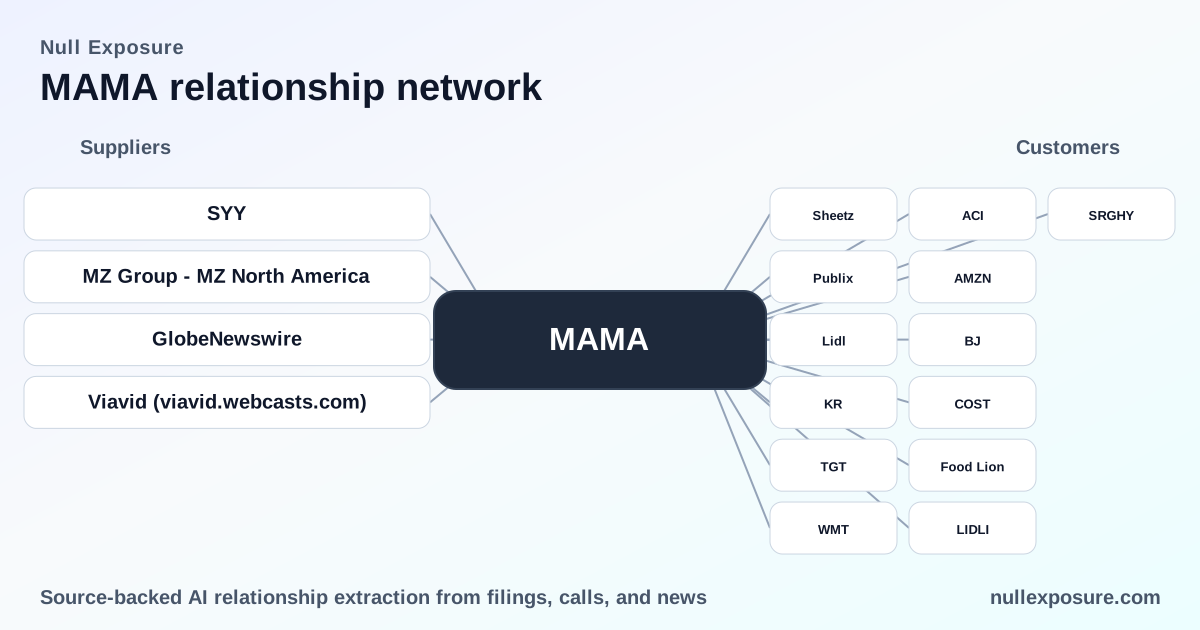
Mama's Creations: A retail-first growth story driven by national grocery placements
Mama's Creations manufactures and markets prepared refrigerated foods and monetizes by selling branded fresh and refrigerated deli items directly into large supermarket, club, mass and convenience chains and through national distributors; revenue scales as the company secures national rollouts and multi-vendor mailers that drive shelf presence and volume. Investors should view Mama's customer book as a mix of rapid retail expansion and meaningful customer concentration: the business is growing through tier‑1 national wins while a single unnamed customer historically accounted for roughly 44% of gross sales. For more company-level context visit https://nullexposure.com/.
Why the customer list matters for valuation and execution
Mama's traction with major retailers is central to its revenue multiple and margin outlook. The company sells into large enterprise buyers, distributes nationally across North America, and positions its products as core refrigerated items rather than adjunct SKUs. Those characteristics create two primary dynamics for operators and investors: operational leverage from national rollouts (costs fall as production scales) and concentration risk (revenue dependence on a small set of large buyers).
- Contracting posture: Mama's sells to large retail chains and distributors that direct fulfillment to their warehouses, which produces standard retail terms and operational discipline. This is a company-level signal drawn from management commentary.
- Geography and scale: Distribution is national across North America; Mama's reports placement in over 10,000 grocery, mass, club and convenience outlets.
- Materiality and concentration: For the year ended January 31, 2025, one customer accounted for approximately 44% of gross revenue — a high concentration that materially influences cash flow stability.
- Role and product focus: Customers are buyers (retailers and distributors) and placements are core product listings in refrigerated categories, not one-off promotions.
These constraints define Mama's operating model: high upside from successful national introductions and parallel downside if a major buyer reduces orders or renegotiates terms.
Channel-by-channel: what each customer relationship contributes
Below is a concise, plain‑English rundown of every customer relationship disclosed in the reporting and commentary set.
Publix
Mama's secured new commitments from Publix for enhanced "Meals for One," reflecting a national grocery chain rollout of core refrigerated items. This was discussed on the Q1 2026 earnings call (March 7, 2026).
Sheetz
Sheetz is a notable convenience-store launch partner for Mama's paninis, reflecting expansion into c-store channels and new route-to-market formats; management referenced a major Q1 c-store launch on the Q4 2025 earnings call and again in Q1 2026 commentary (March 2026).
Lidl
Lidl accepted multiple new sleeve items and is taking chicken stuffed meatballs, marking Mama's first multi-item program with this retailer and enabling fuller utilization of chicken breast products; management highlighted these wins in the Q4 2025 and Q1 2026 earnings calls (March 2026).
BJ's Wholesale Club
BJ's is carrying new non-protein items and has received "grandma-quality" chicken strips from Mama's, signaling club-channel penetration that complements national club efforts like Costco; references come from Q4 2025 and Q1 2026 earnings commentary (March 2026).
Costco
Costco is a strategic, high-visibility partner: Mama's completed an unannounced Costco audit with a 99.8% score and executed its first National Costco Multi‑Vendor Mailer (MVM) with branded Beef Meatballs; GlobeNewswire releases and earnings commentary across FY2025–FY2026 document these developments (Dec 2025; Apr 2026; Mar 2026).
Kroger (Home Chef division)
Mama's achieved its first item placement in Kroger's Home Chef division, a meaningful entry into a large retailer's meal-kit/home chef channel that expands reach beyond traditional refrigerated lanes; management disclosed this on the Q4 2025 earnings call (March 2026).
Target
Target committed to staged, national placements (a rollout to 1,995 stores and additional items in setup stages); the company cited Target as a new tier‑one national placement in GlobeNewswire releases and investor conference materials across FY2025–FY2026 (Dec 2025; Jan–Apr 2026).
Walmart
Walmart expanded placements with Mama's in FY2026, described by management as a major tier‑1 national placement that increases scale and distribution footprint; this was noted in the FY2026 financial results press release (Apr 2026).
Albertsons
Albertsons is now stocking Mama's products across its regions, a national supermarket channel placement that supports consistent weekly velocity in stores; management described being in "all Albertsons regions" on the Q4 2025 and Q1 2026 calls (March 2026).
Amazon Fresh
Amazon Fresh is launching Mama's Meals for One with extended shelf-life technology, representing a growing digital grocery channel and a different logistics model for refrigerated commerce; management discussed this in Q4 2025 and Q1 2026 remarks (March 2026).
Food Lion
Mama's secured new national introductions at Food Lion, part of the company's FY2025–FY2026 tier‑one retail wins that support broader southeastern and regional distribution gains; GlobeNewswire and FY2026 releases reference this placement (Dec 2025; Apr 2026).
ShopRite
ShopRite is listed among retailers carrying Mama Mancini's products, demonstrating continued penetration into regional supermarket chains alongside national rollouts; PR Newswire referenced ShopRite placements in a March 2026 release.
What these relationships imply for operations, margins and risk
- Revenue growth engine: National rollouts at Costco, Target, Walmart and Kroger constitute the primary growth vector — these placements drive meaningful incremental volume and brand awareness (GlobeNewswire and earnings calls, FY2025–FY2026).
- Operational demands: Large retailer programs require high audit standards and reliable extended shelf-life solutions; the 99.8% Costco audit score signals operational maturity but also raises the bar for ongoing compliance (Q4 2025 / FY2026 commentary).
- Concentration risk: The company-level disclosure that a single customer accounted for ~44% of gross revenue for FY2025 is a material concentration; this creates leverage in negotiations but also vulnerability if that buyer changes course (company filings for year ended Jan 31, 2025).
- Channel diversification: Club (Costco, BJ's), mass (Target, Walmart), supermarket (Albertsons, Publix, Food Lion, ShopRite), c-store (Sheetz) and digital (Amazon Fresh) exposure reduces single-channel dependence and increases optionality for margin expansion.
Investment takeaway and next steps
Mama's Creations is executing a deliberate strategy to convert capacity expansion into national retail wins, and those wins are already visible across every major channel—club, mass, supermarket, convenience and digital. The company balances high upside from MVMs and national rollouts with the sober reality of customer concentration. Investors and operators evaluating MAMA should watch (1) the cadence of national rollouts converting to repeat orders, and (2) the evolution of customer concentration beyond the ~44% single-customer exposure disclosed for FY2025.
For an up-to-date view of Mama's placements and commercial progress, visit https://nullexposure.com/.
Bold takeaways: national tier‑1 placements drive scale; operational execution is proven by stringent audits; concentration remains the principal risk that determines valuation sensitivity.