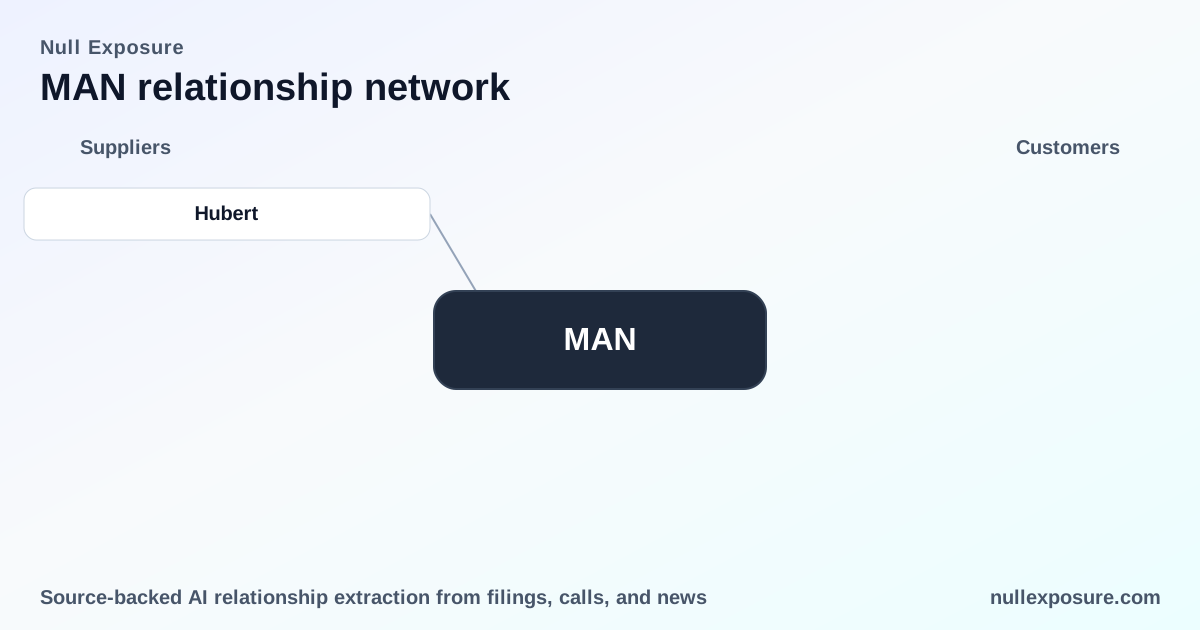
ManpowerGroup (MAN): Customer Relationships That Define Revenue Quality and Operational Risk
ManpowerGroup is a global provider of workforce solutions that monetizes primarily by supplying staffing, recruitment, outsourcing and workforce consulting services, billing hourly for staffing/interim work and collecting placement fees or outcome-based contracts for recruiting and outsourcing. With trailing revenue of $18.4 billion and a network spanning roughly 75 countries, ManpowerGroup’s business is services-led, geographically diversified but Europe-sensitive, and its customer posture is dominated by short-term, usage-based and outcome-oriented contracts. For investors focused on client concentration, contract durability and recent portfolio moves, this note synthesizes public relationship signals and the operational constraints that shape MAN’s earnings profile. For additional company relationship intelligence, visit https://nullexposure.com/.
Quick investor snapshot: what drives revenue and what to watch
- Revenue model: Hourly staffing and interim services recorded over time; permanent recruitment recognized at point of placement.
- Scale and geography: Approximately 85% of revenues generated outside the U.S., with 48% of revenue from European operations, making Europe a material operating region.
- Client mix: Large national and multinational clients represented about 60% of revenues in 2024, while mid-market and local businesses account for the remainder.
- Recent portfolio action: ManpowerGroup completed a strategic divestiture of its Jefferson Wells U.S. business for $100 million in 2026, a transaction that reshapes its consulting footprint and cash position.
How ManpowerGroup structures customer contracts and why it matters
ManpowerGroup’s contracts exhibit patterns that explain both its resilience and its earnings volatility:
- Predominantly short-term contracting posture: staffing and interim client arrangements are generally one year or less and frequently renewed at local discretion; this generates recurring but flexible and replaceable revenue.
- Usage-based and franchise economics: franchise fees are typically a percentage of franchise revenue and recognized monthly, producing steady, usage-linked cash flow where franchise performance drives recognition.
- Spot and point-in-time elements: Permanent recruitment fees are recognized at placement, creating episodic revenue spikes tied to hiring cycles.
- Service-provider orientation: The company is predominantly a provider of staffing, outsourcing and workforce consulting services rather than a product vendor—revenues derive from labor supply and outcomes, not manufactured goods.
- Geographic concentration risk: Europe is material to consolidated results and exchange-rate fluctuations primarily affect reported earnings more than underlying cash generation.
These characteristics together imply high revenue volume and cyclicality: the firm can scale quickly with demand due to short-term contracts, but that also makes revenue sensitive to cyclical hiring and regional economic shifts.
Active relationships and material events investors should track
Sikich — buyer of Jefferson Wells U.S.
ManpowerGroup sold its Jefferson Wells U.S. professional-services unit to Sikich for $100 million, a transaction disclosed in ManpowerGroup’s 1Q2026 release and widely reported across business media. The divested unit generated roughly $76 million of revenue in 2025, and the sale is presented as a deliberate portfolio optimization to sharpen the company’s focus on core workforce solutions. (Sources: ManpowerGroup press release via PR Newswire Apr–May 2026; Hoodline May 3, 2026; Intellectia May 2026.)
ATCOL — evidence of MAN engines in large marine assets
A March 2026 report from LNG Prime noted that newly chartered 15,000‑TEU containerships commissioned by Seaspan and ZIM will be fitted with MAN ME‑GI engines, illustrating demand for MAN’s industrial engine technology in large marine platforms. While this citation sits in the dataset as ATCOL, the relevant public report identifies MAN engines as the propulsion choice for major vessel classes serving Asia–US East Coast trades. (Source: LNG Prime, March 9, 2026.)
What these relationships reveal about operating focus and strategy
- The Sikich transaction is a clear signal of active portfolio management: selling a $76M‑revenue unit for $100M crystallizes value, frees capital and reduces exposure to certain professional-services margins. Investors should treat this as earnings quality neutral to modestly accretive on a margin and capital-allocation basis, given the proceeds and the non-core nature described in public filings. (Source: PR Newswire; Intellectia May 2026.)
- The marine-engine reference is peripheral to ManpowerGroup’s staffing core but underscores MAN’s brand reach in industrial markets through its parent group’s product lines (where applicable). This highlights that MAN-related revenues can arise in different legal entities and product segments, reinforcing the need to separate service cash flows from equipment or licensing revenues when modeling the company.
Credit and operational implications for investors
- Contract brevity increases revenue agility and volatility. Short-term staffing contracts allow rapid margin recovery when demand returns but also lead to quick revenue degradation in downturns.
- Diversification dampens single-market shocks but concentrates Europe risk. Global footprint and a 60/40 split toward large clients provide scale, but 48% European exposure makes macro developments in EU labor markets a primary driver of near‑term performance.
- Portfolio reshaping reduces non-core complexity. The Jefferson Wells U.S. divestiture generates cash and simplifies the revenue base; investors should update rolling revenue forecasts to reflect the $76M revenue reduction net of any recurring partner arrangements. (Source: PR Newswire; Intellectia May 2026.)
- Earnings recognition nuances matter for modeling. Usage-based franchise fees recognized monthly and placement fees recorded at point-in-time require separate modeling of recurring versus episodic revenue streams.
Bottom line: what investors should take away
- ManpowerGroup is fundamentally a services business with predictable hourly revenue and episodic recruitment upside, but it trades on the cyclical demand for labor and the economic health of Europe.
- Short-term contracts and usage-based fees create both resilience and earnings variability—the company collects steady cash in growth phases but can lose revenue quickly in contractions.
- The sale of Jefferson Wells U.S. for $100M materially clarifies the firm’s focus and improves liquidity, yet reduces consulting revenue by roughly $76M (2025 base), an adjustment investors must fold into growth and margin scenarios. (Source: PR Newswire; Intellectia; Hoodline May 2026.)
For a more granular breakdown of relationship signals and to monitor upcoming customer events that affect revenue quality, explore the full coverage at https://nullexposure.com/.