Manchester United (MANU): Customer Network and Commercial Risk Profile
Manchester United monetizes a global brand through three principal revenue pillars: broadcasting distributions, sponsorships and commercial partnerships, and global merchandise and matchday revenue. The club converts global fan engagement into predictable cash flows via long-term kit and commercial deals, while tactical player loans and transfers are used to manage wage exposure and realize asset value. For investors, the critical question is how sponsorship concentration and broadcast receipts tied to televised matches interact with sporting performance and balance-sheet leverage to drive free cash flow. For deeper relationship mapping and ongoing monitoring, visit https://nullexposure.com/.
How Manchester United’s commercial engine is structured
Manchester United operates as a media‑friendly consumer brand that sells exposure. Broadcasting rights and televised matches generate large, semi‑contractual distributions from league authorities and broadcasters, while sponsors pay for logo placement and global activation rights tied to a fixed-term commercial contract. Player trading and loan arrangements are treated as working capital tools: loans reduce short‑term wage burden and transfers crystallize asset gains or losses depending on fees received.
- Broadcasting income is structurally important and partially insulated from single-season performance because league distributions include TV allocations tied to matches televised and historical coefficients.
- Sponsorships are contractually concentrated but long‑dated, making them critical revenue anchors; their renewal dynamics are a primary driver of near‑term commercial upside or downside.
- Player loans and transfers are used pragmatically to manage payroll and balance-sheet optics; these moves can produce one‑off accounting gains or losses.
Customer and partner map — the relationships that matter
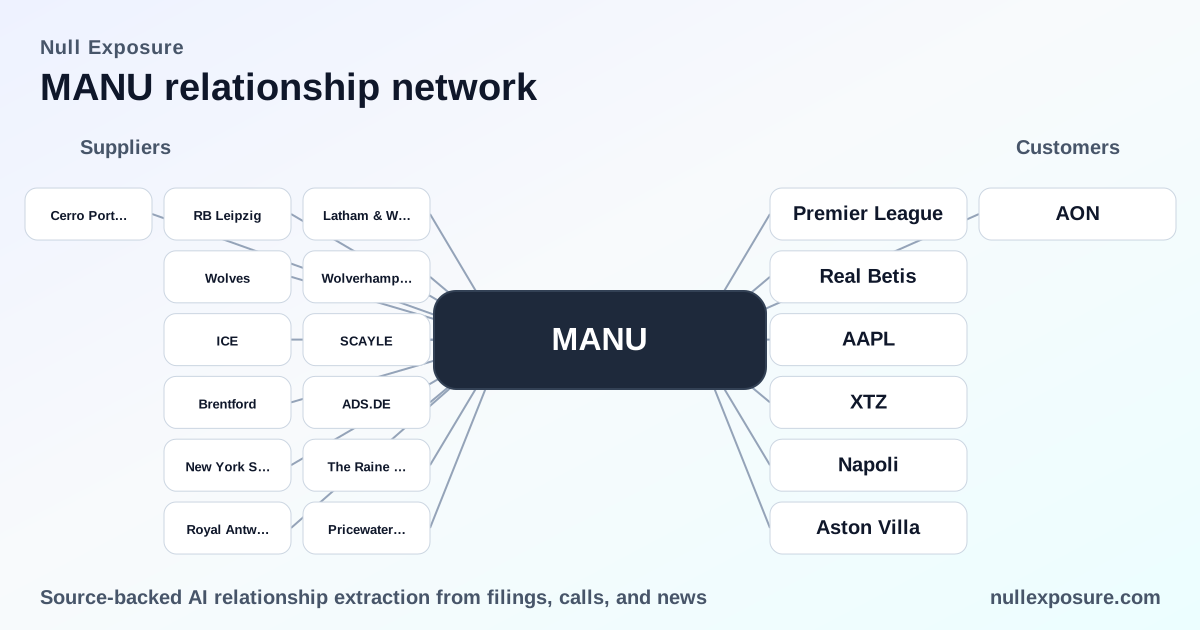
Below I list every partner and customer referenced in the underlying dataset and summarize their commercial relevance to MANU in plain English.
Premier League
The Premier League is a core revenue source for Manchester United; the club received £136.2 million in distribution for the referenced season driven in part by the high number of televised matches. Source: The New York Times / The Athletic, Oct 8, 2025 (analysis of FY2025 distributions): https://www.nytimes.com/athletic/6680109/2025/10/08/man-united-finances-debt-transfers-analysed/
Real Betis
Manchester United completed an outgoing deal with Real Betis that removed a player from United’s wage bill but generated an accounting loss on the transfer. This demonstrates the club’s use of transfers to manage both payroll and balance-sheet recognition. Source: The New York Times / The Athletic, Oct 8, 2025 (FY2025): https://www.nytimes.com/athletic/6680109/2025/10/08/man-united-finances-debt-transfers-analysed/
Apple (AAPL)
Apple has been mentioned in market commentary as a potential strategic acquirer or commercial partner; such interest underscores the strategic value of Manchester United’s digital and content reach for large media platforms. Source: Proactive Investors (coverage citing FY2022 speculation and later reporting), March 2026: https://www.proactiveinvestors.co.uk/companies/news/999461/apple-s-interest-in-manchester-united-would-mark-a-major-escalation-in-the-streaming-war-999461.html
Tezos (XTZ)
Tezos signed a high‑profile commercial deal to place its logo on Manchester United training gear, reported as a £20 million agreement that replaced Aon on training kit rights and signals the club’s willingness to accept non‑traditional technology partners for commercial income. Source: Irish Mirror (reporting on the sponsorship deal, FY2022/announcement timing in press): https://www.irishmirror.ie/sport/soccer/man-utd-shirt-sponsor-tezos-26195177
TeamViewer (TMV.DE)
TeamViewer is cited as a named sponsor contributing to the club’s commercial revenue pool, demonstrating Manchester United’s multi‑sponsor model across different product placements and activation channels. Source: TradingView company summary (FY2026 commentary on sponsors/contributions): https://www.tradingview.com/symbols/HAN-MUF/
Aon
Aon was the prior commercial partner on training and kit rights and its exit demonstrates normal commercial churn in stadium and training apparel rights; Aon’s replacement illustrates sponsor lifecycle transitions that impact near‑term commercial income. Source: Irish Mirror (coverage of sponsorship replacement), FY2022: https://www.irishmirror.ie/sport/soccer/man-utd-shirt-sponsor-tezos-26195177
Aston Villa
Aston Villa covered roughly 80% of Jadon Sancho’s pay during a loan spell, illustrating how Manchester United uses loan arrangements with other clubs to transfer immediate wage obligations and preserve squad flexibility. Source: The New York Times / The Athletic, Oct 8, 2025 (FY2025 player‑loan analysis): https://www.nytimes.com/athletic/6680109/2025/10/08/man-united-finances-debt-transfers-analysed/
Napoli
Napoli’s loan of Rasmus Hojlund to start the season increases the likelihood of a permanent transfer for a pre‑agreed fee (reported at €44 million / £38.3 million), highlighting how conditional loan‑to‑buy structures are used to monetize academy or recently acquired talent. Source: The New York Times / The Athletic, Oct 8, 2025 (FY2025): https://www.nytimes.com/athletic/6680109/2025/10/08/man-united-finances-debt-transfers-analysed/
Adidas (ADS.DE)
Adidas is a major legacy kit partner referenced among the club’s core sponsorships and is a pillar of Manchester United’s merchandise and apparel revenue streams. Source: TradingView company summary (FY2026 sponsorship commentary): https://www.tradingview.com/symbols/HAM-MUF/
What the relationship map implies for investors
- Concentration and criticality: Broadcasting receipts and a handful of major sponsors (Adidas historically, TeamViewer, Tezos) are central to revenue predictability; loss or non‑renewal of major sponsors would have immediate earnings impact. That said, the club’s broad global fanbase diversifies retail and licensing channels.
- Contracting posture and maturity: Sponsorship deals are typically multiyear and structured for brand activation; the club routinely replaces sponsors as contracts expire, a normal commercial dynamic but one that introduces renewal risk at discrete points in the calendar.
- Operational levers: Player loans and transfer structures are actively used to manage payroll and convert long‑term sporting assets into cash; reported loan coverage of wages (e.g., Sancho) shows direct balance‑sheet relief.
- Market interest upside: Strategic buyer interest from global media or tech companies (Apple coverage) reflects the intangible value of the club’s digital reach and could re‑rate multiples under an acquisition thesis. Source: Proactive Investors (March 2026).
No explicit contractual constraints were provided in the reviewed dataset; as a company‑level signal, this means the relationship map must be interpreted from public reporting and press coverage rather than from filed contractual exhibits.
Risks and upside to position size
- Risk: Sporting performance remains a vector for revenue volatility because televised match counts and merchandising sentiment respond to on‑field results; broadcast distribution is material (reported £136.2m in the referenced season). Source: The New York Times / The Athletic, Oct 8, 2025.
- Upside: Successful sponsor renewals or a strategic acquisition could materially improve multiple expansion; deals such as the £20m Tezos agreement show the club can extract sizeable headline commercial fees even while transitioning partners. Source: Irish Mirror.
For ongoing tracking of Manchester United’s commercial relationships and counterparty exposure, see the relationship coverage and monitoring tools at https://nullexposure.com/.
Bottom line for investors
Manchester United converts brand equity into repeatable commercial cash flows through a sponsor‑heavy, broadcast‑dependent model supplemented by active player trading. The relationship map shows high commercial sophistication but also concentration risk around marquee sponsors and televised match income. Investment theses should price in both the durability of long‑term sponsorship contracts and the short‑term volatility that sporting results and sponsor churn introduce to cash flow.