Marathon Digital (MARA): Customer Relationships Signal a Shift from Pure Mining to Infrastructure Platform
Marathon Digital operates large-scale Bitcoin mining operations while transitioning into a vertically integrated energy and digital infrastructure company that monetizes through three primary channels: (1) Bitcoin mining and realized coin sales, (2) hosting and infrastructure services for institutional miners and data center operators, and (3) sale and licensing of infrastructure and software (immersion cooling, load management, and proprietary applications). For investors, the customer relationships disclosed in recent filings and press coverage show a deliberate pivot toward long-term, capital‑intensive infrastructure projects and strategic partners that supply power, development expertise, and software/IP. Learn more at https://nullexposure.com/.
How these relationships illustrate Marathon’s operating model in plain language
Marathon’s disclosed counterparties reflect a company executing a hybrid model: self-mining economics underpinned by hosting revenue and infrastructure sales. Contract evidence suggests a mix of short-term, usage‑based hosting agreements alongside larger strategic development deals and equity investments that push the company into the AI/HPC and data center market.
- Contract posture: contracts for hosting and energy services skew short duration and usage-priced, exposing revenue to utilization swings while reducing long-term lock‑in.
- Counterparty type and concentration: counterparties are primarily large enterprises and institutional providers, indicating Marathon pursues high-capacity partners for scale and energy supply.
- Criticality and maturity: early-stage pilots and a declared winding‑down of some hosting locations indicate a transition phase from third‑party hosting to Marathon‑owned, vertically integrated operations.
Key takeaway: Marathon is trading some hosting variability for strategic control of energy and data center assets, increasing capital intensity but also capturing higher-margin infrastructure upside.
The relationship map investors need to track
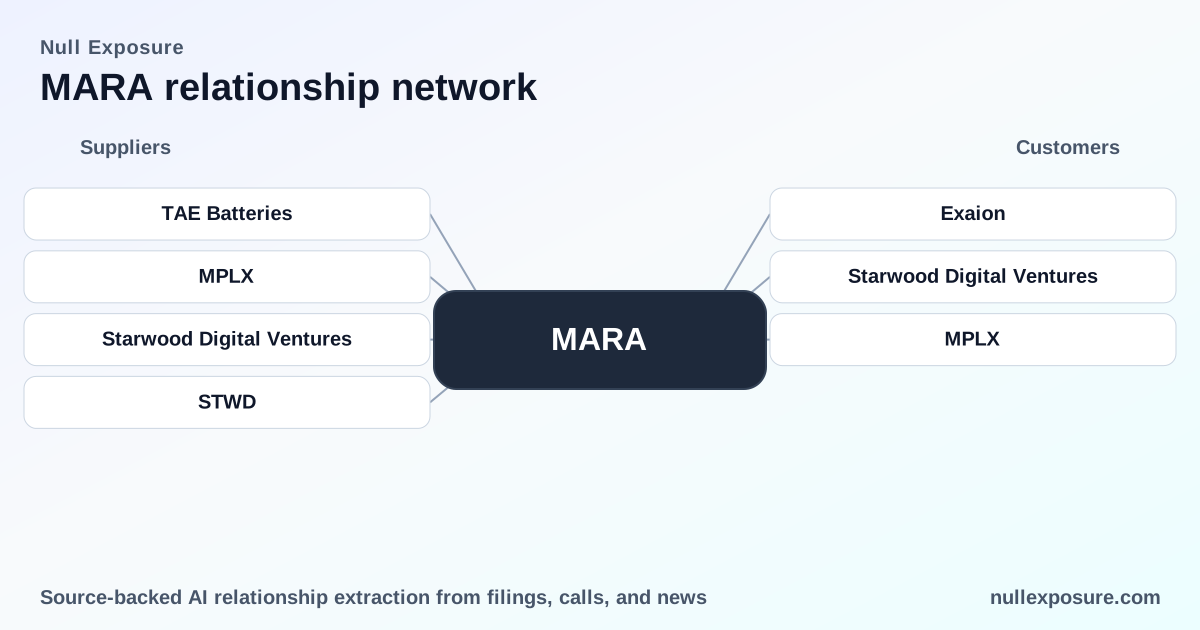
Below are every customer or partner relationship mentioned in the available results, with a concise investor‑facing summary and the original source context.
Exaion
Marathon acquired a 64% stake in Exaion, expanding its enterprise AI and HPC capabilities and accelerating a move into high-performance compute services beyond Bitcoin mining. This is disclosed in Marathon’s 2025 Q4 earnings call commentary. (2025 Q4 earnings call)
Starwood Digital Ventures
Marathon announced a strategic partnership with Starwood Digital Ventures, the data center development arm of Starwood Capital, to leverage Starwood’s development and operational expertise for data center projects. The partnership was presented as a marquee development relationship in the 2025 Q4 earnings call. (2025 Q4 earnings call)
MPLX (earnings call)
Marathon is advancing discussions with MPLX to develop integrated power and data campuses in West Texas, characterizing the initiative as a longer‑term, capital‑intensive project. This update was presented during Marathon’s 2025 Q4 earnings call. (2025 Q4 earnings call)
GLXY (Galaxy Digital)
Marathon transferred 1,318 BTC (≈$87M) to counterparties including Galaxy Digital, Two Prime, and BitGo, demonstrating active use of institutional custody and liquidity providers for corporate treasury management and coin movement. This transfer was reported by CryptoBriefing citing Arkham Intelligence (FY2026 reporting). (CryptoBriefing, FY2026)
MPLX (regional report / LOI)
A regional business report described a letter of intent between MPLX LP and Marathon to provide natural gas to planned gas-fired generation supporting Marathon’s West Texas campuses—initial capacity around 400 MW with scalability to 1.5 GW under a tolling structure where MPLX supplies gas and receives electricity. The arrangement positions Marathon to own/operate generation and data centers subject to definitive agreements. (Regional report summarized by ts2.tech, Nov. 6, 2025 / FY2025)
MPLX LP (duplicate LOI entry)
The regional account separately recorded the same LOI language with MPLX LP, reinforcing the scope and commercial structure of the proposed natural gas-to-power supply for Marathon’s planned West Texas facilities. This duplicative mention consolidates the public record around the LOI terms. (Regional report summarized by ts2.tech, Nov. 6, 2025 / FY2025)
What the constraints tell you about Marathon’s business risks and levers
Treat the following constraints as company‑level signals explaining how Marathon operates and how investors should model the business.
- Short‑term contracts and usage pricing: Marathon’s hosting relationships are frequently short duration and billed on consumption, which keeps customer onboarding flexible but exposes revenue to mining hardware utilization and crypto price cycles. This increases revenue volatility while limiting contractually guaranteed cash flows.
- Service provider and licensor roles: Marathon functions as a service provider (hosting, verification) and licensor of proprietary software and immersion systems, creating diversified revenue vectors but also requiring continued R&D and customer support capabilities.
- Winding‑down legacy hosting locations; pivot to self‑mining: Marathon is transitioning certain hosted sites to self-mining, indicating a tactical consolidation of operations to improve margin capture, at the cost of near-term capex and execution risk as customer agreements expire.
- Pilot deployments and global footprint: Pilot heat‑recovery projects (e.g., Finland) and operations spanning four continents signal maturing operational sophistication and multiple commercialization pathways beyond pure coin production.
- Infrastructure segment focus: The company emphasizes selling data center infrastructure and immersion systems, which increases product revenue potential but also demands different go‑to‑market and vendor management capabilities.
Investment implications and risk checklist
- Opportunity: Vertical integration into power and data centers is a structural step toward higher, more stable margins if Marathon secures long-term power contracts and scales AI/HPC workloads.
- Risk: Heavy capital requirements for gas-fired generation and data center buildout introduce permitting, execution, and commodity‑supply risks; short-term, usage-based customer contracts limit near-term revenue visibility.
- Counterparty profile: Engagements with established players (Starwood, MPLX, Galaxy) reduce execution risk but increase counterparty dependency and negotiation complexity for tolling and off-take arrangements.
- Operational pivot: The acquisition of Exaion and pilot commercialization projects are value-accretive if transformed into recurring enterprise contracts.
For a deeper dataset of MARA’s partner ecosystem and to monitor evolving disclosures, visit https://nullexposure.com/.
Bottom line
Marathon is reshaping from a pure-play miner into a capital‑intensive infrastructure operator that monetizes both compute and the energy that powers it. Investors should value Marathon not only on coin inventory and hash rate but also on its ability to execute long-term power projects, convert pilot technologies into commercial offerings, and manage short-duration hosting contracts during the transition.