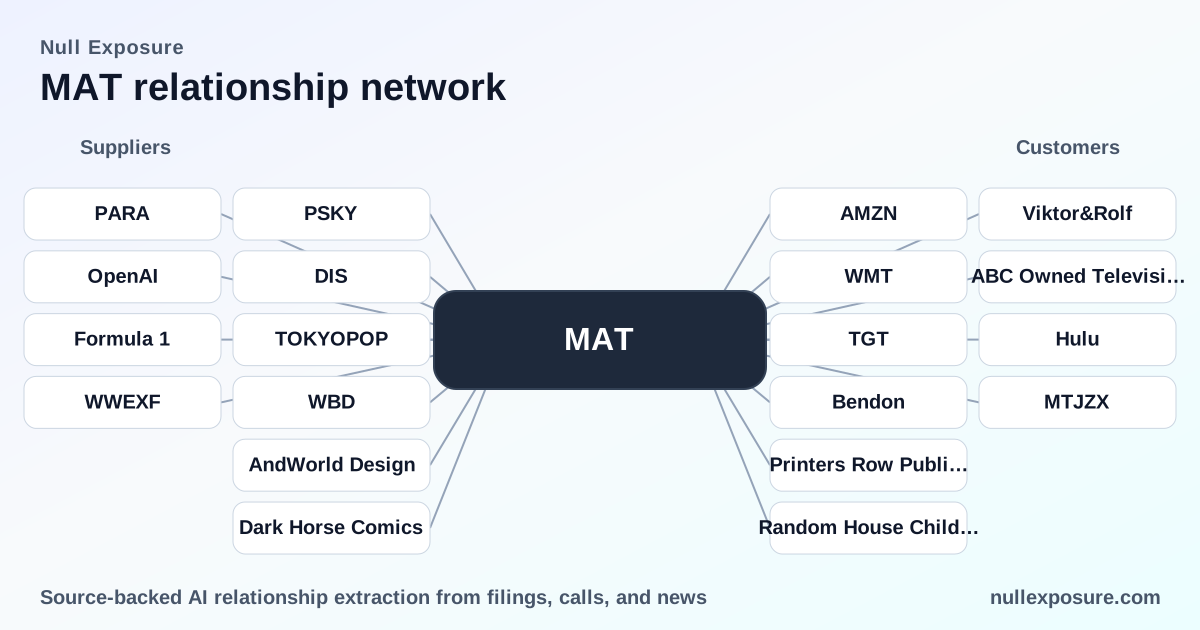
Mattel (MAT): customer map and what it means for revenue durability
Mattel monetizes through two clear levers: product sales to large retail chains and distributors, and royalties from licensed intellectual property. The company sells finished goods through wholesale channels and directly to consumers via Mattel Creations and e‑commerce, while licensing brands for media, publishing, and games generates recurring royalty streams and marketing lift.
For a focused read on counterparty concentration and relationship risk, see additional coverage at https://nullexposure.com/.
Why the customer base matters now
Top customers are a structural revenue driver: Mattel disclosed in its 2024 Form 10‑K that Walmart, Target and Amazon together accounted for approximately 44% of consolidated net sales ($1.17B, $0.68B, and $0.51B respectively in 2024). That concentration elevates bargaining leverage for a small set of retail partners and anchors demand patterns for core product franchises. (Source: Mattel 2024 Form 10‑K, reported in the company filing and summarized in news coverage of the filing).
Beyond wholesale, Mattel combines spot retail purchase orders with longer‑running licensing agreements where third parties pay royalties and sometimes minimum guarantees — this dual contracting posture balances transactable product sales against more predictable licensing revenue. (Source: Mattel 10‑K disclosures on licensing and sales terms, FY2024).
How Mattel contracts and distributes — practical operating constraints
- Contracting posture: The company operates largely on one‑time purchase orders for inventory sold to retailers, while also entering symbolic and functional licensing arrangements that deliver royalties and occasional minimum guarantees. This mix creates both cash flow variability tied to retail orders and steady royalty inflows from media/publishing/game partnerships. (Source: Mattel 10‑K excerpts on purchase orders and licensing).
- Counterparty mix and concentration: Both large enterprises and individual consumers matter — Mattel sells through massive retail partners and directly to consumers via its e‑commerce platforms. The large‑enterprise signal is explicit in the 10‑K naming Walmart, Target and Amazon as primary customers. (Source: Mattel 2024 Form 10‑K).
- Geography and distribution maturity: North America accounts for the majority of net sales, but products are sold globally through a mix of direct retail relationships and distribution agents where Mattel lacks direct presence. This reflects an established international footprint balanced by North American revenue dependence. (Source: Mattel 2024 Form 10‑K).
- Materiality profile: Top‑three customer concentration is material to revenue (44% of sales in 2024), while other legal accruals noted in filings are described as immaterial. (Source: Mattel 2024 Form 10‑K).
Relationship readout — every partner in the public results
Below are concise, investor‑oriented summaries for each counterparty named in the available results, with source references.
-
Amazon — Amazon is a significant retail and platform partner for Mattel: products are distributed via Amazon’s retail channels and Amazon is named among Mattel’s three largest customers in the company’s 2024 Form 10‑K; press coverage in March 2026 also notes Hot Wheels and new building sets will be available on Amazon and other retailers. (Source: Mattel 2024 Form 10‑K; Old Cars Weekly, March 10, 2026).
-
Target (TGT) — Target is one of Mattel’s top three customers, representing roughly $0.68 billion of net sales in 2024 and a primary wholesale channel for product launches and seasonal assortments. (Source: Mattel 2024 Form 10‑K; Old Cars Weekly, March 10, 2026).
-
Walmart (WMT) — Walmart is Mattel’s largest single customer in 2024 at approximately $1.17 billion of net sales and is a critical distribution anchor for scale and national assortment planning. (Source: Mattel 2024 Form 10‑K; TradingView summary of the 10‑K, March 2026).
-
Bendon — Bendon is listed among Mattel’s publishing licensees; Mattel’s move to form its own publishing imprint is intended to complement titles from Bendon and others. This is a license‑partner relationship for brand extensions into children’s publishing. (Source: Publishers Weekly, March 2026).
-
Printers Row Publishing Group’s Studio Fun imprint — Studio Fun is another publishing licensee whose titles sit alongside Mattel’s forthcoming in‑house imprint, supporting book and character merchandising strategies. (Source: Publishers Weekly, March 2026).
-
Random House Children’s Books — Random House Children’s Books is named as an established publishing licensee, providing an external channel for Mattel IP to reach children’s book markets. (Source: Publishers Weekly, March 2026).
-
Viktor&Rolf — Viktor&Rolf collaborated with Mattel on a Disney Collector Cinderella Doll, sold via Mattel Creations with an SRP noted in the press; the partnership drives premium, collectible SKU economics and earned media exposure. (Source: WebWire press release, March 2026).
-
Amazon Game Studios — Amazon Game Studios is publishing a Masters of the Universe game developed under license from Mattel, demonstrating direct monetization of IP in interactive entertainment. (Source: Amazon Game Studios press release, May 3, 2026).
-
Amazon MGM — Amazon MGM is co‑leading a multi‑platform marketing campaign with Mattel, reflecting strategic coordination between Mattel and Amazon’s media assets to amplify franchise launches. (Source: Mattel Q1 2026 earnings call transcript summarized in InsiderMonkey, May 2026).
-
Netflix — Netflix is a partner in Mattel’s digital game licensing business (e.g., a Pictionary title), reflecting license revenue and promotional cross‑benefits between streaming and toy/game ecosystems. (Source: Mattel Q1 2026 earnings call transcript summarized in InsiderMonkey, May 2026).
-
Mobil 1 (XOM) — Mobil 1 sponsors the Hot Wheels Legends Tour presented by Mobil 1, a brand partnership that supports experiential marketing and earned exposure for Hot Wheels. (Source: Old Cars Weekly, May 3, 2026).
-
Bandit Island Games — Bandit Island Games is identified as the developer for the Masters of the Universe title published by Amazon Game Studios under license from Mattel, representing the developer layer in Mattel’s game license stack. (Source: Amazon Game Studios press release, May 3, 2026).
-
ABC Owned Television Stations — ABC owned stations carried a documentary special tied to the Viktor&Rolf collaboration, signaling traditional and linear media placements as part of Mattel’s owned‑and‑partnered marketing mix. (Source: WebWire press release, March 2026).
-
Hulu — The Viktor&Rolf documentary also debuted on Hulu, underlining streaming platforms as distribution channels for brand storytelling and product promotion. (Source: WebWire press release, March 2026).
Key investment takeaways
- Concentration is the dominant counterparty risk — Walmart, Target and Amazon together accounted for 44% of net sales in 2024, giving these buyers significant negotiating leverage and making Mattel’s near‑term revenue sensitive to large‑retailer assortment decisions. (Source: Mattel 2024 Form 10‑K).
- Revenue diversity beyond retailers exists, but is secondary — licensing into publishing, streaming, games and branded partnerships provides recurring royalties and marketing synergies that de‑risk pure wholesale cyclicality. Examples include game licensing with Amazon Game Studios/Bandit Island Games, publishing partners, and co‑marketing with Amazon MGM and Hulu/ABC. (Sources: Publishers Weekly; Amazon Game Studios; InsiderMonkey; WebWire).
- Operating model implies cash‑flow variability — the mix of spot purchase orders and royalties creates a balance of volatile order‑driven revenue and steadier licensing income; investors should underwrite both cadence differences and the materiality of large retailer relationships. (Source: Mattel 2024 Form 10‑K).
For a concise dashboard view and deeper counterparty scoring, visit https://nullexposure.com/ — our portal aggregates these relationship signals and primary sources for investor workflows.
Bottom line: Mattel’s franchise monetization is robust and multi‑modal, but top‑customer concentration and reliance on retail purchase orders are the principal operational constraints that investment models must incorporate.