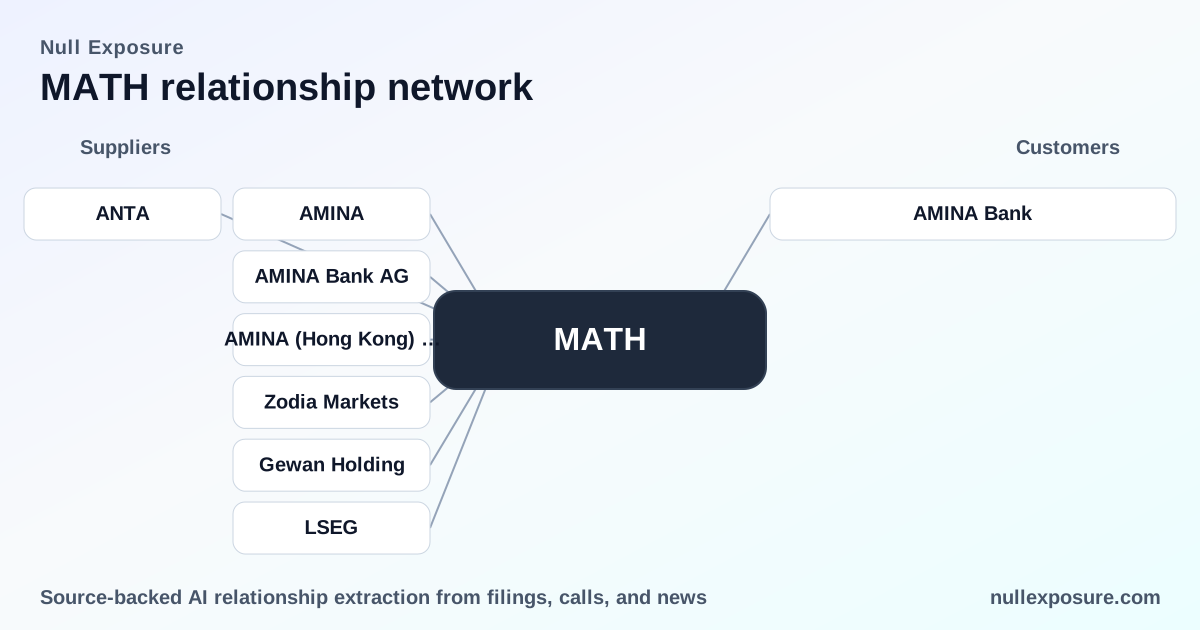
Metalpha (MATH) customer map: the AMINA Bank distribution tie and what investors need to know
Metalpha Technology Holding Limited operates as a crypto-focused wealth manager and fintech platform that monetizes through asset management and distribution fees, trading and execution services, and enterprise-grade technology for institutional counterparties. The firm packages digital-asset strategies into funds and wealth products, sells those through third-party distributors and direct clients, and derives recurring revenue from management and performance fees—a model reflected in steady revenue generation (Revenue TTM $36.9M) and a positive profit margin (18.9%) despite operating-margin pressure. For investors evaluating customer relationships, the critical question is how distribution partnerships and counterparty concentration translate into durable fee flow and scalable AUM growth. For a quick company overview and ongoing coverage, visit https://nullexposure.com/.
Headline relationship: AMINA Bank — a European distribution partner
A March 10, 2026 WealthBriefing report noted that Switzerland-headquartered AMINA Bank has partnered with Nasdaq-listed Metalpha to distribute Metalpha’s Principal Fund I, initiating the commercial relationship through external distribution of the fund. This is a direct distribution arrangement that places Metalpha product into a European private-bank channel, expanding its geographic reach outside Asia and Hong Kong. (WealthBriefing, March 10, 2026: https://www.wealthbriefing.com/html/article.php/amina-bank-partners-with-hong-kong_dash_based-digital-assets-wealth-firm--)
Complete list of customer relationships discovered
- AMINA Bank — Switzerland-headquartered private bank distributing Metalpha’s Principal Fund I; a commercial distribution partnership that opens European private-banking channels for Metalpha’s wealth products. Source: WealthBriefing report dated March 10, 2026 (article linked above).
This analysis covers every customer relationship surfaced in the review period; no other named customers or distributors were identified in the available reporting.
Why the AMINA tie matters for revenue and distribution
The AMINA arrangement is a distribution-first commercial relationship: by placing Principal Fund I through an external private bank, Metalpha converts product development into revenue opportunities without direct retail marketing expense. Distribution deals translate into fee-bearing AUM when clients onboard the fund, and they accelerate geographic diversification of investor bases. Given Metalpha’s business model—asset management fees as a principal revenue driver—the effective channeling of products through banks like AMINA is a direct lever on top-line growth and AUM stability.
Company-level operating-model signals and constraints
No relationship-level contractual constraints or limitations were reported in the sourced materials. At the company level, publicly available signals point to the following operating characteristics:
- Contracting posture: Metalpha’s visible go-to-market approach relies on third-party distribution partnerships rather than solely direct channels, indicating a partner-centric sales posture that scales through intermediaries.
- Concentration dynamics: Institutional ownership is low (2.52%) while insiders hold roughly 33% of shares outstanding, indicating founder/insider control and potential concentration of voting power that investors must monitor for governance implications.
- Customer criticality: Distribution partners such as AMINA act as critical conduits for fee generation—losing or failing to expand such ties would materially slow organic AUM growth.
- Maturity signals: The firm’s listed status on Nasdaq, positive net profit margin (18.9%) and modest EBITDA ($6.54M) position Metalpha as a revenue-generating, early-to-mid stage public fintech; operating margin (-24.2% TTM) signals ongoing investment in growth or scaling inefficiencies.
These are company-level signals derived from filings and reported financials rather than explicit contractual constraints.
Investment implications — risks and upside in plain language
- Upside: The AMINA Bank distribution relationship is a clear commercial validation in Europe that supports AUM growth without proportionate sales expense. Metalpha’s valuation metrics—trailing P/E of 6.06 and EV/Revenue of 0.459—imply the market is pricing in either high risk or significant upside; successful scaling of distribution partners could re-rate multiple expansion.
- Risk: Customer concentration and the relative scarcity of publicly disclosed distribution relationships create execution risk: the company’s ability to convert channel partnerships into sustained AUM growth remains the primary operational lever. Additionally, low institutional ownership reduces the likelihood of large, stabilizing institutional investors stepping in during drawdowns; insider concentration increases governance risk.
- Regulatory and macro considerations: Metalpha operates in the digital-asset space and is Hong Kong-headquartered with Nasdaq listing; regulatory shifts in crypto policy across jurisdictions and cross-border distribution compliance requirements elevate execution complexity for fund placement in European banking channels.
What to watch next (practical signals for operators and investors)
- New distribution agreements or expansion of AMINA’s offered Metalpha products will be direct indicators of AUM ramp.
- Quarterly filings and regulatory disclosures that enumerate client concentrations, fee schedules, or fund inflows will convert headlines into determinative revenue forecasts.
- Changes in insider ownership or institutional investment patterns will alter governance and liquidity dynamics materially.
For ongoing monitoring of Metalpha’s customer network and to assess how new distribution relationships affect valuation, visit https://nullexposure.com/ for structured coverage and alerts.
Bottom line
The AMINA Bank partnership is the single publicly reported customer relationship identified in the review window and functions as a distribution channel that materially supports Metalpha’s fee-generating business model. Investors should treat such partnerships as high-leverage commercial arrangements: they drive AUM growth without proportionate sales cost, but they also concentrate execution risk on a limited number of channels. Metalpha’s financials show profitable operations but negative operating margin pressure that underscores the importance of scaling distribution efficiently. Monitor incremental distribution agreements and quarterly fund inflows as the next decisive data points for valuation and operational durability.