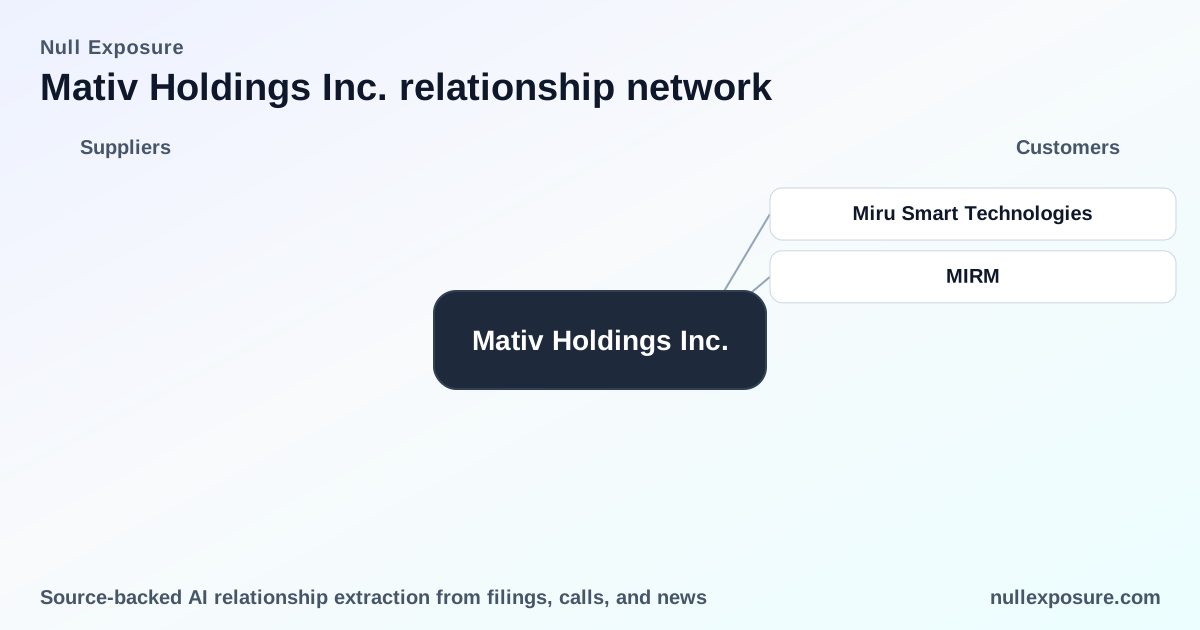
Mativ Holdings (MATV): Customer relationships and what the Miru tie-up means for growth
Mativ is a global B2B specialty materials manufacturer that monetizes through the sale of engineered films, extrusions and component materials to industrial and consumer end markets, serving customers directly and through distributors. The company’s revenue mix is geographically diversified across North America, Europe and Asia, and it operates on short payment cycles while providing both custom components for system integrators and finished materials for distributors and retailers. Investors should view Mativ as a manufacturing-driven platform where strategic OEM partnerships—rather than single large customers—drive incremental growth. For a quick company reference, visit the Null Exposure homepage: https://nullexposure.com/
Why the Miru collaboration matters now
Mativ announced stepped-up commercial integration with Miru Smart Technologies around high-performance TPU films and extrusion capacity. This relationship is the clearest near-term commercial growth vector tied to a targeted product deployment (automotive eWindows) and therefore is the most material customer development for investors to monitor.
-
Miru Smart Technologies — large-volume manufacturing support
Miru has set a target to deliver 10 million square feet of automotive eWindows by 2028, and Mativ’s global extrusion capabilities plus its Argotec TPU films are explicitly identified as supporting that ramp. This positions Mativ as a scaling supplier to a potentially high-volume automotive program. Source: Finviz news report (Mar 10, 2026), https://finviz.com/news/281036/mativ-miru-collaboration-accelerates-automotive-ewindow-deployment -
MIRM / Miru (as discussed on Mativ’s earnings call)
Company management confirmed on the Q4 2025 earnings call that Mativ has invested in the collaboration with Miru and expects initial sales tied to the partnership to begin late 2026 with more substantive flows in 2027, framing the arrangement as a multi-year commercialization ramp rather than immediate volume. Source: InsiderMonkey transcript of Mativ Q4 2025 earnings call (published Mar 2026), https://www.insidermonkey.com/blog/mativ-holdings-inc-nysematv-q4-2025-earnings-call-transcript-1699665/ -
Miru (duplicate reporting of the earnings call)
Management’s public comments reiterated excitement about technology investments and the expected market-driven sales cadence, reinforcing the timeline and strategic importance of Miru as a partner for energy-efficient automotive and building applications. Source: InsiderMonkey earnings call transcript (Mar 2026), https://www.insidermonkey.com/blog/mativ-holdings-inc-nysematv-q4-2025-earnings-call-transcript-1699665/
How the company-level constraints shape customer risk and commercial posture
The filings and company disclosures collectively define an operating model that is transactional, global, and low customer concentration:
- Short-term contracting posture: Sales terms average 15–60 days for customer payments, indicating working-capital intensity and limited long-duration receivable exposure. This is a commercial posture that favors fast-turn product sales rather than long-term contract lockups. Evidence from company filings: “Our sales terms average between 15 and 60 days…”
- Geographic diversification: Net sales are allocated across North America, Europe and Asia-Pacific, with total reported allocations suggesting the United States and Europe are the largest regional contributors (documents record cumulative regional sales such as United States ~$1,097.5m; Europe ~$518.0m; Asia‑Pacific ~$210.0m across reported periods). This supports a global manufacturing and sales footprint rather than dependence on a single market.
- Low customer concentration: No single customer represents more than 10% of consolidated net sales, and there were no customers contributing ≥10% in specific segments, which reduces counterparty concentration risk.
- Mixed go-to-market roles: Mativ operates as manufacturer and seller, and sells through distributors and converters for some segments; the company supplies component parts directly to system integrators while also servicing distributors and retailers. This dual channel strategy balances direct OEM relationships with distributed sales volume.
These constraints are company-level signals derived from SEC filings and the company’s public disclosures.
What this means for concentration, criticality and timing
- Concentration: The company’s disclosures establish immaterial customer concentration, so earnings volatility is unlikely to come from the loss of a single large account. That said, strategic partnerships like Miru can be disproportionate drivers of incremental growth without violating the concentration rule—i.e., a single program can be important commercially while still not comprising >10% of historic consolidated sales.
- Criticality: For products where Mativ supplies integrated materials (for example, Argotec TPU in window films), the company becomes a critical upstream supplier for partners seeking automotive-grade durability and scale. This increases bargaining leverage for scale volumes but also creates execution risk if production capacity cannot meet partner ramps.
- Maturity and timing: The Miru collaboration is early commercial—management expects sales to begin late 2026 and ramp in 2027, so the relationship is a medium-term growth vector rather than an immediate earnings driver. Source: Mativ Q4 2025 earnings call (InsiderMonkey, Mar 2026).
Financial context for the customer picture
Mativ reported Revenue (TTM) of $1.987 billion and EBITDA of $185.5 million as of the latest quarter (2025-12-31), with a negative diluted EPS of -5.81 reflecting ongoing investment and amortization dynamics. The business trades at modest valuation multiples on an EV/EBITDA basis (around 9.55) and has a dividend yield near 4.26% per the company snapshot. These metrics frame the Miru opportunity against a mid‑to‑large revenue base and positive operating cash generation that can support targeted capacity investments.
Investor takeaway and actionable tracking points
- Key takeaway: Mativ operates as a diversified specialty materials manufacturer with global reach, short payment terms, low customer concentration, and the ability to be a critical supplier on targeted OEM programs. The Miru relationship provides an explicit commercialization runway for Argotec TPU films tied to automotive eWindows with first sales expected late 2026 and ramping in 2027. (Source: Finviz news and the company’s Q4 2025 earnings call, Mar 2026.)
- Risks to monitor: execution on extrusion capacity and quality for automotive specs, working-capital strain from short payment cycles during ramps, and the tempo of Miru’s commercial adoption.
- Signals to watch: quarterly disclosures of new customer contracts or volume commitments, capacity expansion announcements, and the quarterly sales contributions that reflect the Miru ramp.
For a concise monitoring notebook and to track evolving customer relationships for investment decisions, consult the Null Exposure homepage: https://nullexposure.com/
Mativ’s customer set is structurally defensive because of diversification, yet strategically flexible: partnerships like Miru convert that defensive base into targeted upside, and investors should prioritize execution data on capacity, qualification milestones, and reported sales flow-through in 2026–2027.