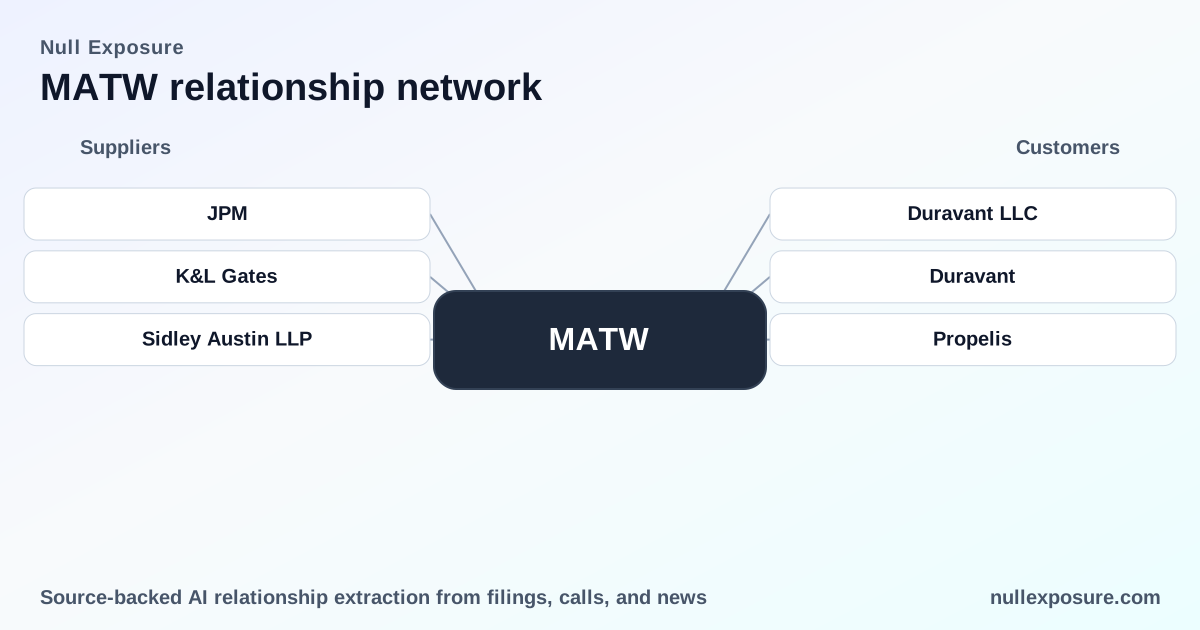
Matthews International (MATW): customer relationships and the commercial footprint investors should price in
Matthews International builds revenue from three core vectors: manufacturing and selling engineered industrial equipment, providing memorialization products and software-as-a-service to funeral professionals, and brand solutions for packaging and identification. The company monetizes through product sales, multi-year engineering contracts recognized over time, recurring SaaS/subscription arrangements in memorialization, and licensing of intellectual property — a mix that blends lumpy, project-driven cash flows with steady service revenue. For a deeper view of counterparties and contract structure, see Null Exposure’s coverage: https://nullexposure.com/.
Recent transactional headlines change the counterparty map
Matthews closed two material disposition events across FY2025–FY2026 that reshape which counterparties drive near-term cash and reduce exposure in industrial automation. Below are the primary media and release items captured in the market record; each entry is summarized and sourced.
Duravant LLC — Yahoo Finance (March 10, 2026)
Matthews signed a definitive agreement to sell its Warehouse Automation business to Duravant LLC, transferring that line of business to a global engineered-equipment specialist. According to Yahoo Finance on March 10, 2026, the transaction was executed as a strategic divestiture of the automation unit. Source: https://finance.yahoo.com/news/matthews-international-announces-sale-warehouse-140000843.html
Duravant, LLC — Investing.com (May 3, 2026)
The sale of the Warehouse Automation business closed for $232.1 million total consideration, which included $225.4 million in cash and the assumption of certain liabilities, materially crystallizing proceeds to Matthews. Investing.com reported the completion of the sale and the cash/assumption breakdown on May 3, 2026. Source: https://ca.investing.com/news/company-news/matthews-international-declares-quarterly-dividend-of-0255-93CH-4424540
Duravant LLC — DC Velocity (March 10, 2026)
An industry trade disclosure described the transaction value at approximately $230 million and positioned Duravant as an Illinois-based provider expanding its automation footprint through the acquisition. DC Velocity covered the deal economics and strategic fit for warehouse automation on March 10, 2026. Source: https://www.dcvelocity.com/material-handling/matthews-to-sell-warehouse-automation-unit-for-230-million-to-duravant
Duravant — SAHM Capital release (December 8, 2025)
A shareholder-activist update from SAHM Capital referenced Matthews’ November 2025 announcement that the Warehouse Automations business would be sold to Duravant for roughly $230 million in total consideration, highlighting the transaction as part of a broader value-creation program. SAHM Capital’s communication reiterated the headline terms and timing. Source: https://www.sahmcapital.com/news/content/matthews-international-provides-update-on-actions-to-create-shareholder-value-and-addresses-director-nominations-2025-12-08
Propelis — SAHM Capital release (December 8, 2025)
Separately, Matthews announced the sale of the SGK Brand Solutions business to Propelis in January 2025, representing an earlier divestiture of one of its brand-focused units. SAHM Capital summarized the Propelis transaction in the same shareholder letter describing the company’s portfolio rationalization. Source: https://www.sahmcapital.com/news/content/matthews-international-provides-update-on-actions-to-create-shareholder-value-and-addresses-director-nominations-2025-12-08
What these relationships tell investors about how Matthews operates
-
Portfolio pruning and capital redeployment. The cluster of sales to Duravant and Propelis reflects an explicit strategy to monetize non-core or lower-growth units and redeploy capital to higher-return areas or to the balance sheet. The Duravant sale alone generated roughly $230M of consideration that materially alters Matthews’ cash and asset base.
-
Counterparties are large, strategic buyers. The buyers in these entries — Duravant and Propelis — are established industry players acquiring capability rather than small financial sponsors. This is consistent with Matthews’ historical customer base that includes large retail, e-commerce and third-party logistics firms and major vehicle OEMs, pointing to counterparty sophistication and longer contract horizons.
-
Mix of cash sale proceeds and assumed liabilities. Public reporting recorded both cash consideration and assumption of liabilities in the Duravant transaction, signaling Matthews negotiates for immediate cash while offloading future operating obligations when divesting engineered businesses.
-
Active portfolio management is now part of the investment case. Management is executing on transactions disclosed in FY2025 and FY2026 that change revenue composition; investors should treat these actions as deliberate reallocation of exposure away from warehouse automation.
(If you want the consolidated view and analytics behind these moves, visit https://nullexposure.com/.)
Operating model constraints that shape customer economics
Investors should view Matthews’ revenue and contractual profile through several firm-level signals drawn from corporate disclosures:
-
Contracting posture and revenue recognition: Matthews uses a combination of long-term, engineering-style contracts and point-of-sale equipment sales. Revenue on major engineering and construction projects — including EV energy storage and warehouse automation — is recognized over time using input methods, which creates progress-dependent revenue volatility and working capital sensitivity.
-
Recurring software and licensing revenue: The Memorialization segment provides software-as-a-service to funeral homes and sells licensing arrangements for IP; this produces recurring subscription-like cash flows that are higher-margin and contractually stickier than project business.
-
Counterparty concentration and scale: The Industrial Technologies book includes very large and large enterprise customers — major retailers, e-commerce platforms, OEMs and tier-1 battery manufacturers — introducing both concentration risk and downside protection through long purchasing cycles and integration costs for alternatives.
-
Geographic revenue footprint: Matthews is North America-centric, with roughly 71% of sales from North America versus 24% in Europe, ~3% in Asia and limited exposure elsewhere in FY2025, concentrating macro sensitivity to the U.S. industrial and retail cycles.
-
Business segments that drive capital intensity: The company mixes hardware manufacturing, bespoke engineering, and software; the hardware and manufacturing components demand capex and create project timing risk, while the software/subscription side introduces predictable, annuitized revenue.
-
Relationship stage and role: Disclosures indicate Matthews is predominantly a seller of equipment and solutions and maintains active ongoing projects with large energy storage customers, indicating continued exposure to multi-year delivery risk.
These constraints define Matthews’ cash-flow profile: lumpy project receipts, recurring SaaS revenue, and targetable divestitures that management can use to rebalance risk.
Investment implications: what investors should price in now
-
Earnings quality improves modestly post-divestiture. Removing the warehouse automation unit reduces exposure to project-delay volatility and frees up cash; however, it also reduces potential upside if e-commerce automation rebounds. The net effect is improved predictability with somewhat lower cyclicality.
-
Balance-sheet optionality is meaningful. The ~$230M disposition proceeds strengthen liquidity and create optionality for bolt-on M&A or accelerated buybacks/dividends — an explicit shareholder-value lever management is deploying.
-
Concentration remains a watch item. Major energy storage and large enterprise customers still drive project timing and working capital; investors must monitor order cadence and contract schedules to anticipate earnings swings.
-
Recurring revenue is a stabilizer. The SaaS and licensing streams in memorialization offset some industrial cyclicality, creating a hybrid revenue base investors should model separately rather than as a single, homogeneous sales line.
Bottom line for allocators
Matthews has transitioned toward a cleaner, more stable revenue mix by selling warehouse automation and earlier SGK assets, while retaining capital-intensive and high-margin engineered businesses tied to EV and energy storage. Expect lower project volatility, better cash visibility, and continued dependence on a handful of large enterprise relationships. For transaction-level sourcing and to track follow-on counterparties, consult Null Exposure’s ongoing coverage: https://nullexposure.com/.
Key takeaway: Matthews’ moves convert near-term asset value into liquidity and reduce a class of execution risk, but they do not eliminate concentration in major engineered projects — investors should underwrite both the stability brought by recurring software revenue and the residual project timing risk in manufacturing.