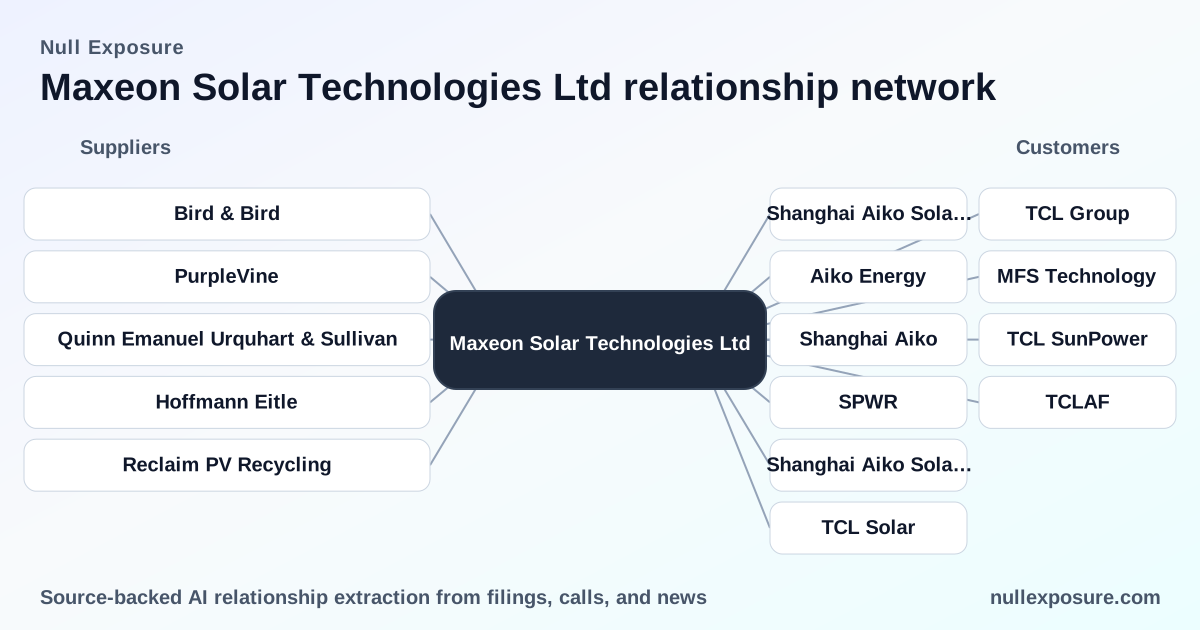
MAXN: Customer Relationships That Define the Turnaround Thesis
Maxeon Solar Technologies designs and licenses high-efficiency back-contact solar cell and module technology and sells modules through a mix of direct sales, branded partnerships and patent licensing. Revenue today derives from licensing its Back Contact (BC) intellectual property, product sales to distributors and residual branded supply agreements; recent asset sales and licensing deals signal a shift toward IP monetization and a leaner manufacturing footprint. For investors evaluating customer exposure and counterparty risk, the mix of legacy concentration with SunPower, new licensing revenue from Aiko, and multiple divestments to TCL-related buyers are the single most important drivers of valuation and recovery prospects. Visit https://nullexposure.com/ for a concise data view of these relationships.
Operational and balance-sheet context
- Maxeon historically relied on a concentrated major buyer (SunPower) and on a manufacturing footprint that it has been actively monetizing. That concentration creates both downside risk and negotiating leverage for licensing outcomes.
- The company is actively extracting value from IP via multi-year licenses (notably with Aiko) while selling non-U.S. sales and marketing assets to TCL-related entities and manufacturing assets to third parties such as MFS Technology; this transforms the business from vertically integrated manufacturer toward an IP-licensing and selective supply model.
- Recent journalism and filings reference judicial-management/rescue filings and reports of missed payments; these are company-level operational signals indicating financial distress and restructuring dynamics rather than isolated counterparty disputes.
How the relationship map affects credit and recovery
- Concentration on a former large buyer (SunPower) creates legacy demand risk; converting technology into recurring license fees (Aiko) and disposing non-core assets to TCL and others compresses operational complexity but amplifies counterparty risk tied to licensing receipts and one-off sale proceeds.
- Licensing terms (geography, duration and payment schedules) are now the core cash drivers; delayed or forfeited payments materially affect near-term liquidity.
Relationship-by-relationship breakdown Below I cover every named counterparty referenced in public reporting for MAXN in the provided results. Each entry is a concise, investor-facing summary with the primary source noted.
Shanghai Aiko Solar Energy Co., Ltd. (AIKO)
Maxeon reached a multi-year patent licensing agreement with Shanghai Aiko that grants Aiko the right to use Maxeon’s Back Contact (BC) cell and module patents outside the United States, covering existing patents and those filed over the next five years. According to press releases and market coverage in February–May 2026, the license is a cornerstone IP monetization deal for Maxeon (see Sahm Capital, Finviz, Investing.com, Morningstar and Aiko’s joint statement in 2026).
Aiko Energy (alternate reporting name)
Chinese manufacturer Aiko Energy is the counterparty described in multiple legal and industry write-ups; reporting confirms it will take five‑year licenses for Maxeon technology outside the U.S. with no reverse licensing. Coverage in Juve‑Patent and China-focused outlets in early 2026 documents the settlement and license terms.
Maoxing Holdings Corporation
Aiko appointed Maoxing Holdings as its licensing agent to handle payments; reporting indicates Maoxing was to make installments that would fund portions of the licensed consideration (taiyangnews, May 2026). This agent arrangement is directly relevant to Maxeon’s receivables profile under the Aiko license.
SunPower / SunPower Corporation (SPWR)
SunPower is described repeatedly as Maxeon’s former parent and historically largest buyer; filings and press indicate that Maxeon relied on SunPower for exclusive sales of certain products and that SunPower later filed for bankruptcy. Legal notices and reporting in 2024–2026 (GlobeNewswire, PV‑Magazine USA, IndexBox) identify SunPower as a concentration risk that materially impacted Maxeon’s revenue when the relationship changed.
Greentech Renewables
Certain Maxeon products were sold through U.S. distributor Greentech Renewables, establishing a distribution channel in the U.S. market (PV‑Magazine USA, April 2026). That relationship is relevant to U.S. aftermarket and inventory flows.
MFS Technology
MFS Technology completed the acquisition of Maxeon’s Malaysian manufacturing subsidiary in February 2026, representing a realized sale of production capacity and a one‑time cash inflow to Maxeon (CNBC/Ti pranks coverage, Feb 2026). This divestiture reduces fixed-cost exposure but removes in‑house manufacturing optionality.
TCL Zhonghuan Renewable Energy Technology
Documents reference a services agreement involving a TCL Zhonghuan subsidiary connected to the sale of Maxeon’s interest in SunPower Philippines Manufacturing; this is part of the group of TCL‑related transactions that transferred non‑U.S. assets (taiyangnews, May 2026). Such service agreements create ongoing counterparty service dependencies tied to those asset sales.
TCL Solar
TCL Solar is reported to have launched back‑contact modules that incorporate Maxeon’s IBC technology, illustrating commercial use of Maxeon‑derived technology in the TCL ecosystem (taiyangnews, 2025 coverage). This points to downstream commercialization of licensed tech under related agreements.
TCL Group / TCL / TCLAF
Multiple reports indicate Maxeon has sold global sales and marketing assets and other non‑U.S. assets to TCL Group — proceeds cited at roughly US$94 million in press coverage — and that Maxeon is exploring further monetization or divestment to TCL‑related parties (TheEdgeMalaysia, PV‑Tech, ValueTheMarkets, FY2025–FY2026 reporting). These transactions materially change the company’s geographic go‑to‑market and reduce Maxeon’s direct international distribution.
TCL SunPower
Maxeon has historically sold modules under the SunPower brand in Europe, a channel now marketed by TCL SunPower per patent and brand licensing reporting; that arrangement is important for legacy European revenues (Sahm Capital, Dec 2025 reporting).
Other company‑level signals and constraints
- The dataset provided no explicit contractual constraints enumerated as structured items; that absence itself is a signal: detailed contractual terms (payment schedules, security, territory carve‑outs) are not present in the public summary and must be confirmed from filings and license contracts for precise cash‑flow modelling.
- Public reporting documents judicial‑management filings, missed or forfeited payments linked to the Aiko arrangement and the SunPower bankruptcy — these are company-level operational constraints that increase the priority of near‑term cash collection and license enforcement.
- Asset sales to TCL and MFS are evidence of strategic de‑risking and liquidity generation, but they also concentrate future revenues into license receipts and third‑party distribution economics rather than product margin capture.
Key takeaways for investors
- IP monetization is the central operating pivot: the Aiko license and related payments, plus sales of manufacturing and sales assets, redefine Maxeon as a licensor and seller of specialty modules rather than an integrated global manufacturer.
- Concentration risk has shifted rather than disappeared: SunPower’s legacy role created a demand trough; licensing and TCL sales reduce operating complexity but replace diversified product cash flows with counterparty‑dependent receipts.
- Execution and collections drive short‑term value: the timing and enforceability of licensing payments (Aiko/Maoxing), completion of asset sale proceeds (TCL/MFS) and recovery from legacy distributor channels (Greentech) determine liquidity and recovery for equity and creditors.
If you want a consolidated, source‑linked view of these counterparty relationships and an up‑to‑date cash‑flow implication map, visit https://nullexposure.com/ where coverage and document links are maintained for MAXN.